PCA Insights
SBA Veteran Acquisition Equity Rules: What Changed in November 2026
November 9, 2026

Updated November 9, 2026. Announced effective date: November 11, 2026.
Military veterans preparing to buy an existing business have a new financing option to evaluate. The U.S. Small Business Administration announced that eligible veteran buyers using the SBA 7(a) program may satisfy the full required 10% acquisition equity contribution with permitted outside funding sources.
The practical distinction matters: the acquisition still needs its required contribution. The announcement changes where eligible veterans can obtain it. A buyer may be able to preserve personal savings while assembling the capital needed to acquire and operate a business.
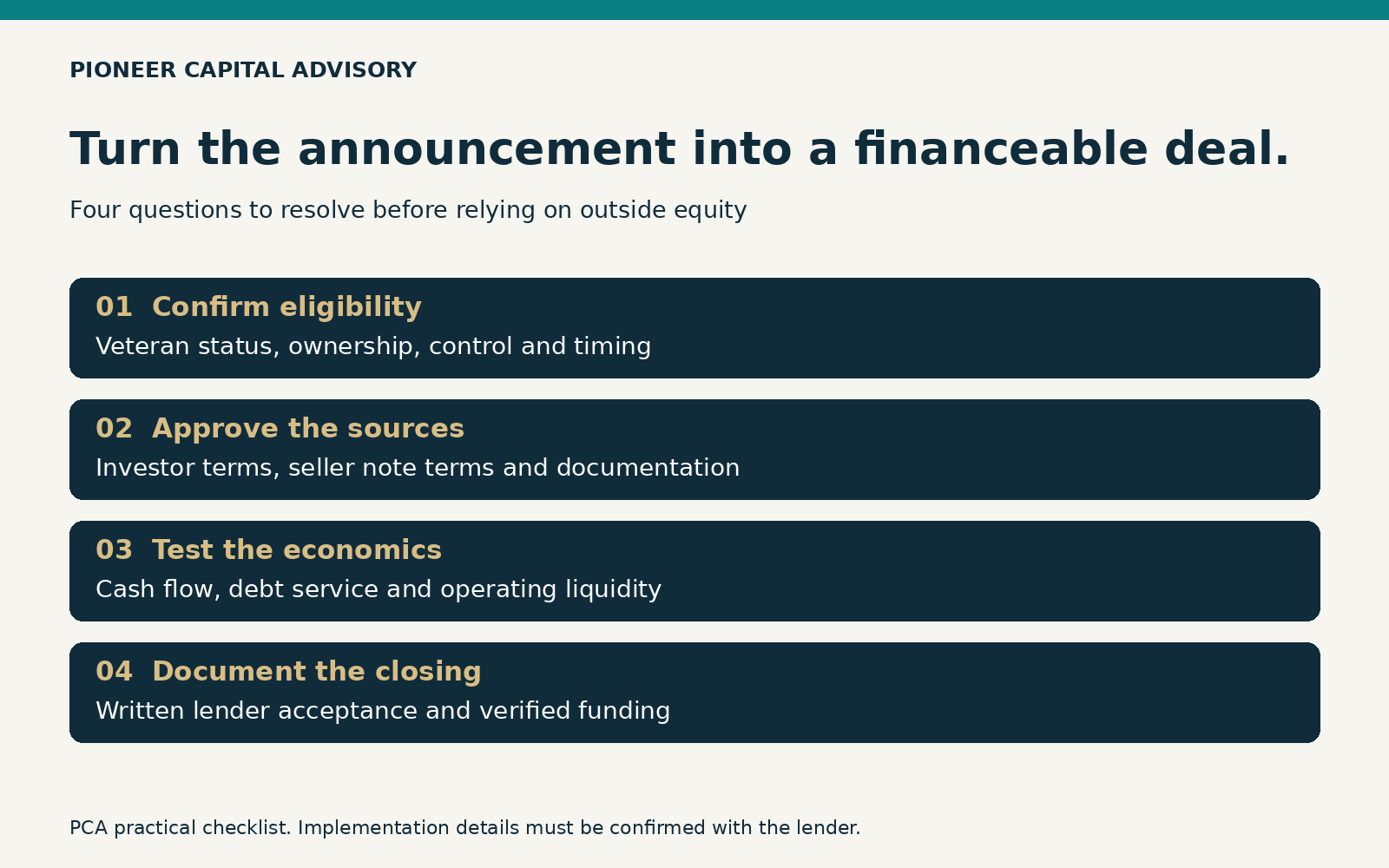
This guide explains the announcement, walks through hypothetical acquisition budgets, and identifies the questions to resolve before relying on the flexibility in an offer or financing plan. The policy summary comes from SBA News Release 26-117, published November 9, 2026. The structuring examples and preparation recommendations are Pioneer Capital Advisory’s analysis, rather than additional requirements announced by SBA.
What changed in the SBA equity requirement for veterans?
Under the announced policy, eligible veterans acquiring an existing small business through SBA 7(a) financing may obtain the entire required 10% contribution from permitted outside sources. SBA identifies seller standby notes, investor capital, and external equity contributions in its explanation of the change.
The release describes the prior treatment of certain outside sources as limiting them to half of the required contribution. Its announced veteran flexibility expands the amount that may come from permitted outside sources to the full contribution. That description should not be read as a complete historical rulebook for every type of investor structure.
The announcement does not provide a detailed eligibility test, a complete list of permitted sources, or the required terms for every instrument. Those points need to be confirmed under the applicable implementation guidance and with the lender reviewing the transaction.
When does the veteran acquisition policy take effect?
SBA announced the change on November 9, 2026 and stated that it begins on Veterans Day, November 11, 2026. The release says it remains in place through federal fiscal year 2027, which ends September 30, 2027.
Buyers should confirm which transaction milestone controls eligibility. The release does not specify whether a loan must be submitted, approved, authorized, or disbursed within a particular window. A planned closing date alone is not enough to establish that a transaction qualifies.
For a deal already under LOI, ask the lender to address timing before revising the financing assumptions. For a search still underway, use the announcement to start a financing conversation rather than assume an eventual acquisition will automatically qualify.
Does this mean veterans can buy a business with no money down?
An eligible veteran may be able to avoid contributing personal cash toward the required equity injection if permitted outside sources cover it. That is different from eliminating the injection or receiving a loan covering every transaction cost.
For example, a hypothetical $3 million total project with a 10% contribution requires $300,000 of qualifying funding alongside the acquisition loan. The new flexibility could allow that $300,000 to come entirely from approved outside sources. It does not make the $300,000 disappear.
There can also be cash needs outside the approved financing budget: diligence expenses incurred before closing, deposits, relocation costs, household expenses during the transition, or a reserve for unexpected operating needs. Determine which costs can be financed, which must be paid earlier, and which remain the buyer’s responsibility.
Using outside capital can preserve savings, but it can also introduce repayment obligations, ownership dilution, governance rights, or restrictions on distributions. Evaluate those economic consequences alongside the reduction in personal cash invested at closing.
How is the 10% equity contribution calculated?
The release uses total project costs as the base. Buyers should therefore develop the full acquisition budget before estimating the contribution.
A purchase price is only one component. Depending on the transaction and applicable financing rules, the budget may include working capital, eligible closing costs, and other approved uses. The lender must determine the final eligible project costs and required injection.
Example: a $2.5 million purchase with $3 million in total project costs
- Business purchase price: $2,500,000.
- Working capital: $300,000.
- Illustrative eligible fees and closing costs: $200,000.
- Total project costs: $3,000,000.
- Required contribution at 10%: $300,000.
- Remaining funding in this simplified example: $2,700,000.
Calculating 10% of the purchase price alone would produce $250,000. In this example, that would leave a $50,000 shortfall against the contribution calculated on total project costs.

Which outside funding sources should a veteran buyer discuss with a lender?
Investor capital
An investor can supply capital in exchange for an ownership interest. Before treating those funds as qualifying contribution, provide the lender with the proposed ownership structure and investment terms.
A capital commitment is only part of the analysis. The lender will need to understand who is investing, where the funds originate, what rights the investor receives, and whether the structure creates repayment or redemption obligations that affect underwriting.
From the buyer’s perspective, compare the amount of personal cash preserved with the ownership and future distributions being shared. A structure that helps close the acquisition may have meaningful long-term consequences for control and proceeds on a future sale.
Seller standby notes
A seller note defers part of the seller’s purchase proceeds. A standby arrangement restricts payments according to agreed terms. The release specifically references seller standby notes, making them an important subject for the financing discussion.
However, the announcement does not establish that any seller note, on any terms, can satisfy the entire contribution. Obtain confirmation of the qualifying amount, standby period, interest treatment, payment restrictions, subordination, and required documents before relying on a note in the capital structure.
Also distinguish the seller’s willingness to provide financing from the lender’s willingness to count it toward the injection. Both need to be resolved. A seller who expects immediate monthly payments may have a different economic proposal in mind from a lender-approved standby instrument.
A combination of sources
A buyer may want to explore a combination of investor capital, qualifying seller financing, and personal funds. The release’s core change creates room to consider outside funding for the entire required contribution; it does not require veterans to avoid personal investment.
A blended approach may better align the seller, investors, lender, and operator. Evaluate the documentation and economics of the complete structure, rather than treating each source as independently interchangeable.
Three hypothetical ways to evaluate a $300,000 contribution
The following scenarios illustrate planning choices. They are not lender commitments or confirmation that a particular instrument qualifies.
Scenario A: investor-funded contribution
An outside investor provides $300,000, and the veteran operator contributes no personal cash toward the injection. The critical questions concern investment eligibility, ownership and control, investor rights, funding documentation, and lender acceptance.
The buyer preserves personal liquidity, but shares the economics of the business. Review distributions, decision rights, future capital calls, and exit provisions with counsel before finalizing the investment.
Scenario B: seller-note contribution
The seller agrees to defer $300,000 through a note intended to qualify toward the required contribution. This scenario depends on confirmation that the amount and note terms are permitted under the implemented veteran policy.
Unlike investor cash, a seller note does not deposit new money into the operating account. It reduces the cash needed to pay the seller at closing. The acquisition must still have sufficient funded working capital and reserves.
Scenario C: blended contribution
The proposed contribution consists of $150,000 of investor capital, a $100,000 qualifying seller note, and $50,000 of the buyer’s own funds. The arithmetic totals $300,000, but the lender must still accept each component and the overall structure.
This approach illustrates why the best financing plan is not always the one with the lowest personal injection. A modest personal contribution may be worth considering if it improves the transaction’s economics or reduces the amount of ownership sold.
What does the announcement leave unresolved?
The release establishes the policy direction. It does not answer every question a lender must resolve to close a loan. Before committing to a structure, request written clarity on:
- How eligible veteran status must be established and documented.
- The required veteran ownership and control, including mixed veteran and non-veteran buyer groups.
- Whether any special treatment extends to spouses, reservists, National Guard members, or other military-connected applicants.
- The complete permitted-source rules and restrictions on borrowed or conditionally repayable funds.
- The amount and terms of seller debt that may count toward the contribution.
- The timing milestone that determines whether a transaction falls within the effective period.
- How the lender will handle applications already in process.
- Any lender-specific requirement for buyer cash or retained liquidity.
Do not import the ownership thresholds of an unrelated veteran program into this financing policy. For example, federal contracting certification has its own eligibility framework. The acquisition announcement must be evaluated on its own implementing terms.
What will lenders still need to underwrite?
SBA’s general 7(a) program information continues to require creditworthiness and a reasonable ability to repay. The veteran equity announcement addresses contribution sourcing; it does not announce a general waiver of underwriting.
For an acquisition, the financing conversation should still address the quality of historical earnings, the buyer’s operating plan, the transition from the seller, the business’s working capital needs, and the capacity to service the proposed debt. These are practical underwriting considerations, not additional veteran eligibility rules established in the release.
Cash flow and debt service
Model the acquisition loan alongside any permitted seller debt and other obligations. If a seller note has a payment deferral followed by scheduled payments, evaluate the later payment burden as well as the initial period. Use the lender’s required cash-flow calculation and coverage standard.
Stress-test lower sales, margin pressure, and higher variable interest costs where relevant. A capital structure that meets the contribution requirement can still leave too little operating cash after debt service.
Operating liquidity
Separate three buckets: the required acquisition contribution, cash available inside the business, and personal reserves outside the business. A dollar assigned to the contribution should not also be counted as available operating cash.
Review payroll timing, customer collections, inventory purchases, insurance, taxes, and seasonal demands. The announcement’s stated opportunity to preserve personal savings is most useful when those savings sit alongside an adequately funded operating plan.
Management and transition
Explain how military leadership experience translates into the responsibilities of the company being purchased. A useful operating plan identifies the veteran’s day-to-day role, key employees, industry-specific licensing needs, and the seller’s transition responsibilities.
For a business that depends heavily on the seller’s customer relationships or technical expertise, address that concentration directly. Financing flexibility does not replace a credible handover plan.
How should veterans prepare before submitting an LOI?
Begin with a preliminary financing review and a realistic acquisition budget. Identify which outside sources are actually available, what each provider expects, and how quickly the funds or documents can be delivered.
Then align the LOI with a structure the lender can evaluate. If seller standby financing is essential, discuss that expectation before treating the purchase price and cash-at-close figure as settled. Have transaction counsel address the appropriate financing conditions and documents.
Prepare a package containing the proposed sources and uses, ownership chart, buyer resume, preliminary operating plan, available target financials, investor commitments, and proposed seller-note terms. Ask the lender which additional veteran-status and funding-source documents it needs.
Frequently asked questions about SBA veteran acquisition equity
Is the SBA eliminating the 10% acquisition equity requirement for veterans?
No. The November 9, 2026 announcement retains the required 10% contribution while allowing eligible veterans to obtain the full amount from permitted outside sources.
When does the new veteran equity flexibility begin?
SBA announced a November 11, 2026 start date and said the policy continues through FY2027. Buyers should confirm the applicable loan timing milestone with their lender.
Can a veteran use a seller note for the entire required contribution?
The announcement references seller standby notes and full outside-source funding. It does not specify every permitted note structure. Confirm the qualifying amount, standby terms, and documentation with the lender under the implementing guidance.
Does the policy apply to SBA 504 loans or startups?
The cited release addresses veterans acquiring existing businesses through the SBA 7(a) program. It does not establish an equivalent change for 504 loans or startups.
Can a military spouse or non-veteran partner qualify automatically?
The release does not provide those eligibility details. Do not assume a military connection or a veteran minority partner is sufficient; confirm the applicable veteran, ownership, and control tests.
Does outside equity eliminate a personal guarantee?
The release does not announce a waiver of personal guarantees or collateral requirements. Confirm the applicable obligations with the lender before agreeing to the ownership and financing structure.
Is the 10% calculated on the purchase price?
The release states that the contribution is based on total project costs. Develop a complete lender-reviewed budget rather than using the purchase price alone.
Does the announcement guarantee lender approval?
No. The acquisition, applicant, funding sources, and structure remain subject to applicable SBA requirements and lender underwriting.
What is the difference between a standby seller note and investor equity?
A seller note defers purchase proceeds and may create a future debt obligation. Investor equity supplies capital in exchange for an ownership interest. Their cash-flow, control, and documentation consequences differ.
What should a veteran buyer do next?
Build a preliminary sources-and-uses budget and ask a lender or acquisition-financing advisor to review veteran eligibility, proposed funding sources, note or investment terms, liquidity, and timing before relying on the flexibility.
How Pioneer Capital Advisory can help veteran business buyers
Pioneer Capital Advisory helps business buyers evaluate SBA acquisition financing, prepare lender materials, and coordinate the financing process through underwriting and closing. For a veteran acquisition, that work starts with a complete view of the buyer, business, capital sources, and operating plan.
We can help organize the sources and uses, frame the questions that need lender confirmation, and compare the proposed financing structure with the cash flow and liquidity needs of the acquisition. The lender makes the credit decision and determines whether the transaction meets applicable requirements.
If you are evaluating a business or already have an LOI, contact Pioneer Capital Advisory with the purchase price, industry, available financial information, proposed buyer group, and anticipated capital sources. Learn more about our SBA acquisition financing services.
Related acquisition financing guides
- Working capital in an acquisition budget
- Seller note requirements and acquisition structure
- Personal guarantees and collateral
Read these general guides alongside the veteran-specific announcement and applicable implementation guidance; older guidance may not reflect the new exception.
Official sources and publication notes
- SBA News Release 26-117: veteran acquisition equity flexibility, November 9, 2026. Primary source for this article’s policy summary.
- SBA 7(a) program overview. General eligibility, permitted uses, and application information.
- SBA SOP 50 10 landing page. Consult applicable origination guidance and subsequent notices.
- SBA veteran resources. Training, counseling, and related programs.
This article reflects the November 9, 2026 announcement. It does not represent confirmation of a specific borrower’s eligibility or a lender commitment. Hypothetical examples are for explanation only. Eligibility, permitted sources, transaction timing, and loan terms must be confirmed under applicable SBA guidance and lender requirements. Consult your legal, tax, and financing advisors concerning your transaction.
Ready to Secure Financing?
Ready to Close Your Deal?
Book a free strategy call with our team. SBA engagements are lender-paid, no upfront cost to you.



Get Started
Ready to Secure the Right Financing?
Select your financing path below to book a strategy call. SBA engagements are lender-paid.
SBA 7(a) Loans
Finance Your Business Acquisition
Our core SBA 7(a) services for buyers looking to acquire a business or optimize existing debt. We quarterback the entire process from pre-LOI to closing.
100% Lender-Paid Engagements
Add-Ons & Growth
Expand Your Platform
Leverage SBA financing to add locations, acquire add-ons, or expand your current platform. We help you structure the capital stack seamlessly.
100% Lender-Paid Engagements
Debt Optimization
Finance Your Business Acquisition
Looking to optimize debt or re-amortize an existing SBA acquisition loan. No LOI required, one call to get started.
100% Lender-Paid Engagements
Non-SBA / Private Credit
Independent Sponsor Deals
For sponsors pursuing $2M+ EBITDA transactions. We structure private credit and institutional capital with faster timelines.
Buyer Pays Pioneer Fee
All consultations are confidential

Pioneer Capital Advisory is a commercial financing advisory firm for SBA and non-SBA acquisition financing.