PCA Insights
SBA Financing FAQs: Personal Guarantees and Collateral Under SOP 50 10 8.1
August 31, 2026
Two questions come up on almost every buyer call we take, usually in the same breath. Who has to sign the personal guarantee, and is the bank going to put a lien on my house.
Both answers moved at the edges with SOP 50 10 8.1, effective October 1, 2026. Neither is as discretionary as buyers assume. Neither is as absolute as buyers fear.
What follows are the nineteen questions we field most, pulled from four months of call transcripts and answered out of the SOP text itself. They run in the order a deal actually raises them. Who signs, then what secures it, then where the money comes from, then how big the loan gets and what it costs.
Every answer carries a citation to the paragraph and page it came from, so you can check us. One thing to know before you start: for a change of ownership, Appendix 15 outranks the rest of the SOP. Its own words are that if any section of SOP 50 10 conflicts with this Appendix, the rules contained in this Appendix shall govern the change of ownership transaction. That is also where you find the sentence that 7(a) Small loans cannot be used for a change of ownership at all.
Appendix 15, introduction, p. 342.
This one assumes you already know the shape of the new rules. If you do not, start with our field guide to buying a business in 2026, which covers the four transaction types, the injection math, the Quality of Earnings trigger and the valuation ceiling. Then come back here for the guaranty and collateral mechanics.
Who signs
1. Who has to personally guarantee an SBA 7(a) acquisition loan?
Anyone with direct or indirect ownership of 20 percent or more. Unlimited full guaranty, SBA Form 148 or the lender's equivalent, no discretion in it. Entities crossing the same line guarantee too.
Then there are the four situations that override the line.
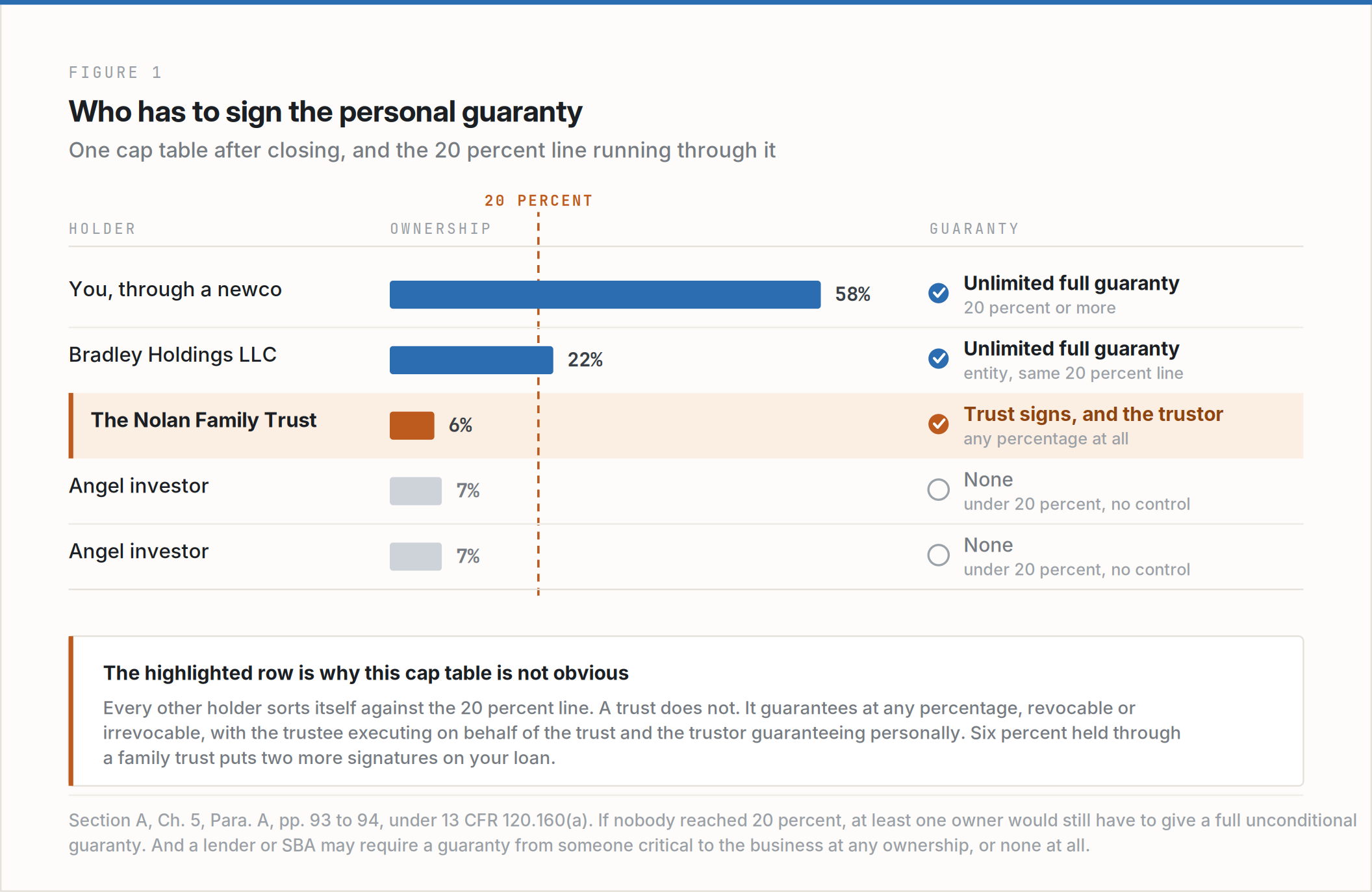
The trust rule is the one that catches people. Read the sentence closely: an entity owner crosses into the guaranty requirement at 20 percent, but where the entity is a trust, revocable or irrevocable, the trust guarantees at any percentage, with the trustee executing on behalf of the trust and the trustor guaranteeing personally. So the family trust holding a friendly 5 percent is not a passive position, and an investor who plans to hold through one needs to know that before the cap table gets papered.
Two smaller details. If you sign the Note as a borrower in your individual capacity you do not sign a separate guaranty on top of it, because the Note already has you. Whether that applies depends on how you buy. In your own name, you and the business are co borrowers and the Note is executed jointly and severally by both. Through a newco, the acquiring entity is the borrower and you are back on a guaranty.
And the percentages are generally measured on post sale ownership rather than on the cap table you walk in with. A seller who keeps a slice of the business after closing falls under a separate rule set with real consequences for the seller, so raise it with your lender before you paper a rollover.
Section A, Ch. 5, Para. A, pp. 93 to 94, under 13 CFR 120.160(a). Post sale measurement at Appendix 15, Para. A.2, p. 348. Initial Acquisition structures at Appendix 15, Para. A.1.a, p. 345.
2. Can a guaranty ever be limited, and can someone with no ownership get pulled in?
Yes to both, and the second one surprises people more.
Where credit or other reasons warrant it, SBA, or the lender on a delegated basis, may require other appropriate individuals or entities to provide full or limited guaranties without regard to the percentage of their ownership interests, if any. The SOP's own example is a person with a minority interest or no interest at all who is critical to the operation of the business. Those are supplemental guarantors.
Two things worth knowing about them. A supplemental guarantor is the one category of guarantor the SOP repeatedly carves out of obligations that otherwise attach. They are excluded from the personal financial statement requirement, excluded from the owner financial statement in the application package, excluded from the personal real estate pledge on a collateral shortfall, and a delinquent federal debt owed by one does not make the applicant ineligible. So being asked to serve as one is not the same exposure as signing as a 20 percent owner.
A different guarantor gets similar relief on collateral. A selling owner who stays in under 20 percent has to give a full guaranty for the full loan amount, but SBA does not require those two year guarantors to pledge personal assets, personal residences included, in the event of a collateral shortfall.
The other direction also exists. Every loan has to be guaranteed by at least one individual or entity, so a cap table where nobody reaches 20 percent does not produce a loan with no guarantor. At least one of the owners has to provide a full unconditional guaranty.
Section A, Ch. 5, Para. A, p. 93. Supplemental guarantor carve outs at Section A, Ch. 5, Para. A.1.e, p. 93, Appendix 19, Para. B.1.b.i, p. 383, and Appendix 20, Para. A.1.c, p. 391. Two year guarantor relief at Appendix 15, Para. A.1.c.ii, p. 347.
3. Does my spouse have to guarantee the loan?
It turns on ownership rather than on marriage. Each spouse owning less than 20 percent has to guarantee the loan in full once the combined interest of both spouses and minor children reaches 20 percent. Interests held by married spouses and minor children are combined for this, so two 12 percent stakes are one 24 percent stake and both signatures come with it.
A related rule sits next to it and is worth knowing if you are planning around children: SBA prohibits businesses where a minor child owns 20 percent or more, because minors are legally prohibited from providing a guaranty.
If your spouse owns nothing, the ownership rule leaves them alone. Two other things do not.
Once you cross 20 percent, the lender has to consider a lien on personal real estate you own jointly with your spouse or minor children. And the owner financial statement the lender collects covers the assets of your spouse and minor children whether or not they hold a share of the business. Underwriting sees the household either way.
In our experience the practical change when a spouse signs is that lenders pull the spouse's income into the household cash flow picture, which is often why the signature gets asked for. The SOP does not require that treatment.
Section A, Ch. 5, Para. A, p. 93. Minor child ownership at Section A, Ch. 1, Para. F, p. 30. Jointly owned real estate at Appendix 15, Para. C.3.d.iii, p. 362. Owner financial statements at Appendix 20, Para. A.1.c, p. 391.
4. I am selling down below 20 percent before we apply. Does that get me out?
Almost certainly not, and this one has a clean answer.
Any person subject to the guaranty requirements 6 months prior to the date of the loan application continues to be subject to them even after changing their ownership interest to less than 20 percent. Trimming a stake on the eve of an application does nothing.
There is one exit a departing partner can actually use, and it is a real one. The lookback does not apply where that person completely divests their interest prior to the date of application. Complete divestiture includes divestiture of all ownership interest and severance of any relationship with the applicant, and with any associated eligible passive company, in any capacity, including as an employee, paid or unpaid, for the life of the loan. All the way out, and staying out.
If you have a partner who wants off the deal, that sentence is the whole plan. Halfway does not work.
Section A, Ch. 5, Para. A, p. 94.
What secures it
5. How does SBA actually value my collateral?
At a discount, and the discounts are the reason so many acquisition files show a shortfall.
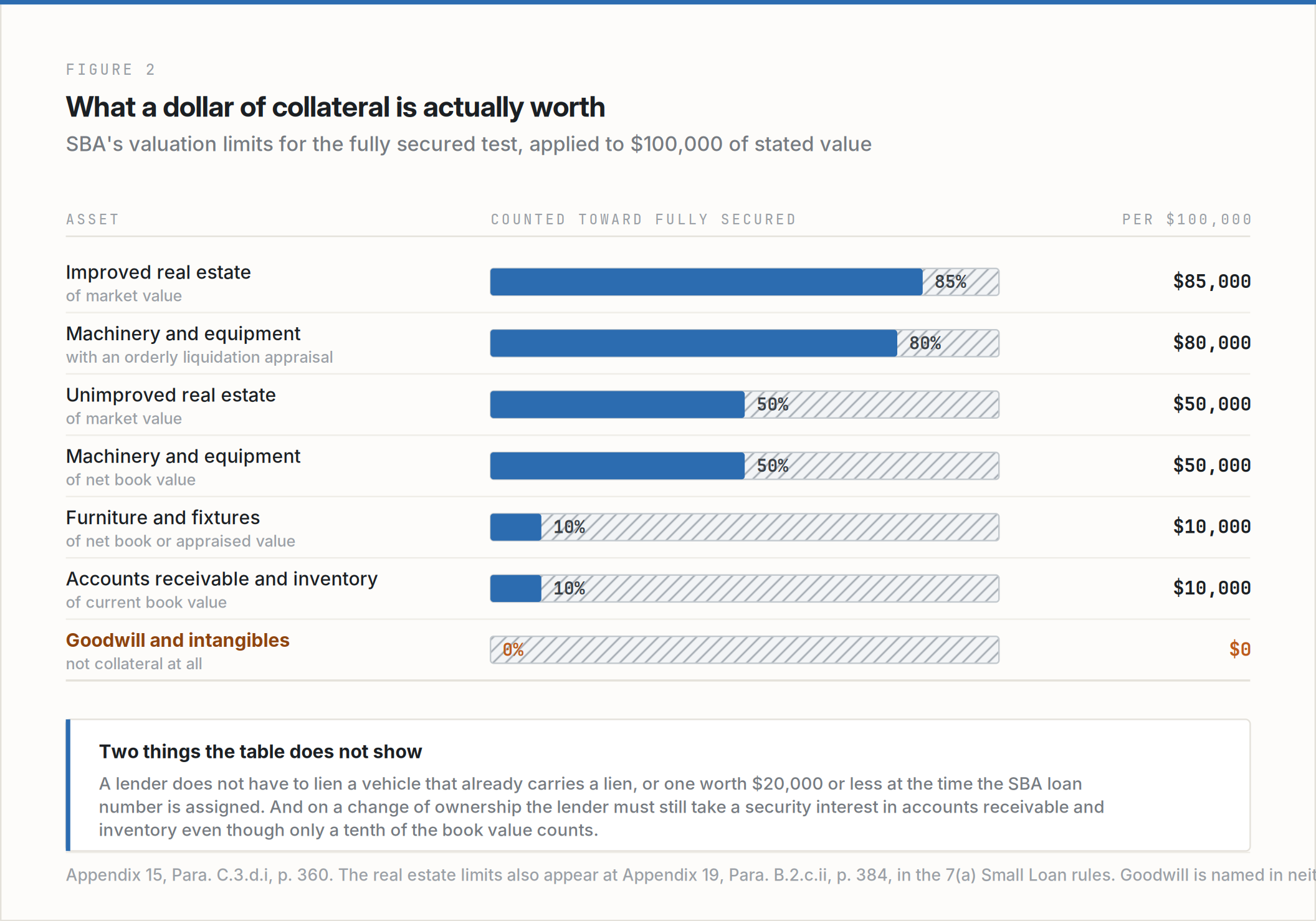
Two of these deserve a second look. Machinery and equipment counts at 50 percent of net book value, or 80 percent with an orderly liquidation appraisal, minus any prior liens. That gap is worth an appraisal on an equipment heavy deal, and it is a lever most buyers never think to pull. And accounts receivable and inventory count at only 10 percent of current book value, even though on a change of ownership the lender must still take a security interest in them.
Goodwill does not appear in the list at all. On a service business that is most of the purchase price.
Appendix 15, Para. C.3.d.i, p. 360. The same improved 85 percent and unimproved 50 percent limits appear at Appendix 19, Para. B.2.c.ii, p. 384, though that paragraph governs 7(a) Small Loans, which cannot fund a change of ownership. Vehicle carve out at Appendix 15, Para. C.3.d.i, p. 360.
6. When is the bank required to take a lien on my house?
Only when the loan is not fully secured.
A Standard 7(a) is fully secured once the lender holds security interests in all available fixed assets of the applicant, valued at the limits above, up to the loan amount. Appendix 15 says the same thing for a change of ownership, phrased around combined net book value as adjusted. Most service business acquisitions never get there.
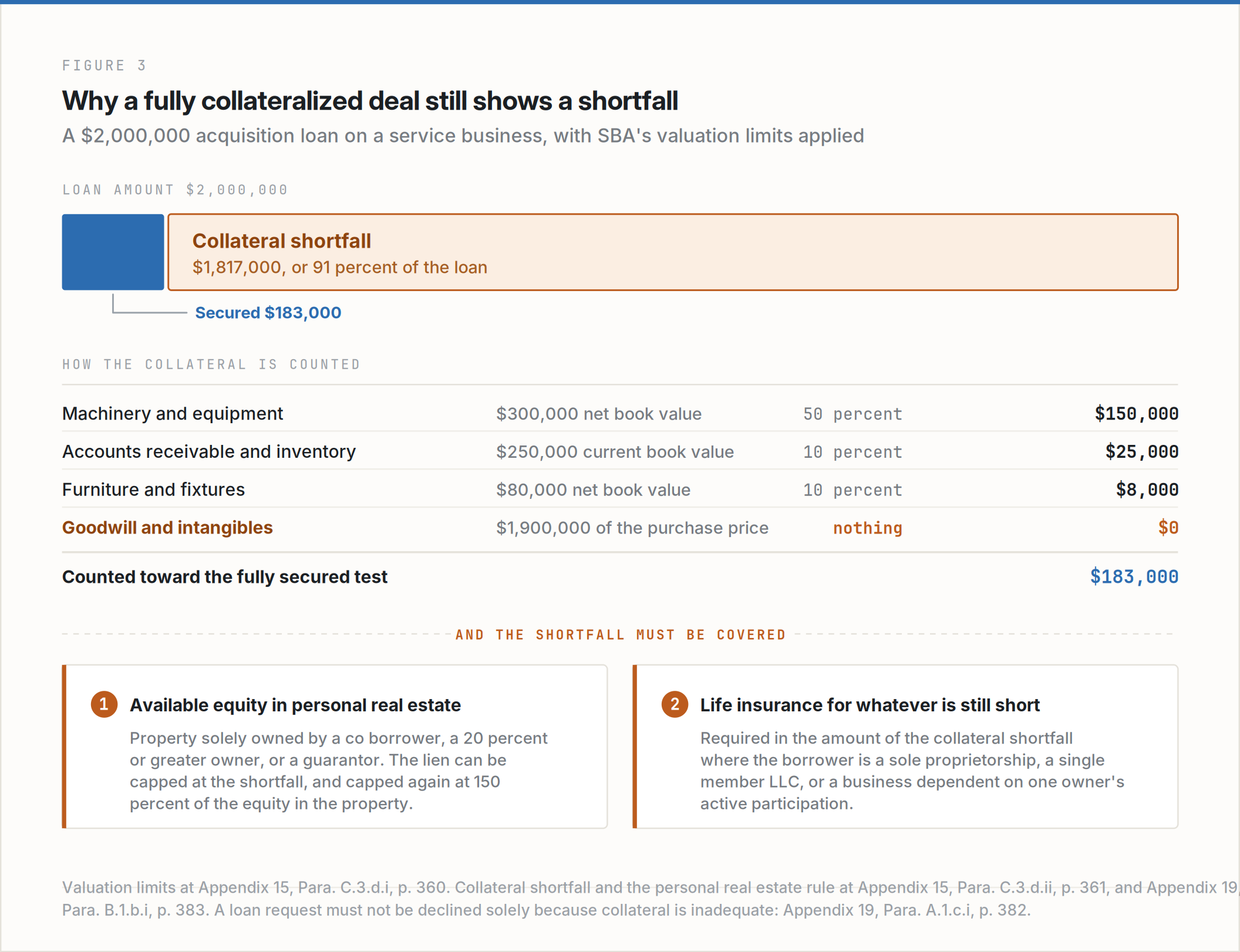
When there is a shortfall, the lender must take available equity in personal real estate, residential and investment property alike, that is solely owned by a co borrower, a 20 percent or greater owner, or a guarantor other than a supplemental guarantor. Two limits soften it. The lien can be capped at the amount of the shortfall, and capped again at 150 percent of the equity in the property.
One sentence in the SOP is worth committing to memory. A loan request must not be declined solely because collateral is inadequate. SBA says plainly that applicants can demonstrate repayment ability without collateral sufficient to repay in full on default. A shortfall is a condition on your loan, and it is a condition most acquisition files carry.
Read that alongside its counterweight, which the SOP puts in the very next sentence: however, the SBA guaranty is not a substitute for available collateral. Inadequate collateral cannot sink your loan on its own. Available collateral you would rather not pledge is a different conversation.
Fully secured at Appendix 19, Para. B.1.b, p. 383, and Appendix 15, Para. C.3.d.i, p. 360. Collateral shortfall at Appendix 15, Para. C.3.d.ii, p. 361, and Appendix 19, Para. B.1.b.i, p. 383. Not declined solely for collateral, and the guaranty not a substitute, both at Appendix 19, Para. A.1.c.i, p. 382.
7. If my home equity is under 25 percent, can they still take it?
Not to satisfy the fully secured test. That much is real. The wording underneath it is where deals get decided.
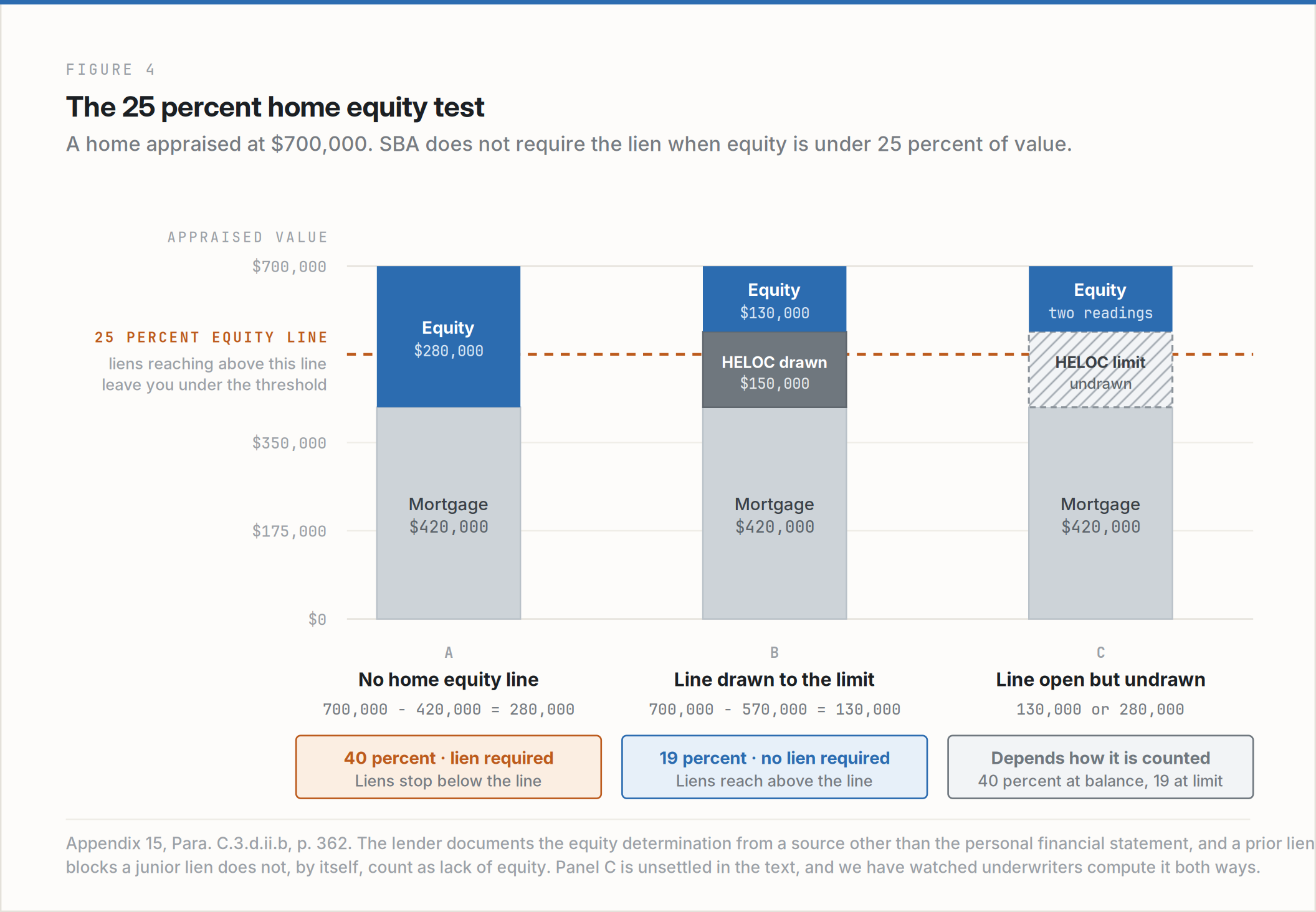
Lack of equity means the fair market value, after giving effect to existing liens, does not provide at least 25 percent equity. The lender has to document that determination from a source other than your personal financial statement, and the SOP names no acceptable source, only an unacceptable one. In practice that means an appraisal, an automated valuation, or at minimum something third party the underwriter can point to.
Now the sentence buyers need to read twice. The mere presence of a prior lien that restricts or prohibits the placement of a junior lien does not, by itself, constitute lack of equity. A first mortgage with a no subordinate financing clause buys you nothing here. The test is arithmetic.
Which brings up the move everyone asks about. Buyers open or draw a home equity line to push measured equity under the threshold. Drawn balances are real liens against real value and they do reduce equity, as in panel B above. An undrawn commitment is panel C, and lenders diverge on it, because the SOP speaks to existing liens without settling whether an untouched line counts at its limit or at its balance. We have watched underwriters compute it both ways on comparable files.
Worth knowing while you plan: SBA has no specific appraisal requirements for non commercial real estate taken to secure a personal guaranty, unless a program specific section of Appendix 19 says otherwise. The formal appraisal machinery, the state licensing rules, the $1,000,000 trigger for a state certified appraiser and the 12 month dating window, all of that governs commercial real estate taken as collateral. Your house is valued however the lender's policy says to value it, which is exactly why the number can move between banks.
What we see in practice. The 25 percent test is where the conversation starts and it is rarely where it ends. We have watched lenders ask for the residence on deals where the equity in the home already sat below the threshold, and the reason given is almost always coverage rather than the equity math. Thin debt service coverage leaves a meaningful unsecured piece in the credit, and the house is the nearest thing available to fill it.
We have also seen the ask arrive at every possible stage. Once as a screening question before any term sheet existed, once written into the term sheet itself, and once only when the closing checklist was being assembled. Banks vary on this more than buyers expect. What we notice is that when a file gets socialized broadly, the feedback on the residence tends to come back consistent across the lenders that are actually interested, which is usually the moment a buyer stops negotiating with us about it and starts deciding.
And the structure everyone asks about. Buyers use the line defensively, taking availability against the house so that the equity left in it is thin and the property is less appealing as bank collateral, while the availability still counts toward the cash a lender wants to see after closing. We have seen that work. We have also seen it ignored. It works better when the line has been in place for a while than when it appears in the middle of underwriting.
Appendix 15, Para. C.3.d.ii.b, p. 362. Appraisal rules for non commercial real estate at Appendix 19, Para. A.1.d.v, p. 382.
8. My house is in my spouse's name, or in a trust. Is it out of reach?
Usually not, if it is jointly held with you, or held through an entity you own, or if it moved to your spouse in the last six months. Property that has sat in a non owning spouse's sole name for years is a different case, and the rules below do not reach it.
Property held in an entity that is solely owned, directly or indirectly, by a co borrower, a 20 percent owner or a guarantor counts as solely owned by that person. Where an individual alone or together with a spouse or minor children owns 20 percent or more of the business, the lender must consider a lien on personal real estate held individually or jointly with that spouse or those children.
And the transfer question, which we get more often than you would think. Real estate transferred by the owner of the applicant to the non owning spouse or to minor children within 6 months of the date of the application will not be exempt from consideration as available collateral.
Note what the rule reaches and what it does not. It names transfers by the owner to a spouse or minor children inside a 6 month window. It does not purport to unwind a trust your parents funded a decade ago. If your ownership picture is genuinely complicated, get your personal financial statement to separate solely owned property from co owned property before a lender builds a collateral position on a wrong reading of it.
Appendix 15, Para. C.3.d.iii, p. 362, and Appendix 19, Para. B.1.d, p. 383.
9. If my house cannot be pledged, what else does the lender want?
Life insurance, triggered by the shortfall itself rather than by whether your house ends up in the pool. Pledging the house does not remove the requirement unless it cures the shortfall.
On Standard 7(a) loans lenders may follow their internal policy for similarly sized conventional loans. But where the loan is not fully secured, life insurance is required in the amount of the collateral shortfall for the principals of sole proprietorships, single member LLCs, and any business otherwise dependent on one owner's active participation. That last clause captures most searcher acquisitions. The credit memorandum has to name who and how much, or justify why none is required.
Two mitigations. Lenders may accept the pledge of an existing life insurance policy, so something you already own can be collaterally assigned rather than replaced. And credit life or whole life should not be required, which keeps this in term insurance territory.
If you have a health history that makes underwriting slow, start the application in week one. On a shortfall deal this is a closing condition, and we have watched it hold up a funding date more than once.
Section A, Ch. 5, Para. C.4, p. 100. Credit memorandum requirement at Section B, Ch. 1, Para. C, p. 120, and Appendix 15, Para. C.2.b.vii, p. 358.
10. Can a second loan sit alongside the 7(a), and can it take my collateral first?
A second loan can sit alongside. It cannot sit in front.
A lender may not take any action that establishes a preference in favor of the lender, and the SOP names the specific structure that does: piggyback financing, where one or more lenders provide more than one loan to a single borrower at or about the same time, for the same or similar purpose, and the SBA guaranteed loan is secured by a junior lien position or no lien position on the collateral securing the non SBA loan. At or about the same time means approved within 90 days of each other.
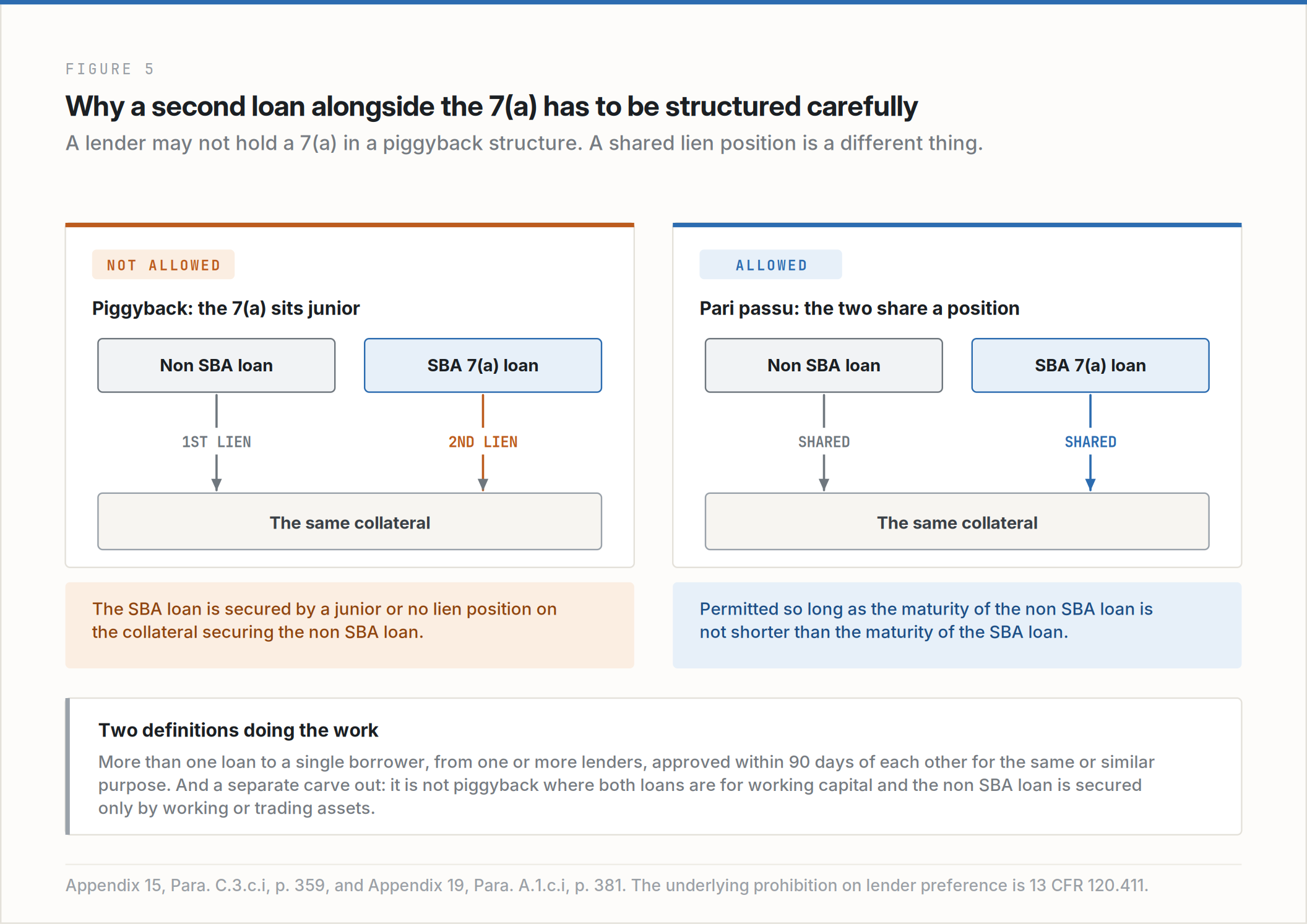
Two carve outs make stacking workable, and both are worth understanding before you shop a larger deal. A structure is not piggyback where both loans are for working capital and the non SBA loan is secured only by working or trading assets. And a pari passu lien position is not piggyback so long as the maturity of the non SBA loan is not shorter than the maturity of the SBA guaranteed loan.
That maturity condition is the one that gets missed. A conventional tranche amortizing faster than the 7(a) is a problem even when the lien positions are shared.
Appendix 15, Para. C.3.c.i, p. 359, and Appendix 19, Para. A.1.c.i, p. 381, under 13 CFR 120.411.
Where the money comes from
11. Can I borrow my 10 percent?
Part of it. The category your money lands in decides how much of the injection it can carry.
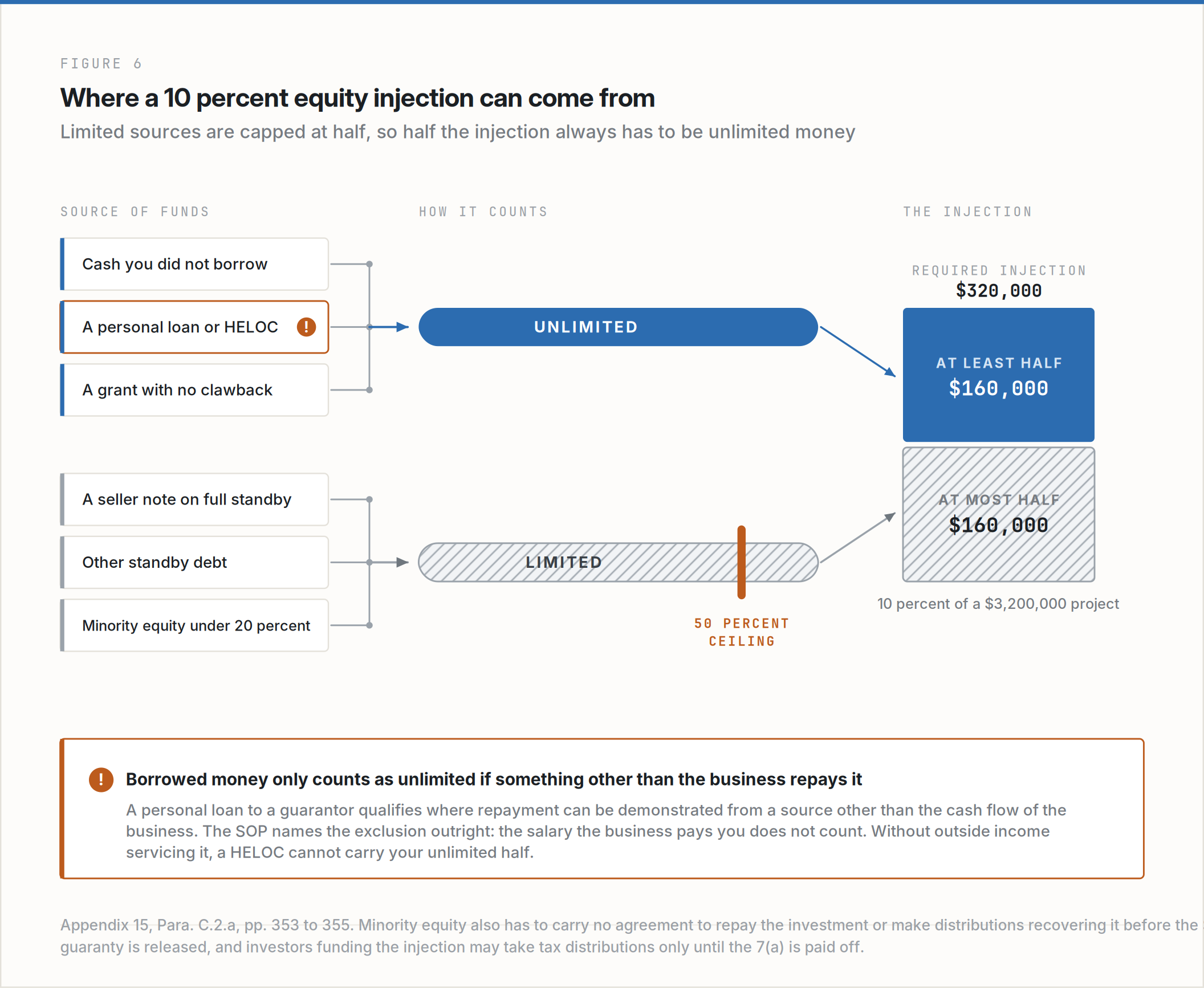
Start with the base. On an Initial Acquisition the injection is 10 percent and the SOP says outright that it cannot be reduced or eliminated. Business Expansions and Owner Buyouts get relief only where the lender has determined that the borrower has sufficient liquidity and working capital to sustain operations after the transaction, and only where the balance sheet is not at negative net worth at the last fiscal year end. Read the next sentence carefully, because it attaches to elimination rather than to any reduction: when eliminating the equity requirement, the lender cannot include permanent working capital in that loan or in any other 7(a) term loan request within 90 days, and any working capital the transaction needs has to come from existing cash or a line of credit.
Then the sources. A home equity line is borrowed money. It counts as an unlimited source only if repayment can be demonstrated to come from a source other than the cash flow of the business, and the SOP names the exclusion outright: the salary the business pays you does not qualify. For a buyer leaving a job to run the business, that usually means a working spouse or documented outside income. Without it, the line cannot carry your unlimited half. This is where deals die quietly at credit, and it is worth settling in week one rather than week nine.
One more source rule that comes up on deals priced above the valuation. Where the sales price exceeds the value supported by the business valuation and the Quality of Earnings report, you may bring in additional limited equity sources above the usual half ceiling, but any additional funds provided must be on full standby. You can bridge a valuation gap. You cannot bridge it with money that gets paid back while the 7(a) is outstanding.
And a small consolation: what you spend out of pocket on the business valuation and the Quality of Earnings report counts toward your injection.
What we see in practice. Home equity lines turn up in acquisition files constantly, sometimes as the source of the injection, sometimes as the reserve a buyer keeps behind the closing, and often as both at once. Two things are worth knowing before you build a structure on one.
Credit teams will often give you credit for a line you have not drawn, so committed availability can count toward the post close liquidity a bank wants to see even if you never touch it. And the number that governs is the one on your signed personal financial statement. When the limit in your model does not match the limit your bank actually approved, underwriting works from the documented figure and your sources and uses have to move to match it. Get the line opened and papered well before you go to underwriting, because a commitment already in place reads very differently to a credit committee than one you promise to arrange later.
Appendix 15, Para. C.2.a, pp. 353 to 355. Diligence costs toward the injection at Appendix 15, Para. C.1, p. 350.
12. How does the injection actually get proved?
With documents, before any money moves, and the file follows the loan for its whole life.
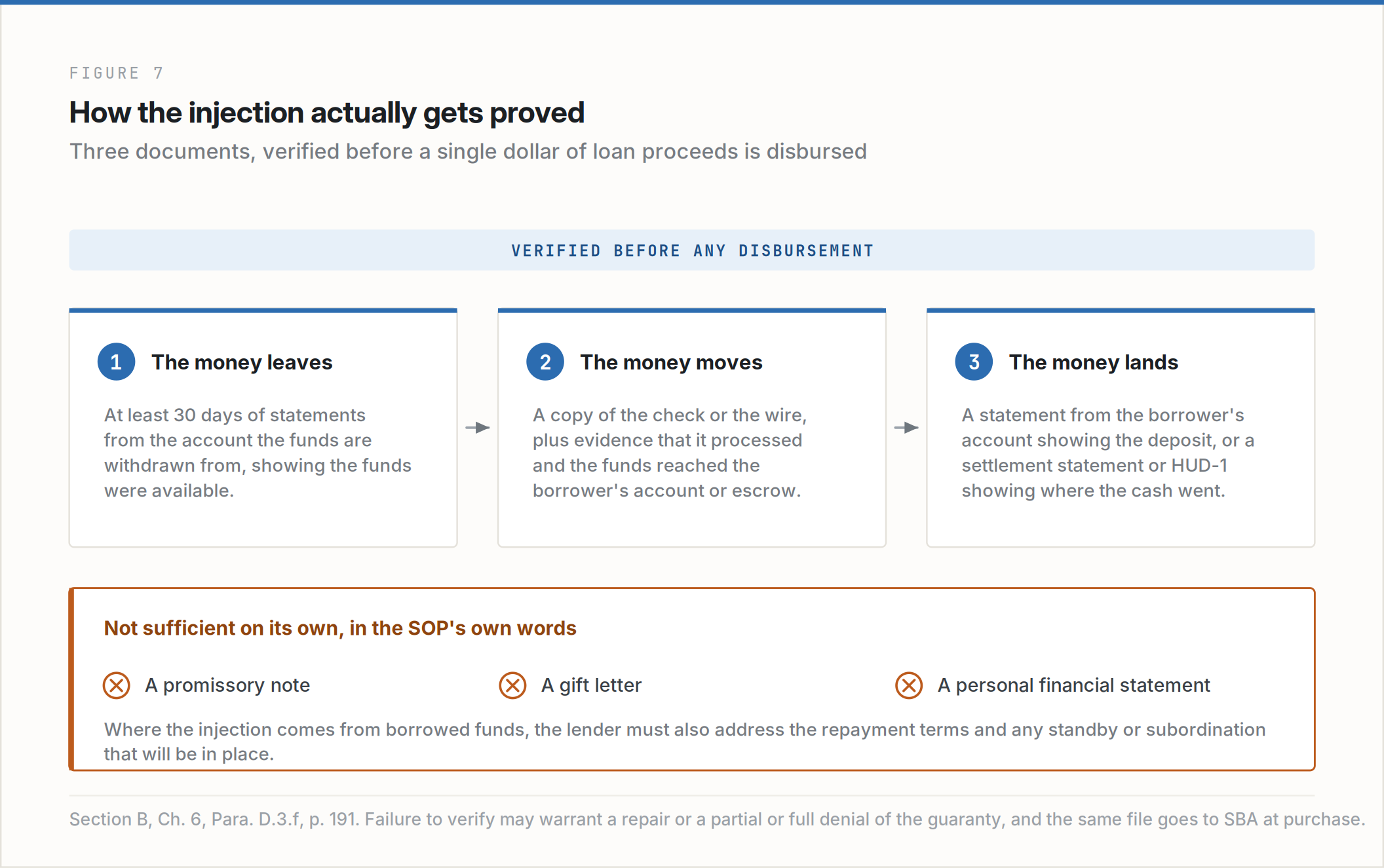
The verification happens prior to disbursing any loan proceeds, and lenders must maintain the evidence in their files. That same documentation gets submitted to SBA with every purchase request on a loan where an injection was required, which is the part buyers rarely appreciate: a thin injection file is a problem years later, at guaranty purchase, not just at closing. The SOP is blunt about the consequence, saying that failure to use reasonable and prudent efforts to verify may warrant a repair or a partial or full denial.
Practical translation. Season the money. Thirty days of statements means thirty real days in an account you can document, so cash that appears the week before closing invites a question you do not want to answer twice.
Section B, Ch. 6, Para. D.3.f, p. 191.
13. Can a seller note cover half my down payment, and what does full standby mean?
It can, and full standby means exactly what it says.
Seller debt that is subordinated to the lender and on full standby, no payments of principal or interest for the term of the 7(a) loan, may be treated as equity. For the life of the loan. Lenders use SBA Form 155 or their own equivalent, with a copy of the note attached and kept in the credit file. Interest may accrue, be added to the standby debt, and amortize after the 7(a) is paid in full. The standby creditor subordinates any lien rights in the collateral and takes no action against the borrower or the collateral without the lender's consent.
Because seller debt is a limited source it shares the 50 percent ceiling with every other limited source. On an Initial Acquisition requiring 10 percent, a seller note carries 5 percent of total project cost at most, and the other 5 percent has to be unlimited money.
A seller note that is not on full standby is still perfectly allowable. It just buys no equity credit, and it counts against the valuation ceiling, since the total debt eligible to support a change of ownership transaction, including seller debt that is not on full standby, is limited to the business valuation amount and must be supported by debt service coverage. Seller debt from a change of ownership becomes eligible for refinancing once it has been in place and current for 36 months.
One more line worth knowing: the provider of standby debt may not take an equity investment in the business. That sentence sits under the SOP's Standby Debt Agreements heading, and the Seller Debt subsection that follows does not repeat it. Whether it reaches a seller who both holds standby paper and rolls equity is a question for your lender rather than one the text settles.
Appendix 15, Para. C.2.a.ii.b, p. 354. Total debt capped at the valuation at Appendix 15, Para. A, p. 343.
14. What do my investors have to give up?
More than they expect, if their money is counting toward your injection.
To be a non controlling minority equity investor at all, the investor must hold less than 20 percent equity and exert no control over the operating business. And to be eligible equity the investment may not be subject to any agreement to repay it, or to make distributions to recover it, prior to release of the SBA guaranty.
Then the live one. Where equity investments are used to meet the injection requirement, distributions to that investor that are not made solely to satisfy the investor's tax obligations attributable to the business's income are prohibited until the 7(a) loan has been paid off. Tax distributions only, for the life of the loan.
There is a way to structure around it that most buyers miss. Additional equity investments that are not used to meet the injection requirement, money brought in for liquidity rather than to satisfy the 10 percent, may receive standard distributions, subject to the lender's agreements. A lender may put debt service coverage covenants into the investor agreements or the loan agreement to make sure the business can support those distributions. So the constraint attaches to the dollars doing injection duty, not to every dollar an investor puts in.
The lender also has to review and document the terms of all equity investments, including provisions that get realized on a sale of the business. Side letters do not stay quiet.
Appendix 15, Para. C.2.a.ii.b.iii, pp. 354 to 355.
How big the loan gets, what it costs, and what you keep
15. How much can one 7(a) carry, and can I stack financing on top?
A Standard 7(a) tops out at $5,000,000. The number that actually binds is the guaranty.
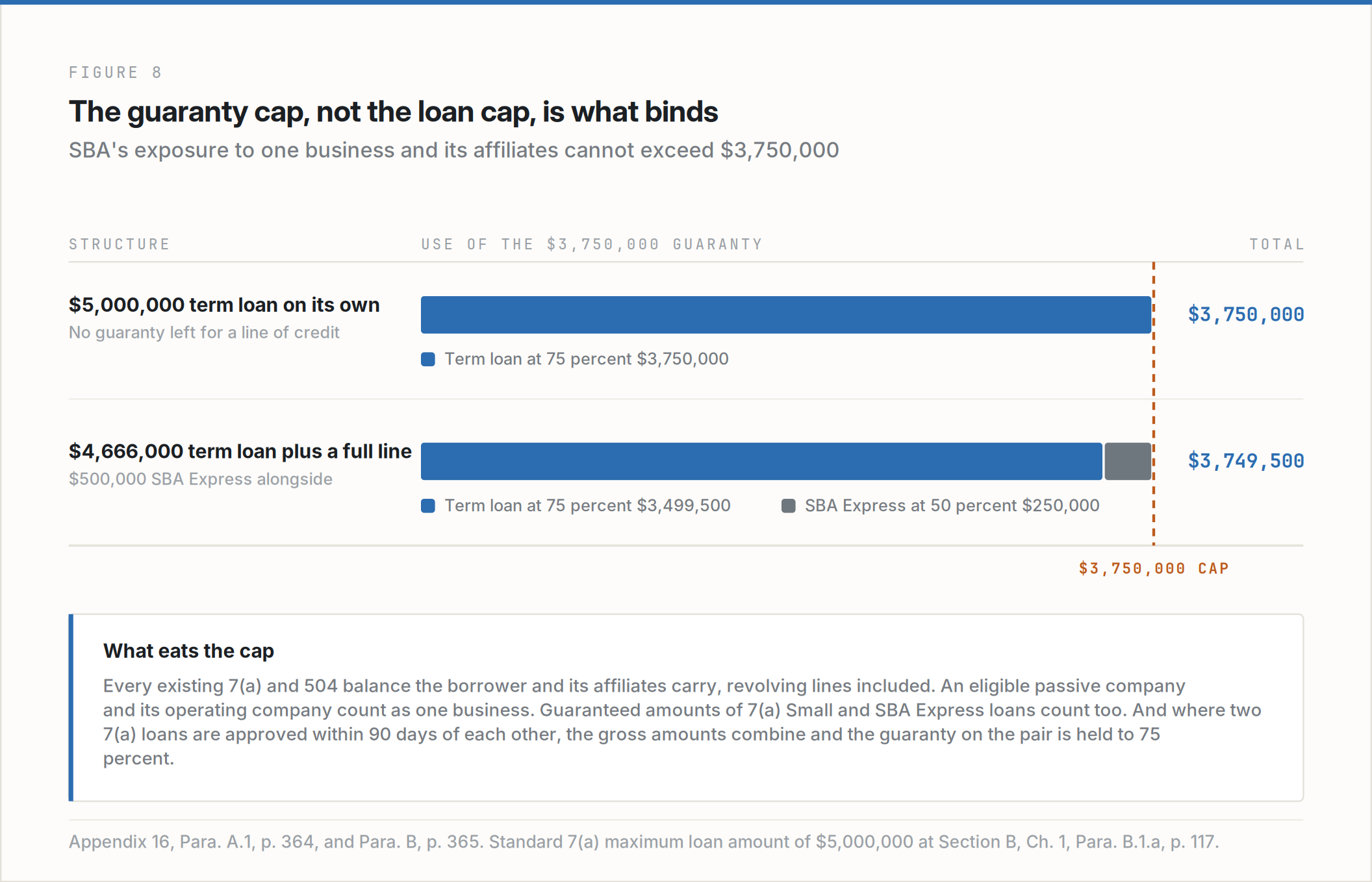
SBA's exposure to any one business and its affiliates cannot exceed $3,750,000, and above $150,000 the guaranty runs at 75 percent. Seventy five percent of $5,000,000 is $3,750,000, which is where the practical ceiling comes from. An eligible passive company and its operating company count as one business for this purpose, and every existing 7(a) or 504 balance, revolving lines included, eats the same cap.
Which is why a line of credit is not free. An SBA Express line is guaranteed at 50 percent, so a full $500,000 Express facility consumes $250,000 of your $3,750,000 and leaves about $4,666,000 of term debt capacity behind it. Take the maximum term loan and there is nothing left to guarantee a line.
Two more mechanics on sizing. Where two 7(a) loans are approved within 90 days of each other, the gross amounts are combined and, above $150,000 combined, the guaranty on the pair is held to 75 percent. And where a borrower is applying for a combination of 7(a) and 504, the 7(a) should be processed and approved first, because statutory requirements say so, and because the order of approval determines the maximum loan and guaranty amount available.
Above the cap you are into conventional money alongside the 7(a), which puts you back in question 10.
Appendix 16, Para. A.1, p. 364, and Para. B, p. 365. Standard 7(a) maximum at Section B, Ch. 1, Para. B.1.a, p. 117. SBA Express maximum at Section B, Ch. 2, Para. B.1.b, p. 125.
16. What will the loan cost, and what does leaving early cost?
The rate has a ceiling set by loan size. The prepayment fee has a trigger set by maturity.
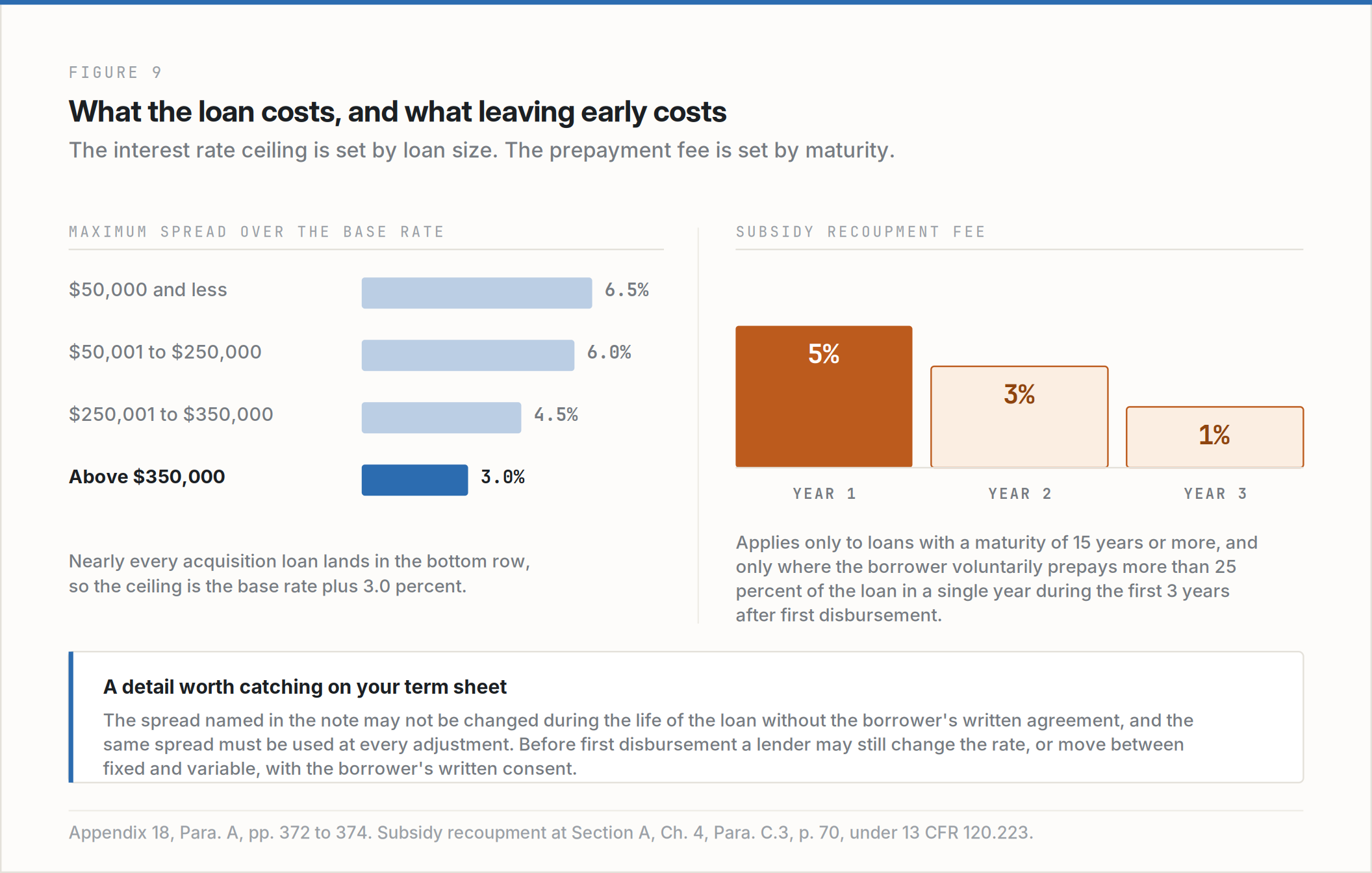
On any loan above $350,000, which is every acquisition loan we work on, the maximum is the base rate plus 3.0 percent. The base rate is the Prime Rate or SBA's Optional Peg Rate. SOFR and the 5 year and 10 year Treasury Note rates are available as alternative base rates, but the ceiling on those loans is still expressed against Prime. The rate you negotiate inside that ceiling is between you and the bank, and it moves with your credit profile, so treat the ceiling as a ceiling rather than as a quote.
Two things to check on a term sheet. The spread above the base rate identified in the Note may not be changed during the life of the loan without your written agreement, and the same spread must be used at every adjustment. Before first disbursement a lender may still change the initial rate, or move between fixed and variable, so long as the new rate does not exceed the maximum allowable at the time of application and you consent in writing, separately from signing the loan documents.
On the way out, the subsidy recoupment fee applies only to loans with a maturity of 15 years or more, and only when you voluntarily prepay more than 25 percent of the loan in any one year during the first 3 years after first disbursement. It runs 5 percent, then 3 percent, then 1 percent. A ten year acquisition loan sits outside it as written. Two ways in: blend real estate into the deal and push the maturity to 15 years or more, or extend the maturity to 15 years or more inside the first 36 months, which pulls the fee onto prepayments you already made before the extension.
Appendix 18, Para. A, pp. 372 to 374. Subsidy recoupment at Section A, Ch. 4, Para. C.3, p. 70, under 13 CFR 120.223.
17. What coverage does the deal actually have to show?
A floor, and it moves with the transaction type. This is one of the places SOP 50 10 8.1 got specific where lenders used to apply their own policy.
Debt service coverage must be satisfied using either the last fiscal year end or an average of the last two fiscal year end statements, on a historical or an adjusted basis, and the ratio depends on which of the four categories your deal falls into. Initial Acquisition is 1.25 to 1. Business Expansion is 1.15 to 1. Owner Buyout is 1.25 to 1. ESOP and Cooperative is 1.25 to 1.
Historical coverage is defined as EBITDA divided by combined debt service after the transaction, and where owner occupied commercial real estate is part of the deal the lender may add back the rent payments. Lenders may also make prudent adjustments for savings the transaction itself creates, which produces the adjusted figure. Both numbers get entered into the SBA Loan System, so neither one is a private working assumption.
Two consequences worth planning around. Business Expansion carries a lower floor than a first acquisition, which is part of why the category matters so much. And where a Quality of Earnings report is required, the earnings it lands on are the earnings used in the coverage test, so a QoE that trims the seller's add backs shrinks the loan rather than the price.
Appendix 15, Para. C.2.b.ii, p. 356. QoE driven loan reduction at Appendix 15, Para. A, p. 343.
18. How much cash do I need after closing?
The SOP sets no post close liquidity number, which is why you get a different answer from every bank.
What it does require is a credit memorandum analyzing working capital adequacy over at least the next 12 months. For Business Expansions and Owner Buyouts the injection can be reduced or eliminated only where the lender documents sufficient liquidity and working capital to keep operating after the transaction.
Cutting the other way, the credit not available elsewhere test makes lenders look at the liquidity of 20 percent owners, their spouses and their minor children, and the applicant itself. The SOP permits owners to hold reasonable funds set aside for possible future medical expenses, education expenses including for the owner's children, and retirement needs, and permits the applicant to hold reasonable funds for capital expenses over the next 24 months and for working capital. Too little liquidity is a credit problem. Too much, without those carve outs doing work, is an eligibility question.
The number itself is lender credit policy. Across the banks we place with, the common landing spots are 10 percent of the loan amount in post close cash at the conservative end, around 5 percent in the middle, and 3 to 6 months of personal living expenses at the most flexible. Plan on the conservative figure. Buyers who fund the injection to the dollar and keep nothing behind it are the ones who get a term sheet and then lose it.
Section A, Ch. 1, Para. H.2.a.i, pp. 37 to 38. Working capital adequacy at Appendix 15, Para. C.2.b.v, p. 358. Injection relief at Appendix 15, Para. C.2.a.i, p. 353.
One more that comes up on every call
19. How long can the seller stay on?
On an Initial Acquisition or a Business Expansion the seller may not remain an officer, director, stockholder or employee of the business. Where a transition period is genuinely needed, the business may contract with the seller as a consultant for a period not to exceed 24 months in aggregate, extensions included. That window is longer than what a lot of buyers are working from, so check any transition timeline you built off older guidance.
Two guardrails sit around it. Seller earnouts are prohibited outright. Buyer rebates based on business performance are allowed, because that is a benefit to the borrower, and where you receive rebate proceeds they must be applied to pay down the principal balance of the 7(a) loan that funded the change of ownership. SBA confirms that applying a rebate this way does not trigger a subsidy recoupment fee.
The practical shape of that: contingent consideration has to be a number that can only move down, or get recharacterized as something not tied to a financial metric. A payment that goes up when the business performs is an earnout by another name, and the SOP prohibits it outright.
Appendix 15, Para. A, p. 343, under 13 CFR 120.223.
Where this leaves you
Almost everything above resolves before you spend a dollar on diligence.
Who signs is a function of your cap table, which you control. Whether your house enters the collateral pool comes down to the shortfall and your equity, and both can be estimated in an afternoon with an appraisal figure, a debt schedule and the haircut table in Figure 2. Where your injection comes from is a structuring decision you make, not a discovery the bank makes for you.
The buyers who get surprised at commitment letter stage are the ones who left these until the bank asked.
Checking any of this yourself
Page numbers above are the ones the SOP's own table of contents gives for each section, so you can confirm any of them by opening the contents page of your copy. Paragraph references are the durable locator if a page ever fails to land. The sections that carry almost all of it:
Appendix 15, 7(a) Changes of Ownership, pp. 342 to 363. Transaction types, seller involvement, equity injection and its sources, standby and seller debt, business valuation and Quality of Earnings, collateral valuation for acquisitions, loan maturities.
Appendix 19, 7(a) Collateral Requirements, pp. 381 to 389. The fully secured test, personal real estate on a shortfall, appraisals, piggyback financing.
Section A, Ch. 5, Para. A, Guaranties, pp. 93 to 94. Who signs, spouses, trusts, entities, the six month lookback.
Section A, Ch. 5, Para. C, Insurance Requirements, pp. 97 to 101. Hazard and life insurance.
Section B, Ch. 6, Para. D, pp. 187 to 196. Closing, disbursement and injection verification.
Appendices 16, 17 and 18, pp. 364 to 380. Guaranty amounts, maturities, interest rates.
For the full picture of the new rules, including the four transaction types, the injection math and the Quality of Earnings trigger, work through the interactive field guide or read the field guide summary.
Every rule above was read directly out of SOP 50 10 8.1. This is written for deal planning, not as a substitute for the SOP itself or for your lender's credit policy. Individual lenders routinely overlay requirements stricter than SBA's floor, and SBA may issue technical updates before the October 1, 2026 effective date.
Want to know whether your house is in the collateral pool before you sign an LOI? Talk to our team. On SBA engagements our advisory fee is paid by the lender at closing, so there is no cost to you.
Discuss guarantees and collateral alongside the complete transaction. Explore our SBA acquisition financing service for help preparing for lender review.
Ready to Secure Financing?
Ready to Close Your Deal?
Book a free strategy call with our team. SBA engagements are lender-paid, no upfront cost to you.
Keep Reading



Get Started
Ready to Secure the Right Financing?
Select your financing path below to book a strategy call. SBA engagements are lender-paid.
SBA 7(a) Loans
Finance Your Business Acquisition
Our core SBA 7(a) services for buyers looking to acquire a business or optimize existing debt. We quarterback the entire process from pre-LOI to closing.
100% Lender-Paid Engagements
Add-Ons & Growth
Expand Your Platform
Leverage SBA financing to add locations, acquire add-ons, or expand your current platform. We help you structure the capital stack seamlessly.
100% Lender-Paid Engagements
Debt Optimization
Finance Your Business Acquisition
Looking to optimize debt or re-amortize an existing SBA acquisition loan. No LOI required, one call to get started.
100% Lender-Paid Engagements
Non-SBA / Private Credit
Independent Sponsor Deals
For sponsors pursuing $2M+ EBITDA transactions. We structure private credit and institutional capital with faster timelines.
Buyer Pays Pioneer Fee
All consultations are confidential

Pioneer Capital Advisory is a commercial financing advisory firm for SBA and non-SBA acquisition financing.