PCA Insights
SBA Seller Note Requirements Under SOP 50 10 8.1: Subordination, Standby, and What Banks Want to See
August 31, 2026
If you're buying a business with an SBA 7(a) loan, there's a good chance a seller note ends up somewhere in your capital stack. Most acquisition deals PCA works on have one. And almost every week, a buyer asks some version of the same question: what does the SBA actually require here, and what will my bank say yes to?
Those are two different questions. The SOP sets the floor. Banks build their own preferences on top of it. This post covers both, based on the text of SOP 50 10 8.1 (the version effective October 1, 2026) and what the Pioneer Capital Advisory team sees on live deals every day.
Fair warning: this one goes deep. Grab a coffee.
What a seller note is doing in your deal
A seller note is simple on its face. Instead of getting 100% of the purchase price wired at closing, the seller agrees to carry a piece of it as a loan to you, paid back over time.
Sellers agree to this for a few reasons. It bridges a valuation gap. It signals to the bank that the seller believes in the business enough to stay financially tied to it. And it can get a deal done that pure bank debt and buyer cash couldn't reach on their own.
In SBA world, though, the SBA and your lender have strong opinions about that side agreement: how it's structured, where it sits in the repayment line, and what it can and can't be used for. Get those wrong and the deal stalls in underwriting. Get them right early and the note becomes one of the most useful tools in the whole transaction.
Rule number one: the seller note sits behind the SBA loan
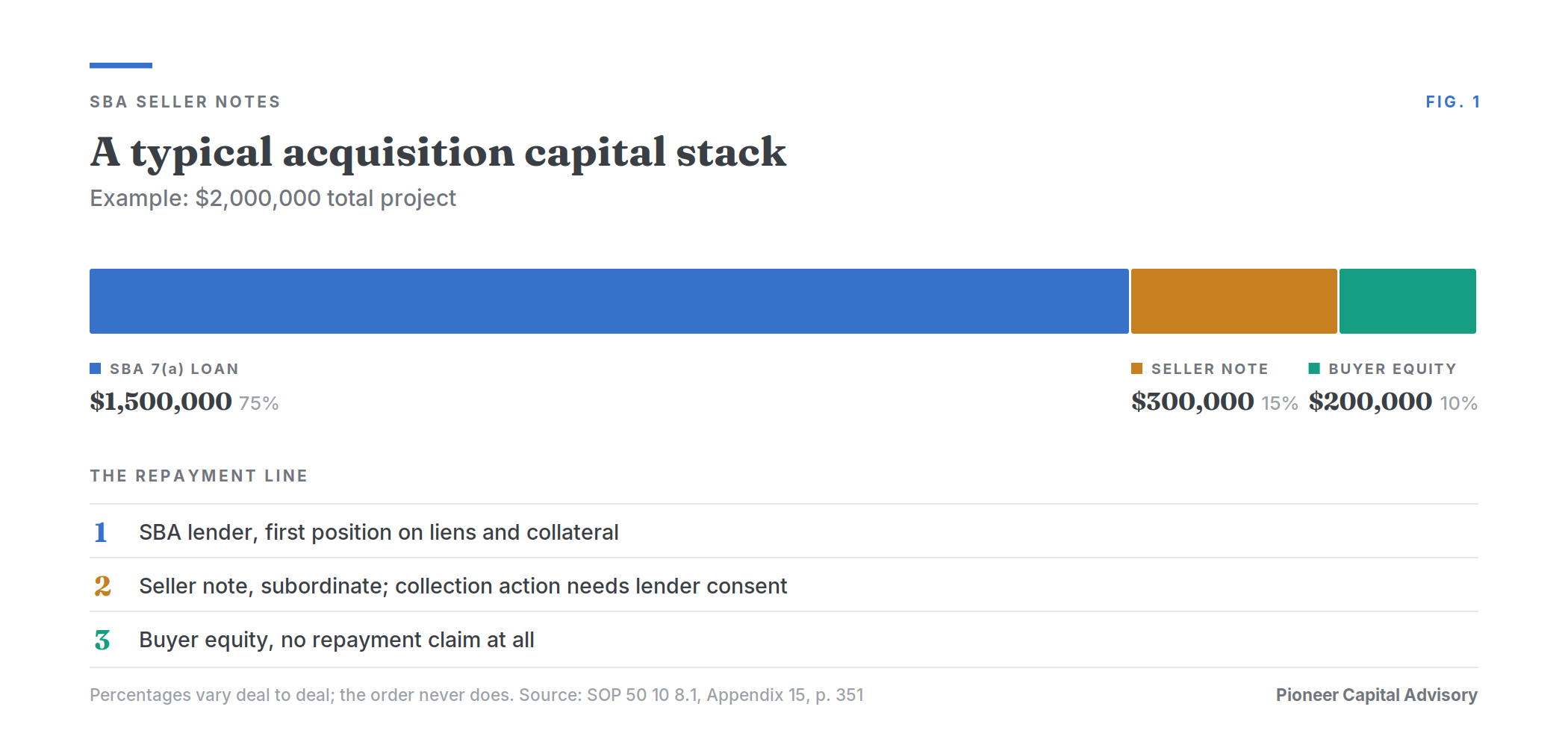
Start with the big one. The SBA lender is in first position, and the seller note is subordinate to it. Every deal, no exceptions.
The SOP is explicit about this wherever standby debt shows up. The standby creditor "must subordinate any lien rights in collateral securing the loan to Lender's rights in the collateral and take no action against Borrower or any collateral securing the Standby Debt without Lender's consent" (SOP 50 10 8.1, Appendix 15, p. 351).
Read that twice, because it covers more than lien priority. The seller can't sue you or move on collateral, and any collection action at all needs the SBA lender's sign off first. If the business hits a rough patch, the bank gets protected before the seller does.
In practice, this gets papered at closing. The seller signs a subordination agreement as one of the standard closing documents, right alongside the note itself. On deals PCA has taken through closing, the lender's closing team circulates that subordination agreement for the seller's signature the same way they circulate everything else in the document package. Sellers who've never done an SBA deal are sometimes surprised by it, so it helps to set that expectation when the LOI is being negotiated rather than the week of closing.
One more piece of the same rule: if the seller took a lien on any collateral to secure their note, that lien sits behind the bank's lien. Most seller notes on the deals PCA sees are unsecured anyway, which keeps things clean.
A seller note can do one of two jobs
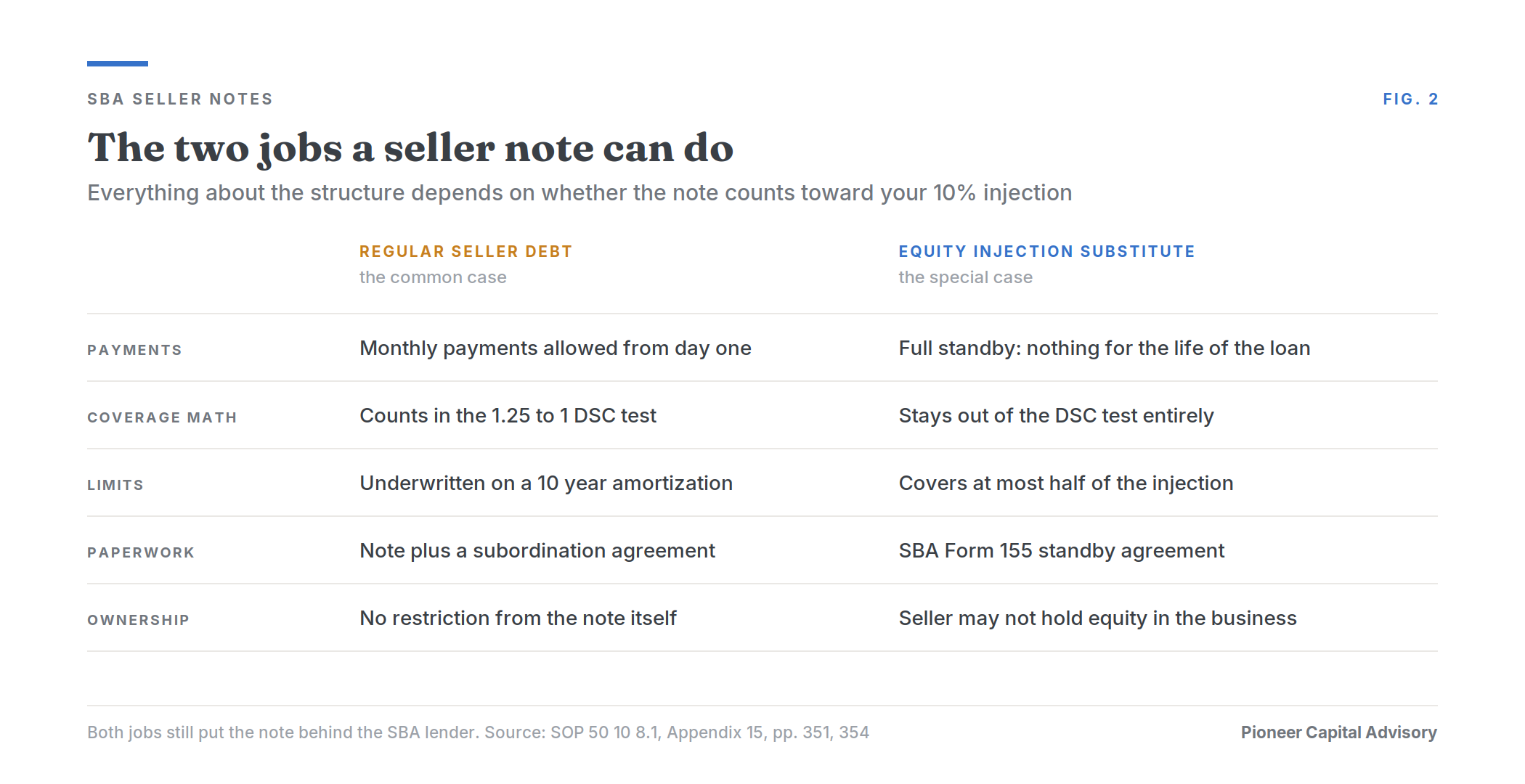
Here's the fork in the road that confuses a lot of buyers. Under the SOP, a seller note plays one of two roles, and the requirements are completely different depending on which one it plays.
Job one: it's just seller debt. Part of the purchase price you'll pay over time, sitting behind the bank. This is the common case.
Job two: it counts toward your required equity injection. This is the special case with the heavy restrictions, and it's where the famous "full standby" requirement comes from.
People mix these up constantly. Buyers hear "seller notes have to be on full standby for 10 years" and think it applies to every seller note on every SBA deal. It doesn't. That requirement only kicks in when the note is doing job two.
Let's take them one at a time, starting with the special case.
When the seller note counts toward your 10% injection
SBA requires a minimum equity injection of 10% for change of ownership transactions, and for an initial acquisition that 10% "cannot be reduced or eliminated" (Appendix 15, p. 350).
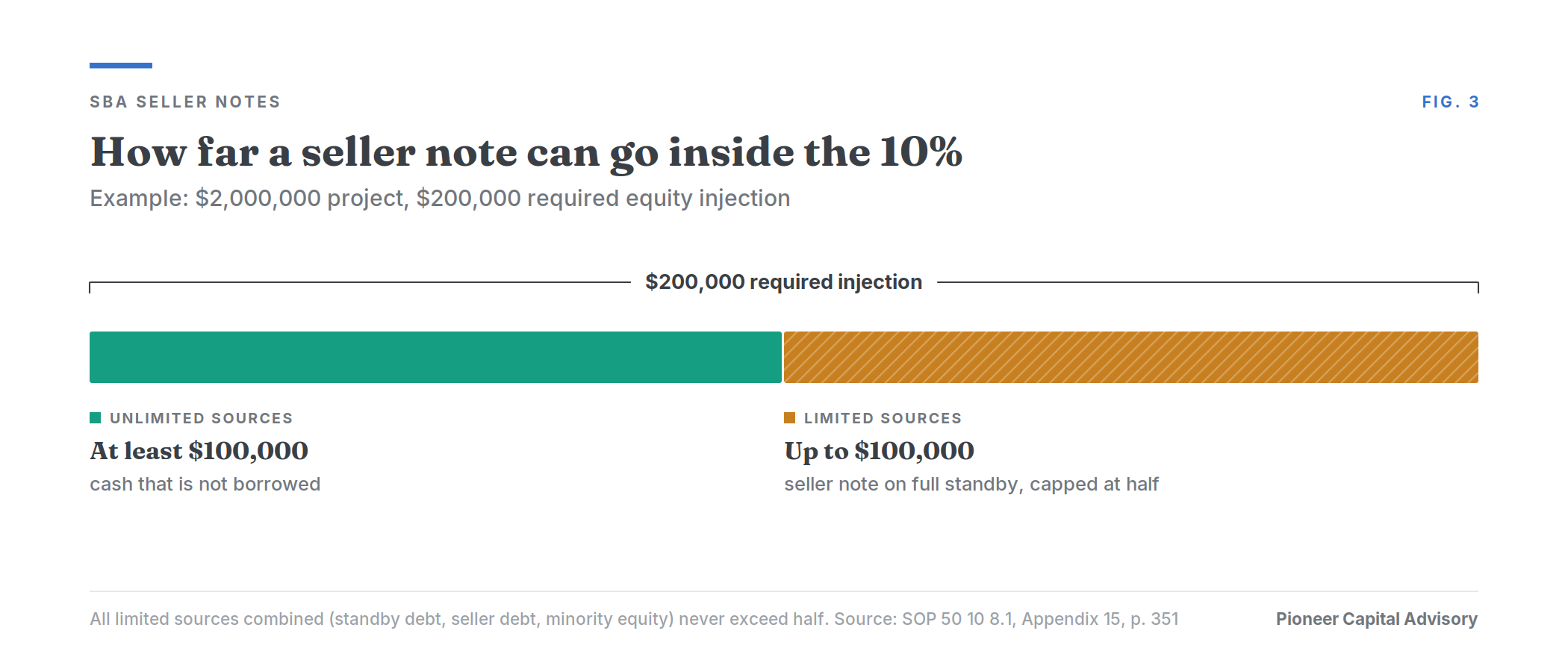
The SOP splits acceptable injection sources into two buckets. Unlimited sources are things like cash that isn't borrowed. Limited sources, which "may provide no more than half of the required Equity Injection" whether used individually or together, include standby debt and seller debt (Appendix 15, p. 351).
So on a $2,000,000 project, your injection is $200,000, and a seller note can cover at most $100,000 of it. The other half has to come from unlimited sources, which for most buyers means their own cash.
And here's the catch. For the seller note to count as equity, the SOP says it must be "subordinated to the Lender and on full standby (no payments of principal or interest for the term of the 7(a) loan)" (Appendix 15, p. 351). The term of a standard acquisition loan is 10 years. That means the seller waits an entire decade before seeing dollar one of principal or interest.
A few more requirements ride along with that:
The lender documents the standby with SBA Form 155, the Standby Creditor's Agreement, or its own equivalent standby agreement, with a copy of the note attached and included in the credit file (Appendix 15, p. 351).
The standby debt may accrue interest during the standby period, and that accrued interest can be added to the balance and amortized after the 7(a) loan is paid in full (Appendix 15, p. 351). So the seller does keep earning a return on the money the whole time. Collecting it is what waits.
The provider of standby debt "may not take an equity investment in the business" (Appendix 15, p. 351). A seller carrying a standby note can't also hold a piece of the company.
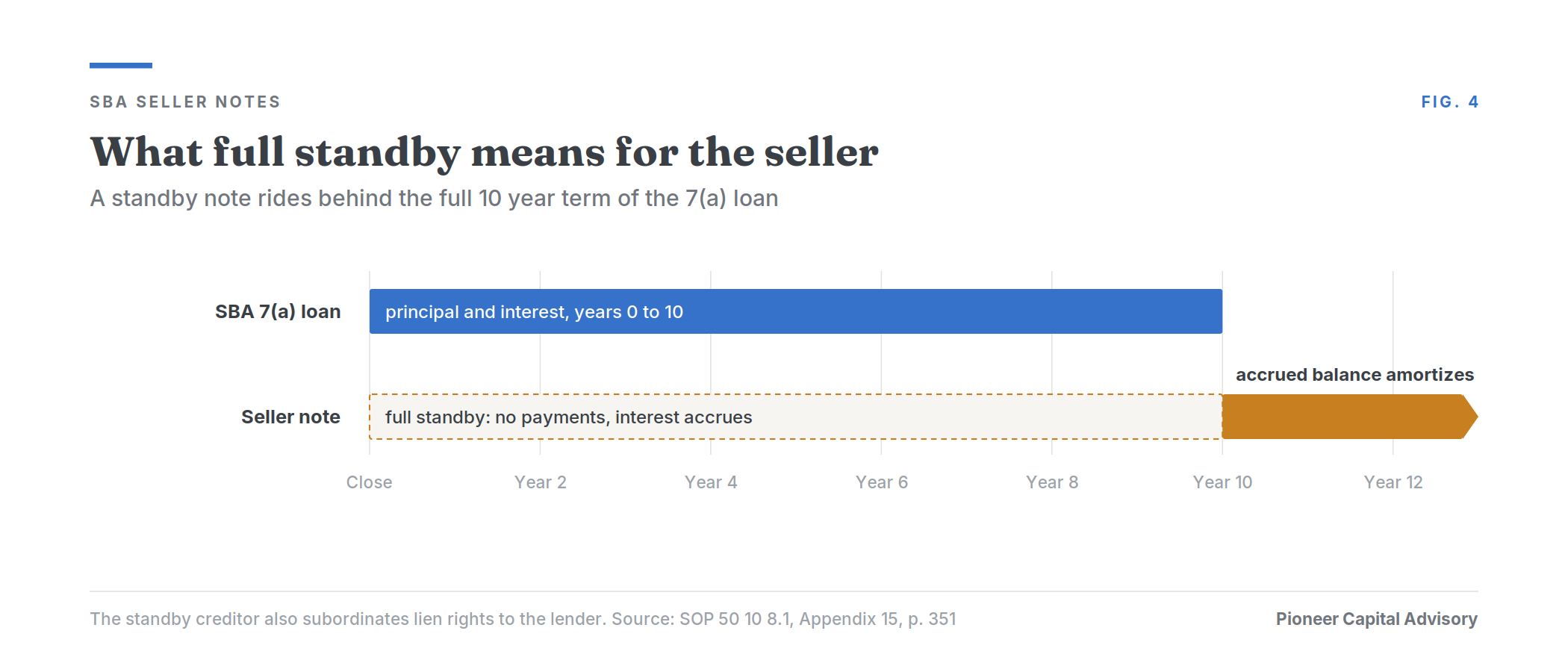
Now for the honest practice commentary. Matthias has watched buyers get excited about covering half their injection with a seller note, and he's watched most of those conversations die the moment the seller understands what full standby means. Very few sellers will wait 10 years to collect on paper when they could push for more cash at close instead. On recent deals, buyers who ran the math on this structure ruled it out themselves once they realized no rational seller would take it. It works occasionally, usually when the seller deeply wants a specific buyer to win, or when the alternative is no deal at all. Treat it as a tool of last resort, and never build your LOI around the assumption that the seller will say yes to it.
There's one situation where full standby paper shows up whether anyone loves it or not: valuation gaps. The SOP requires the business valuation to support the purchase price, and "if the amount paid for the business exceeds the business valuation, the difference must be made up by equity" (Appendix 15, p. 348). The SOP also allows additional limited equity sources to supplement the purchase when the sales price exceeds the value supported by the valuation and QoE report, and in that situation "any additional funds provided must be on full standby" (Appendix 15, p. 351). Translation: if you agreed to pay more than the appraisal supports, the gap gets bridged with full standby seller paper or more cash. The PCA team has seen this exact structure carry deals across the finish line when the appraisal came in light.
When the seller note is just seller debt
This is the normal case, and it's much friendlier. A seller note that isn't being counted toward your equity injection does not need to be on full standby. It can carry regular monthly payments from day one if the cash flow supports it.
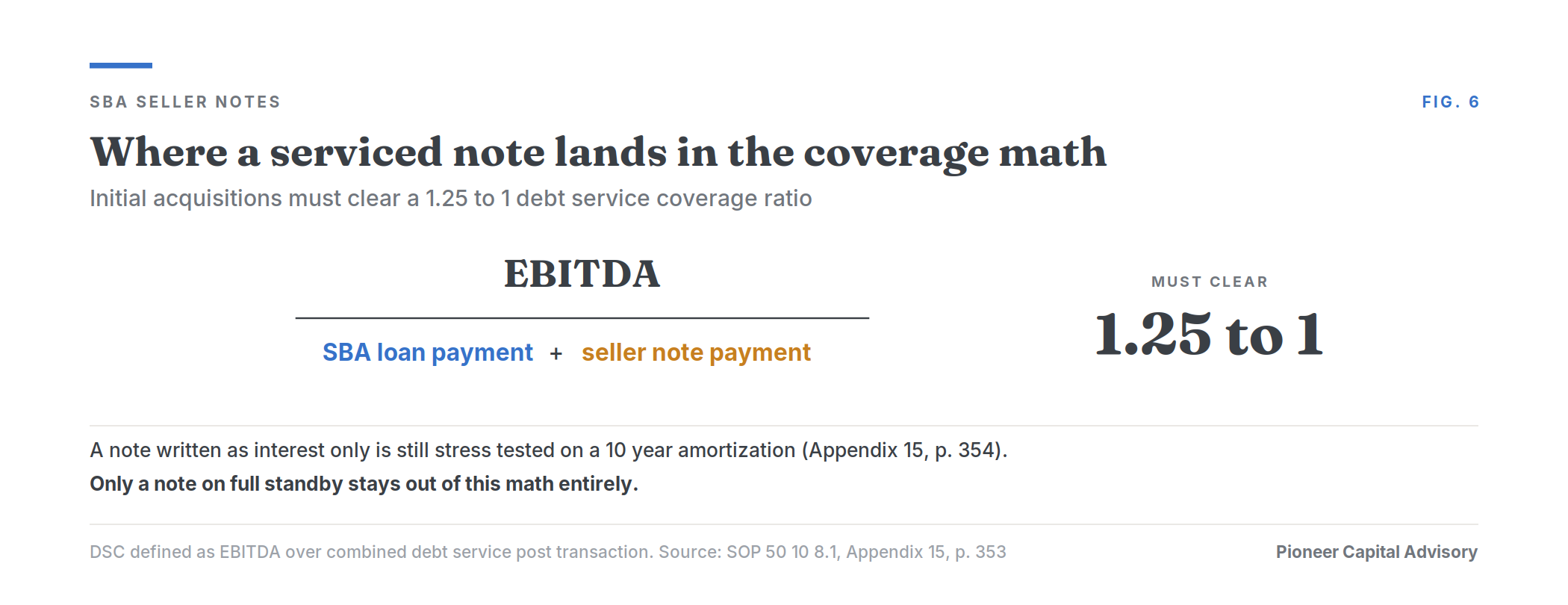
The key phrase is "if the cash flow supports it." Because the moment the note carries payments, those payments count against your debt service coverage. The SOP requires an initial acquisition to hit a DSC ratio of 1.25:1, calculated as EBITDA divided by combined debt service after the transaction closes (Appendix 15, p. 353). Combined means combined. The SBA loan payment and the seller note payment both go in the denominator.
The SOP even closes the loophole that used to hide seller debt from this math. When a change of ownership includes additional debt that isn't on full standby and is structured with interest only payments, the lender must apply an amortization not exceeding 10 years when running the coverage calculation (Appendix 15, p. 354). The SOP says the point of this requirement is making sure the business can service all debt associated with the acquisition, regardless of the source or structure. So a seller note with a token interest only structure and a giant balloon still gets stress tested as if it amortized.
Two more guardrails worth knowing:
Total deal debt is capped by the appraisal. "The total debt eligible to support a change of ownership transaction (including seller debt that is not on full standby) is limited to the business valuation amount and must be supported by the Debt Service Coverage of the Applicant" (Appendix 15, p. 340). You can't pile on seller debt to pay more than the business is worth.
A seller note doesn't help you duck the QoE requirement either. For initial acquisitions and expansion deals at a purchase price of $3 million or more, a lender ordered Quality of Earnings report is mandatory, and that threshold "is determined before the application of buyer equity, seller debt, or other financing sources" (Appendix 15, p. 340). A $3.5 million deal with a $1 million seller note is still a QoE deal.
The earnout problem, and how to write the note so it survives underwriting
This comes up on more deals than any other seller note issue PCA touches. SBA rules prohibit earnouts in change of ownership transactions. If any part of the seller's payout is contingent on how the business performs after closing, you've got an earnout, and the structure is dead on arrival with an SBA lender.
The seller note has to be a fixed obligation based on the historical performance of the business. When PCA provides feedback on a buyer's LOI, the guidance is to write the language so the note amount references historical figures the business already produced, never forward looking targets. A fixed number that can only ratchet down (say, if a specific known risk materializes) generally survives review. A number that ratchets up if revenue grows does not.
Matthias has also seen this become a genuine negotiating advantage. When a competing buyer's offer leans on a big earnout, an SBA backed offer pays real money at close, and that's worth saying out loud to the seller.
What banks actually like to see on seller notes
Everything above is the SOP floor. Here's the layer on top: the patterns PCA sees across the lenders it places deals with. Every bank has its own credit box, so treat these as the center of the fairway rather than hard rules.

On size, most seller notes land between 10% and 15% of the purchase price. Banks like seeing the seller keep meaningful skin in the game, and a note in that range does the job without making the capital stack top heavy. Larger notes show up, sometimes much larger on bigger deals, but that's the common band.
On rate, expect something in the 5% to 8% range. Banks get uncomfortable when the seller note rate creeps above what the business can reasonably carry, and a note priced way above the SBA loan raises eyebrows in credit committee.
On term and amortization, 10 year terms are common once a lender has shaped the structure, and 5 year terms show up frequently in buyer drafted LOIs before the bank weighs in. Remember the 10 year amortization test from the SOP: however the note is written, the lender is going to underwrite it as if it amortizes within 10 years.
On payment timing, banks frequently like a standby or interest only runway at the front of the note. A structure PCA sees often: 24 months of interest only, then principal and interest amortization for the remaining term. Some lenders go further and ask whether the seller would accept two or three years of full standby before any payments start, especially when coverage is tight in year one. That runway gives the business room to absorb the transition before the seller note starts pulling cash out.
On documentation, banks want the seller note terms in writing early. PCA asks every buyer up front whether they plan to include a seller note and on what terms, and a seller note term sheet is a standard input to the cash flow model before anything goes to a lender. There's a reason for that. The SOP requires the lender's credit memo to specifically address seller financing and standby agreements as part of its analysis (Section B, Ch. 1, p. 121). Your bank literally has to write about your seller note in the credit approval. Vague terms slow that down; clean terms speed it up.
And on lender verification, if seller financing beyond the minimum injection is part of the funding picture, the lender must address the proposed repayment terms and any standby or subordination terms that will be in place (Section B, Ch. 6, p. 191). Another reason to have the note fully specified before underwriting starts, and never scribbled on a napkin at the closing table.
Can the seller note be refinanced later?
Yes, with a seasoning requirement. Seller debt structured as part of a 7(a) change of ownership becomes eligible for refinancing after it has been in place and current for 36 months (Appendix 15, p. 351). For the refinance itself, the SOP requires that the seller financed note was in place and current, not on standby, for at least 36 months following the change of ownership, that the refinancing meets SBA's 10% payment improvement requirement, and that it doesn't reduce the lender's exposure (Appendix 15, p. 346).
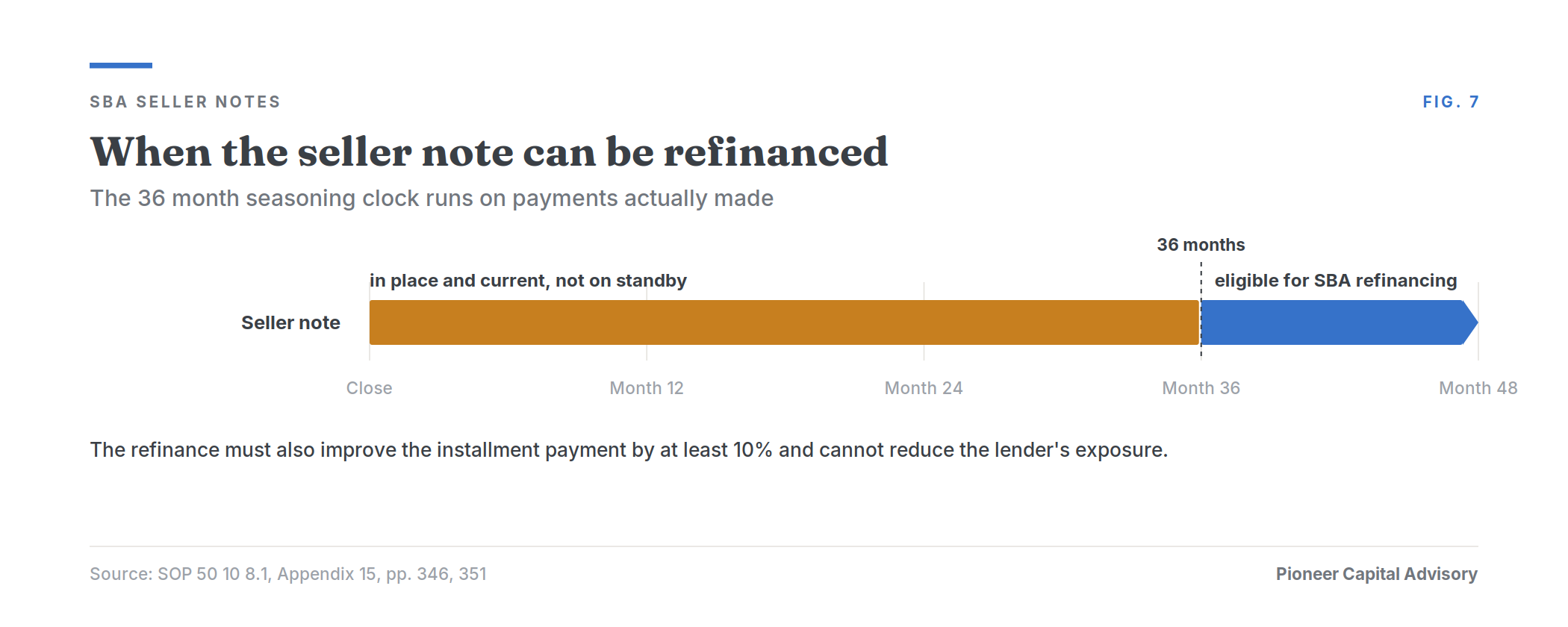
Notice the "not on standby" language. A full standby note that never took payments doesn't build the payment history the refinance rules want to see. Something to keep in mind if the plan was always to take the seller out early.
Pulling it together: how to structure a seller note that sails through
After enough of these deals, the playbook writes itself:
Put the note behind the bank without a fight. Subordination is coming either way, so build it into the LOI language and prep the seller for the subordination agreement at closing.
Decide early which job the note is doing. If it's covering part of your 10% injection, it's capped at half, it's on full standby for the life of the loan, and you need a seller with unusual patience. If it's regular seller debt, it needs to fit inside the 1.25:1 coverage math with a 10 year amortization applied.
Base the number on history, never on future performance. No earnouts, no upward ratchets.
Keep it in the fairway banks recognize: 10% to 15% of the price, a rate in the 5% to 8% neighborhood, and a payment runway (interest only or standby) at the front if coverage needs the help.
Get the terms on paper before underwriting, because your lender's credit memo has to discuss them either way.
Seller notes reward buyers who think about them early and punish buyers who treat them as an afterthought. The difference usually shows up right when it hurts most, three weeks before closing.
If you're working through a deal structure and want a second set of eyes on the seller note before it goes in the LOI, that's exactly what the Pioneer Capital Advisory team does all day. Book a call and bring the numbers.
Pioneer Capital Advisory LLC is a commercial loan brokerage specializing in SBA 7(a) acquisition financing. SOP citations reference SOP 50 10 8.1, effective October 1, 2026. This post is general information, and every deal has facts that change the analysis. Talk to your lender and advisors about your specific transaction.
A seller note needs to fit the rest of the transaction. Explore our SBA acquisition financing service for help reviewing the capital structure, lender fit, and path from LOI to closing.
Ready to Secure Financing?
Ready to Close Your Deal?
Book a free strategy call with our team. SBA engagements are lender-paid, no upfront cost to you.
Keep Reading


Get Started
Ready to Secure the Right Financing?
Select your financing path below to book a strategy call. SBA engagements are lender-paid.
SBA 7(a) Loans
Finance Your Business Acquisition
Our core SBA 7(a) services for buyers looking to acquire a business or optimize existing debt. We quarterback the entire process from pre-LOI to closing.
100% Lender-Paid Engagements
Add-Ons & Growth
Expand Your Platform
Leverage SBA financing to add locations, acquire add-ons, or expand your current platform. We help you structure the capital stack seamlessly.
100% Lender-Paid Engagements
Debt Optimization
Finance Your Business Acquisition
Looking to optimize debt or re-amortize an existing SBA acquisition loan. No LOI required, one call to get started.
100% Lender-Paid Engagements
Non-SBA / Private Credit
Independent Sponsor Deals
For sponsors pursuing $2M+ EBITDA transactions. We structure private credit and institutional capital with faster timelines.
Buyer Pays Pioneer Fee
All consultations are confidential

Pioneer Capital Advisory is a commercial financing advisory firm for SBA and non-SBA acquisition financing.