PCA Insights
From IPO Windfall to Business Owner: The SBA Financing Playbook for SpaceX and Big Tech Employees Exploring ETA
September 1, 2026
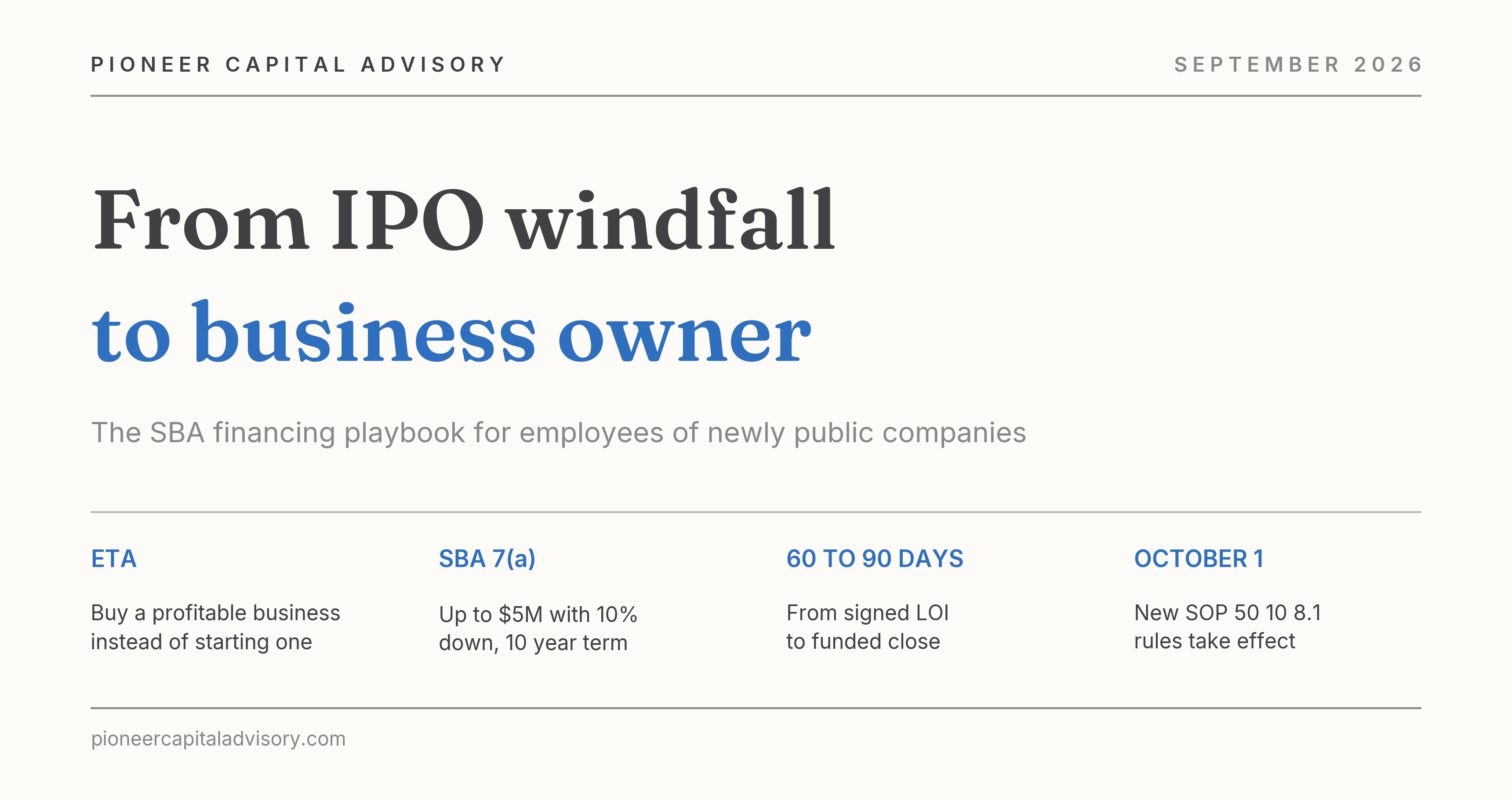
At market open on August 6, 2026, roughly 911 million SpaceX shares became sellable for the first time. [1] Q2 earnings had dropped two days earlier. The first tranche of the staged lockup released, and somewhere between Hawthorne, Boca Chica and Redmond, thousands of engineers refreshed their brokerage accounts and saw a number that used to be theoretical.
That number will keep growing through the fall. SpaceX structured its lockup in stages: about 20% of eligible shares after Q2 earnings, additional releases at 70, 90, 105, 120 and 135 days, and everything by mid December, 180 days after the June 11 IPO. [2] The 2025 class, Figma, Klarna, Chime, CoreWeave, Circle, is already fully unlocked. [3] Anthropic is expected to file its prospectus after Labor Day. [4]
However the next 18 months shake out, one thing is already true. A wave of employees at newly public companies now hold real, spendable equity for the first time in their careers, and they are all quietly asking the same question.
What do I actually do with this?
The default answers are fine. Pay off the house. Max the index funds. Nobody ever got hurt being boring with a windfall.
But there is a fourth path that keeps showing up in Pioneer Capital Advisory's inbox, usually from someone whose signature block says "Senior Propulsion Engineer" or "Staff Software Engineer, L6," and it deserves a longer treatment than it usually gets: use a slice of the windfall as the down payment on a profitable, established small business, borrow the rest through an SBA 7(a) loan, and run the company as its owner.
That path has a name, entrepreneurship through acquisition. It has a financing engine, the 7(a) program, that was built for almost exactly this transaction. And right now it has unusual timing: the SBA's new rulebook, SOP 50 10 8.1, takes effect October 1, 2026, three weeks into the same quarter your shares come free.
This post is the full walkthrough: what ETA is and what the businesses actually look like, what they cost, how the loan works, a worked example with real math, the process week by week, the new rules, and an honest accounting of how a decade at SpaceX or Google translates to running a 30 person fire protection company, including the parts that do not translate.
It is long on purpose. Bookmark it, send it to your spouse, and read it before your next trading window opens.

What ETA actually is
Entrepreneurship through acquisition means buying an existing business instead of starting one. You skip zero to one entirely.
The business you buy has been running for 15 or 30 years. It has customers who reorder, employees who know their jobs, and a profit and loss statement with actual profit on it.
On day one you own something that already works, and your job is to keep it working and make it better.
The idea came out of Stanford's business school in the 1980s under the name "search fund," and for two decades it stayed an MBA niche. [5] That era is over, for two reasons that have nothing to do with fashion.
The first is supply. Baby boomers own millions of American small businesses, and they are aging out of them. A huge share have no succession plan: the kids became dentists in another state and want nothing to do with the family's commercial plumbing company.
These owners built real enterprises, $2 million to $10 million in revenue, and their realistic options are selling to a competitor at a discount, winding down, or finding an individual buyer who will keep the name on the trucks.
There are far more good businesses reaching this point than there are credible people trying to buy them. That imbalance is the entire opportunity. [6]
The second is financing, which is the subject of the rest of this post. The 7(a) program lets a qualified individual buy a multimillion dollar business with 10% of the total project cost as a down payment.
Without that program, ETA belongs to private equity. With it, ETA belongs to anyone who can underwrite themselves into the deal.
The math that makes people sit up
Here is the comparison that stops engineers mid scroll.
Take $2.3 million. Put it in index funds and a sane withdrawal framework gives you about $92,000 a year, and your job is to not touch it. [7]
Now take the ETA version. A buyer deploys roughly $300,000 of that as an equity injection, borrows the rest, and buys a well chosen business producing $700,000 a year in owner earnings. After about $420,000 a year in debt service, they keep something in the neighborhood of $280,000. And two other things are happening underneath: the company is retiring its own acquisition debt every month, and the business itself is still there to sell a decade later.
The caveats matter, so here they are in the main text, not tucked in a footnote. The difference between those two numbers is compensation for three things the index fund never asks of you: full time work, real risk of loss, and a personal guarantee on the debt.
ETA returns are earned, in the oldest sense of the word. Anyone who presents the comparison without saying so is selling something.
But for a specific kind of person, someone who was leaving their W2 eventually anyway, who wants to run something, and who was going to work hard for the next decade regardless, the question flips. If you are going to spend your working hours building an asset, the ownership math is very hard to argue with.
What these businesses actually look like
The good ones are almost aggressively unglamorous.
Pioneer Capital Advisory closed 26 SBA 7(a) acquisition transactions in the first half of 2026, a bit over $61 million in funded volume, and the mix tells the story better than any definition: a 40 year old commercial refrigeration and HVAC company. A cabinet manufacturer. A commercial floor care business. A bath and floor remodeling contractor. An outsourced HR consulting firm. An express car wash bought together with the real estate under it. [8]
None of these will ever be on a magazine cover. All of them share the traits that make a business financeable and worth owning: revenue that recurs because the service is needed, customers who have stayed for years, employees who know the work, and an owner who has been quietly compounding while the internet paid attention to other things.
The classic tell of a great target is an owner who still answers the phone himself and a website that was last updated when Obama was in office. The business never needed marketing. Work found it.
What they cost
Main Street businesses are priced on a multiple of what the owner actually takes home. The industry calls that figure seller's discretionary earnings, or SDE: profit, plus the owner's salary and perks added back, since the buyer steps into all of it.
The biggest driver of the multiple is the size of the earnings themselves. Most Main Street businesses with SDE under $500,000 trade around 2 to 3 times SDE, and the published medians for sold businesses sit near the middle of that band. Between $500,000 and $1 million of SDE, more buyers compete for more durable companies, and pricing moves toward 2.75 to 3.5 times. [9]
Above roughly $1 million of earnings the market changes character. Buyers underwrite on EBITDA with a real manager's salary deducted, lower middle market acquirers and independent sponsors show up, and prices run 3.5 to 5 times EBITDA and climb from there. If a broker quotes a seven figure earnings business at a Main Street multiple, one of you is about to learn something.
Within a band, quality sets where you land. Recurring revenue, a diversified customer list, clean books, and a business that runs without the seller push a deal toward the top of its range. Customer concentration, messy financials, and an owner personally holding everything together drag it toward the bottom, or below it.
Pioneer Capital Advisory's own 2026 deal flow tells the same story from the inside. Setting outliers aside, most of the acquisitions the firm has reviewed and financed this year have priced between roughly 3 and 4.5 times earnings. Smaller companies have clustered at 2.75 to 3.5 times SDE, and businesses with $800,000 or more of earnings at 4 times and up, measured against adjusted EBITDA with a replacement salary for the new owner already deducted. [9]
The deals that priced above 5 times a trailing year all leaned on stronger prior years or projections to justify the number. That is exactly the argument the new SOP's historical coverage test was written to end.

One more number belongs in this section, because it quietly disciplines every negotiation: the SBA coverage math itself. At current rates on a 10 year note, the 1.25x historical coverage floor stops penciling somewhere around 4 to 4.5 times SDE. Sellers can hope for more; SBA buyers cannot finance it, and most of the market knows it.
The arithmetic is still favorable in a way that startup people find disorienting: paying 3.3x SDE means the business generates its own purchase price in cash flow in a little over three years, before growth. Just remember that price and quality are different axes. A cheap business with one customer at 60% of revenue is a lottery ticket with payroll.
There are a few flavors of ETA worth knowing by name. Traditional search funds raise investor money to fund the search and the purchase, and the searcher ends up a minority owner reporting to a board. Independent sponsors raise capital deal by deal.
The model this post is about, and the one that fits someone holding IPO proceeds, is the self funded search: your search, your equity, your SBA loan, and 90 to 100% of the company in your name. It is the highest ownership version of ETA, and the windfall is what makes it available to you.
Why an IPO windfall changes your math
Under SBA rules, a buyer in a complete change of ownership must inject a minimum of 10% of total project costs. [10]
Total project costs means everything: purchase price, working capital, the SBA guaranty fee, closing costs. On a $3.3 million project, that is $330,000. On a $1.5 million project, $150,000. On the largest deals the program can carry, roughly $550,000 to $600,000.
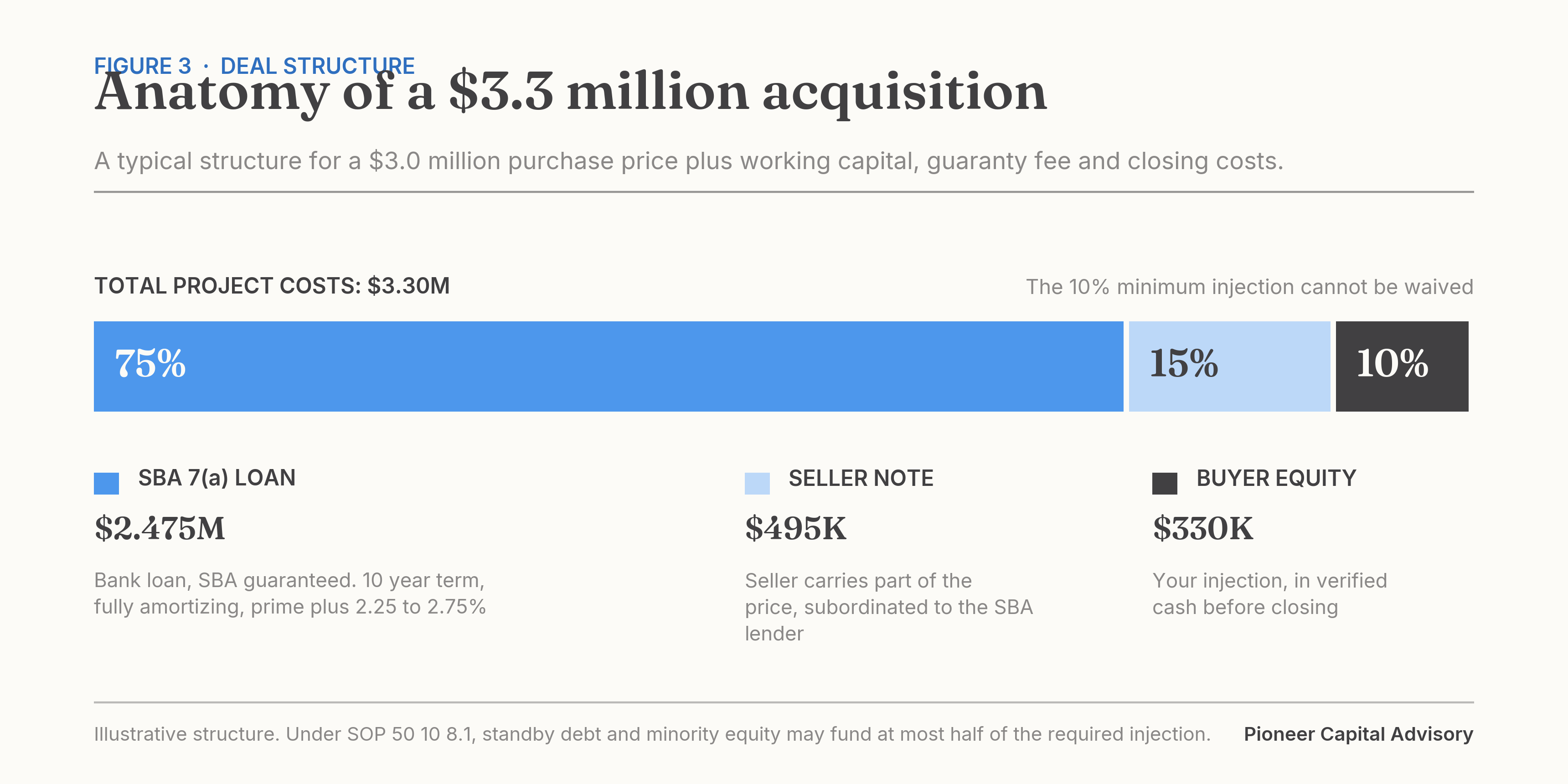
Before June, a SpaceX engineer with nine years of tenure had the number on paper and no way to write the check. Private shares are wealth you can see but not spend, and lenders need funds they can verify in an account, not equity in someone else's cap table. After the lockup releases, the same engineer can sell a slice and have a documented, seasoned injection sitting in a brokerage account before the first broker call.
The injection is the headline, but it is less than half of what liquidity does for a loan file. SBA underwriting evaluates the whole person, and cash strengthens every page:
Post close liquidity. The question every credit officer asks after the injection wires: what does the buyer have left? A buyer who injects $330,000 and keeps $400,000 in reserve is a different credit than one who emptied every account to reach the minimum and is starting ownership with $9,000 and a prayer. Reserves are what absorb the truck that dies in month two and the anchor customer who pays 45 days late in month three.
Pioneer Capital Advisory has watched lenders approve marginal deals because the buyer's balance sheet was unimpeachable, and slow walk strong deals because it was not.
Personal runway. Most self funded searchers keep their job through the search and resign at closing. The gap between the last paycheck and the first comfortable owner draw is where undercapitalized buyers make bad decisions: cutting the wrong costs, chasing the wrong revenue, taking money out of the business faster than it can stand.
Twelve months of household expenses in a separate account converts that anxiety into patience, and patience shows up in the P&L.
Search costs. A real search burns money before anything closes: a quality of earnings review on a deal that dies, legal fees on a letter of intent the seller walks away from, flights to visit a company you end up passing on. Budget $15,000 to $50,000 across a search.
Buyers who cannot afford dead deal costs start skipping diligence, and skipping diligence is how you buy someone else's problem at full price.
The mechanics, because the mechanics bite
The SBA requires the injection in cash, verified, before closing, with a documented source. [11] Three practical consequences for someone whose money is arriving via lockup releases:
Your stock is not an injection until it is cash in an account. Shares still under lockup, or blocked by a trading window, do not count as available funds, and a lender will not close around a promise that the December release will cover it.
Verification looks backward. Lenders typically want two or three months of statements showing the funds, and they will ask where money came from. A large deposit labeled "stock sale" with a matching brokerage confirmation is clean. A chain of transfers between six accounts is a week of underwriting questions. Sell early, consolidate, and let the money sit still.
Company trading policy still applies to employees. Blackout windows and preset trading plan mechanics can put months between deciding to sell and having settled cash. If you are targeting a spring 2027 acquisition, the selling that funds it happens this fall and winter, on your company's calendar rather than your deal's.
A word on the tax sequencing
Pioneer Capital Advisory arranges debt and does not give tax advice, so treat this paragraph as a map of questions for your CPA, not answers. What your sale actually costs in tax depends enormously on how you got the shares.
RSUs that settled at the IPO were taxed as ordinary income at settlement, which means their cost basis is recent and the embedded gain since June may be modest. [12] Options exercised years ago, or shares bought in early tender offers, can carry enormous embedded gains, and the difference between selling those thoughtfully across tax years and dumping them in one panicked week is real money, sometimes injection sized money.
The buyers who do this well make one planning decision before they sell anything: how much do I need for the injection, the reserves, and the runway, and what is the cheapest tax path to that number. Then they sell to the plan.
The SBA 7(a) loan, explained for people who have never needed one
If your career has been salary and equity, the Small Business Administration has never had a reason to cross your mind. Here is the working model.
The structure: a bank or credit union lends its own money, and the federal government guarantees 75% of it on loans above $150,000. [13] The guarantee exists precisely for transactions banks would otherwise decline, and a first time buyer purchasing a goodwill heavy business with 10% down is the canonical example.
No rational bank makes that loan naked. With three quarters of it federally backstopped, hundreds of them make it every week, and business acquisition is one of the program's core uses.
The key terms for an acquisition loan:
Loan size. Up to $5 million. [14] In practice that caps most SBA financed acquisitions around $5.5 to $6 million in total transaction size once the injection and any seller note are layered in. Above that line you are in conventional and private credit territory, which is a different post.
Term. Ten years for a business acquisition without real estate, fully amortizing, no balloon. [15] Every payment from month one is retiring principal. When commercial real estate is part of the purchase, terms extend, and the rules for blending them changed this year; Pioneer Capital Advisory covered that in the post on the 51% rule's elimination and blended amortization.
Rate. Most 7(a) acquisition loans float at Wall Street Journal prime plus a spread. Prime is 6.75% as of this writing. [16] Competitive spreads on quality acquisition deals run 2.25% to 2.75%, putting borrowers at roughly 9.00% to 9.50%.
The SBA caps the spread, but within the cap it is negotiated [17], deal by deal, lender by lender, and creating real competition for your loan is one of the few free levers in the whole process. On a $2.5 million note, three eighths of a percent is about $9,000 a year.
Guaranty fee. The SBA charges an upfront fee on the guaranteed portion, tiered by loan size, low single digit percentages on a multimillion dollar loan. [18] It can be financed into the loan, and it is part of the project costs your 10% is calculated against.
The personal guarantee. Every owner of 20% or more signs an unlimited personal guarantee. [19] There is no negotiating it away, and you should be suspicious of anyone who implies otherwise.
It is the program's answer to an obvious question: why would the government backstop a $2.5 million loan to someone putting in $330,000? Because the borrower is all the way in. You are betting on yourself with recourse, and the guarantee is what makes everything else in this post possible.
Sit with that sentence before you start searching, and read Pioneer Capital Advisory's 19 question FAQ on personal guarantees and collateral, which covers, among other things, exactly when a lender is required to take a lien on your house. If you just used IPO money to pay the house off, that question is not academic, and you want to understand it before underwriting rather than during.
Collateral. The loan is secured first by the business's assets. In a goodwill heavy acquisition those assets rarely cover the balance, and SBA rules then require the lender to look to personally held real estate with meaningful equity. [20] This is the second half of the all the way in structure, and the FAQ post above walks through it in detail.
Eligibility. The business must be small by SBA size standards, which nearly every Main Street target is, must be a for profit US business, and must be entirely owned by US citizens or lawful permanent residents under the current SOP. [21] Most SpaceX employees clear that last bar by construction: the roles required US person status on the way in.
Add a credit profile without recent catastrophes and no disqualifying criminal history, and eligibility is rarely where deals die. Deals die in cash flow, injection verification, and seller behavior, which is why the rest of this post spends its time there.
One mindset shift is worth installing early. Your mortgage was approved by an algorithm that read three numbers.
A 7(a) acquisition loan is approved by a person, a credit officer who reads your resume, your personal financial statement, the target's last three tax returns, and your story about why you can run this company, and then decides whether the combination will make 120 consecutive monthly payments. This is relationship credit. Presentation is underwriting input.
A worked example, start to finish
Composite numbers, illustrative buyer, real structure. Call him Dan.
Dan is a staff avionics engineer, nine years at SpaceX, based in Southern California. Between the August release and the fall tranches he nets roughly $650,000 after tax from staged sales, planned with his CPA across two tax years. He allocates it in three buckets before he looks at a single listing: $350,000 for an injection, $150,000 for post close reserves, and $150,000 for household runway, which his spouse's income stretches further.
In the winter he signs a letter of intent on a commercial fire protection services company, inspection, testing and maintenance of sprinkler and alarm systems, 28 employees, 26 years old, the owner retiring at 63. The business produces $840,000 in seller's discretionary earnings on about $4.2 million of revenue, and roughly 70% of that revenue is recurring inspection work under contract. Price: $2.8 million, or 3.3x SDE.
Here is how the financing stacks:
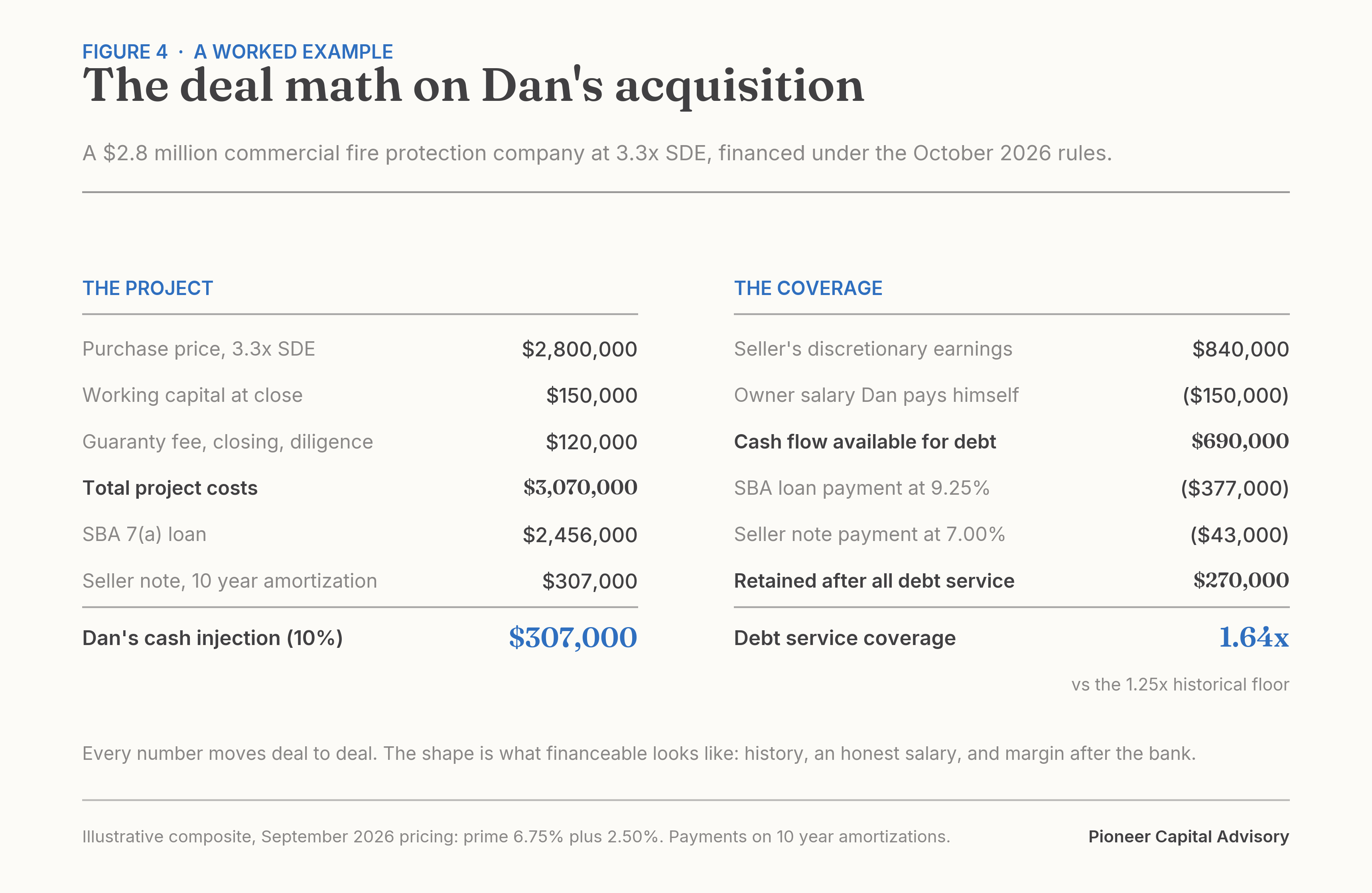
Total project costs come to about $3.07 million: the $2.8 million price, $150,000 in working capital so the company is capitalized on day one, and roughly $120,000 in guaranty fee, closing and diligence costs. Dan's required injection is 10% of that, $307,000, wired from cash he has had sitting verified in one account since December.
The seller carries a $307,000 note on a 10 year amortization, subordinated to the bank; under the new SOP an interest only seller note would have 10 year amortization imputed to it anyway, so it is structured that way from the start. [22] The SBA loan covers the remaining $2.46 million.
Now the number the credit officer actually cares about. At prime plus 2.50%, 9.25% today, the SBA loan costs about $31,400 a month, $377,000 a year. The seller note adds about $43,000 a year. Total debt service: roughly $420,000. [23]
Set that against the cash flow. The business throws off $840,000. Dan pays himself a $150,000 salary, real money but a fraction of his old total comp, leaving $690,000 available for debt service.
Coverage is 1.64x, comfortably above the 1.25x historical minimum the new SOP demands, and the historical number works without a single projection, which is exactly how the new rules require it to work. After debt service, the company retains about $270,000 a year on top of Dan's salary: cushion, reinvestment, and eventually distributions.
Why did the lender say yes in 34 days? The file held together as a story: recurring, code mandated revenue that survives recessions, because fire inspections are not optional; a buyer with $300,000 in reserves after closing and a working spouse; a seller staying six months under a transition agreement; coverage half again above the floor.
Dan's engineering background was the tiebreaker, and his loan broker made sure the resume translated: not "led avionics verification," but "managed 11 engineers and a $30 million subsystem budget against fixed launch dates for six years."
The point of the example is the shape, not the specific trade. Every number above moves deal to deal. The shape is what financeable looks like.
The process, start to finish
Here is the road from curiosity to keys, with realistic timing at each stage and the failure modes marked.

Phase 1: get financeable before you search (2 to 4 weeks)
The most expensive mistake in ETA is sequence. Buyers find a business, fall in love, sign a letter of intent, and then discover what their personal financial picture supports. The strong version runs the other way: know your buying box before your first broker conversation.
A prequalification does that. Pioneer Capital Advisory runs the analysis for prospective buyers at no cost: personal financial statement, credit profile, liquidity and its sources, and the deal size the whole picture supports. The output is a number and a story you can put in front of any broker.
In competitive processes, and good businesses are competitive, a buyer who arrives pre vetted beats a higher offer from a buyer who arrives with questions. Sellers optimize for the deal that actually closes, and price is only one input to that.
This phase is also where you do the housekeeping that becomes painful under deadline: consolidate the funds you plan to use, document the sale that produced them, resolve anything strange on your credit report, and have the tax conversation from earlier if you have not.
Phase 2: search and sign a letter of intent (3 to 18 months)
The search is the long, uncertain middle, and it deserves its own post. The short version: deal flow comes from business brokers, listing marketplaces, and direct outreach to owners. A serious searcher reads hundreds of listings, requests details on dozens, visits a handful, and offers on a few before one holds.
The searchers who close are the ones who treat it like a pipeline with conversion rates rather than a shopping trip, and who define their box tightly enough to say no fast. Vague searches die of exhaustion. Specific searches close.
When a deal holds, you sign a letter of intent: price, structure, exclusivity window, mostly nonbinding. The financing clock starts here.
Phase 3: lender selection and underwriting (30 to 45 days)
Here is the thing about SBA lenders that surprises every first time buyer: they are not interchangeable, and their differences are invisible from outside. Every institution has a credit box: industries it likes and will not touch, deal sizes it wants, how it treats seller notes, how it reads a buyer from outside the industry, and how fast its credit committee actually moves, as opposed to how fast its salespeople say it moves.
The same deal gets declined at one bank in a week, approved at another in a month, and priced 50 basis points apart at two more.
Matching deals to credit boxes before submission, and running two or three lenders in parallel so terms stay honest, is the core of what a loan brokerage does all day. It is the difference between shopping your deal and hoping.
Once a lender engages, expect to produce: three years of the target's business tax returns, current interim financials, your last three personal returns, a personal financial statement, a resume built for a credit officer, and a business plan with projections. The lender orders an independent business valuation. Above $3 million, the lender also commissions the quality of earnings review, mandatory under the new SOP and covered in the next section.
What kills deals in this phase, in rough order of frequency: sellers who take three weeks to produce interim financials, injections that cannot be cleanly verified, add backs that evaporate under QoE scrutiny, undisclosed debts or liens on either side, and revenue that started declining after the listing went up.
Almost none of these are fatal if surfaced in week one, and almost all of them are fatal in week seven. The practical rule: volunteer everything early.
Underwriting ends with a commitment letter, the lender's formal conditional agreement to fund. Three to five weeks from complete application is realistic with responsive parties.
Phase 4: closing (30 to 45 days)
Commitment in hand, the deal converts from analysis to logistics: final purchase agreement, entity formation, insurance binding, lien searches, licenses and permits, landlord consent and lease assignment, the seller note and its standby or subordination agreement, injection verification, and the lender's own closing checklist, all in parallel.
The sneaky long poles are third parties with no urgency: landlords, franchisors, licensing boards. Start those consents the day the commitment letter arrives.
Then funding day. The wire goes out. Someone hands you keys that were cut in 1998, and you own a business.
End to end, a clean deal with organized parties runs 60 to 90 days from signed LOI to close. Pioneer Capital Advisory has seen faster with disciplined sellers, and has watched shoebox bookkeeping push deals past 120.
The search is the variable no one can schedule. The financing, run properly, is not.
The rulebook changes October 1
Every SBA loan is underwritten to a rulebook called the Standard Operating Procedure, and the SBA rewrote it this year. SOP 50 10 8.1 applies to loans issued an SBA loan number on or after October 1, 2026. [24] Anyone starting a search this fall will buy under the new rules, so learn them natively rather than unlearning the old ones.
The structural change: acquisitions now sort into four boxes, initial acquisitions, business expansions, owner buyouts, and employee or cooperative purchases, each with its own requirements. [25] A first time buyer lands in the initial acquisition box. It is the strictest of the four, and its rules are worth knowing cold.
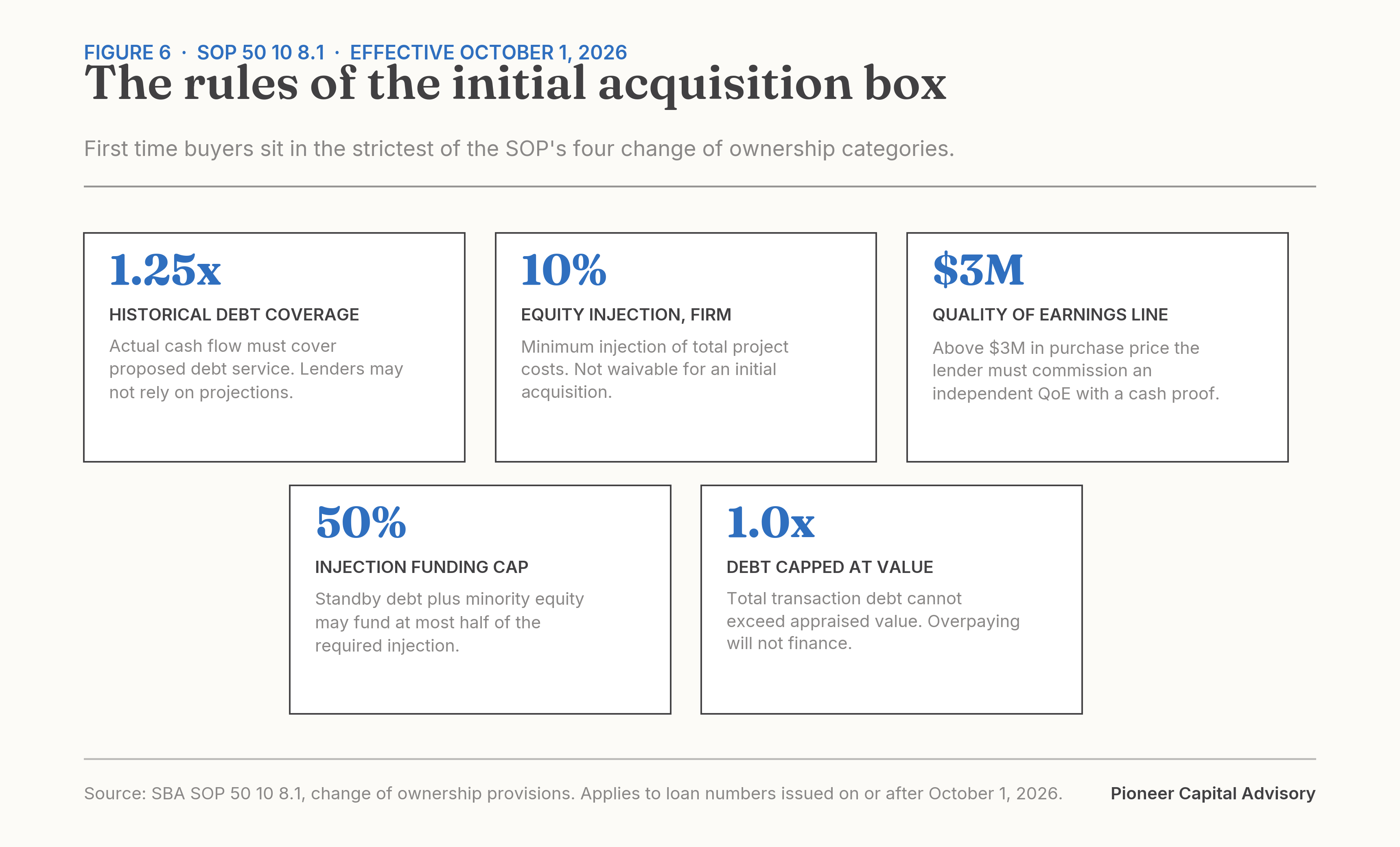
Historical coverage of 1.25x, no projections. The business's actual, demonstrated cash flow must cover the proposed debt payments by 1.25 times. [26] Lenders can review your projections, but they may not rely on them to reach the threshold.
Read that as the SBA writing your diligence discipline into federal policy: the business has to work on the numbers it already produces, not the numbers you believe your improvements will produce. Dan's 1.64x cleared this easily. A deal that only works if you grow it is now, correctly, a deal that does not finance.
A 10% injection that cannot be waived. For initial acquisitions, the minimum is firm. And the composition rules tightened: standby debt and non controlling minority equity together may fund no more than half of the required injection. [27] Under the old SOP a seller note on full standby could carry up to half of it; the new framework keeps that ceiling and polices everything that flows into it.
If you want the deep version of how seller notes work, what full standby means, and what banks actually like to see, Pioneer Capital Advisory wrote a full breakdown of seller note requirements.
The short version for this audience: your IPO proceeds mean you never need to engineer the injection. Half of your file's questions disappear because the money is simply there.
Mandatory quality of earnings above $3 million. When the business purchase price exceeds $3 million, the lender must commission an independent QoE report, including a cash proof that ties bank deposits to the financial statements, and a report the buyer ordered does not satisfy the requirement. [28] It adds cost and roughly two weeks.
It is also the best consumer protection in the SOP: a QoE that finds the seller's add backs were fiction is the cheapest bad deal you will never do. Buyers under the threshold should hear the SBA's message and order one anyway on any deal with complexity.
Total debt capped at the valuation. The combined debt on the transaction cannot exceed the business's appraised value. [29] Structurally overpaying, financing a price the valuation cannot support, is now blocked at the rulebook level.
No more small loan shortcut. The streamlined 7(a) small loan path is closed to change of ownership deals entirely, whatever their size. [30] Every acquisition gets full underwriting.
The pattern across all five rules points one direction: the SBA is pushing acquisition lending toward verified history and away from optimism. For a well capitalized, well prepared buyer, that is good news twice over. Your deals get safer, and your less prepared competition gets filtered out before they can bid prices up.
Pioneer Capital Advisory has published a clause level comparison of the old and new rules, 18 changes, 93 SOP citations, with an interactive calculator, at SOP 50 10 8.1 vs 50 10 8, and a broader 2026 field guide to buying a business. Both are worth an evening before you make your first offer.
Does a decade at SpaceX count as management experience?
Strip the politeness off the question every engineer eventually asks, and it reads: I have never owned a P&L. Will a bank really hand me $2.5 million?
The answer is yes, routinely, and it is worth understanding why rather than taking it on faith.
SBA underwriting requires relevant management experience, but relevance is judged functionally, not by industry code. A credit officer reading the file of a SpaceX integration and test lead is looking at someone who ran cross functional teams against unmovable deadlines, owned budgets, hired and fired, managed vendors and a supply chain, and operated in a culture where sloppy work has visible, sometimes explosive consequences. That is management capability by any functional definition.
What the underwriter cannot do is translate it, because "led Dragon GNC verification campaign" means nothing to a bank in Wisconsin. Translation is the buyer's job, and the broker's: team size, budget owned, vendors managed, outcomes delivered, in the credit officer's language.
Underwriting reads resumes the way you read one from an unfamiliar industry: generously, if someone converts the units.
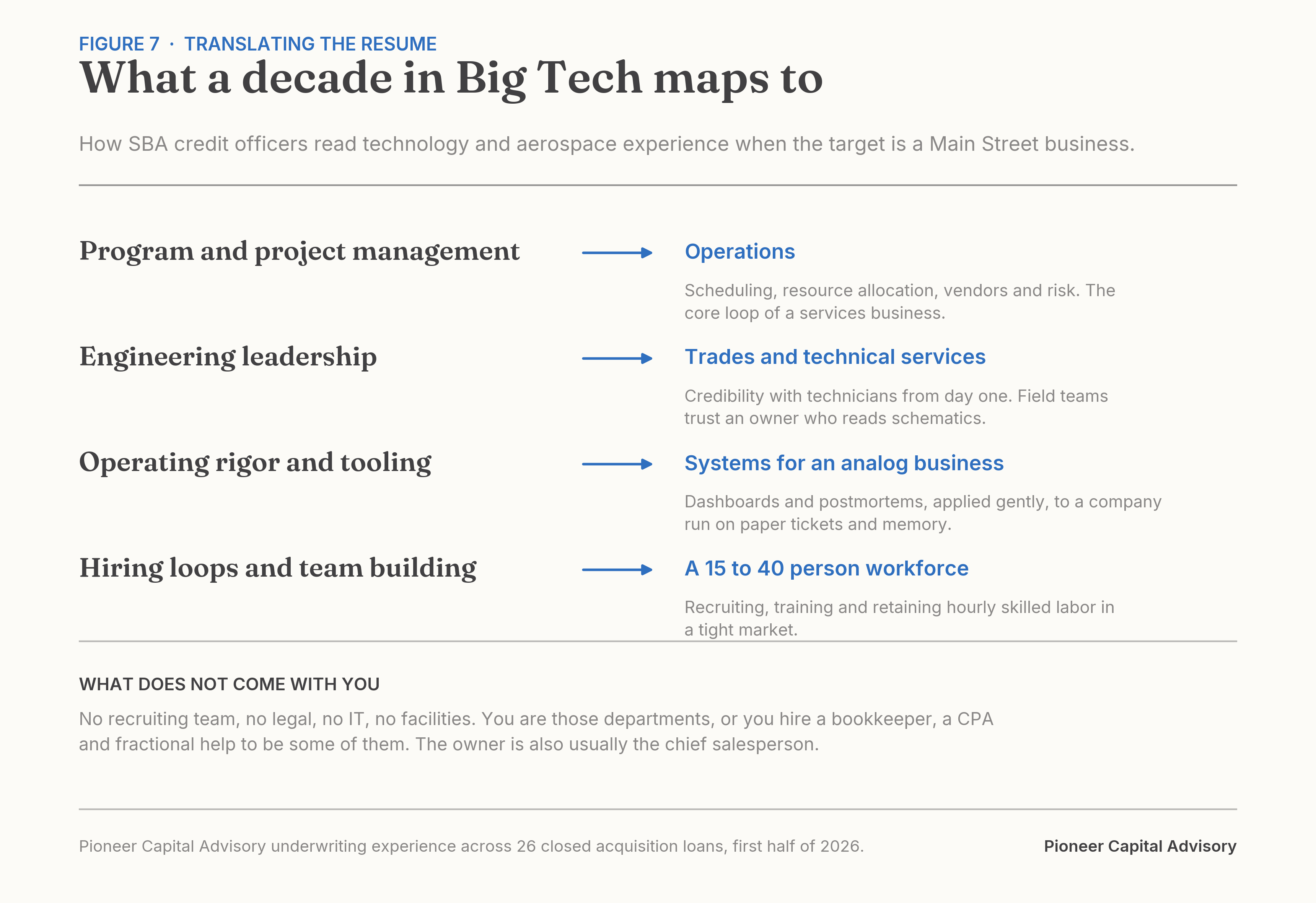
The mappings that hold up in closed deals:
Program management is operations. Running a launch campaign is scheduling, resource allocation, vendor management and risk burndown. So is running a commercial roofing company. The tools are cruder, the stakes are lower, and people who arrive from aerospace tend to describe the change as relaxing.
Engineering leadership is credibility in the trades. An owner who can read a schematic earns a technician's respect in the first week. Field employees can smell a spreadsheet buyer at a hundred yards, and they extend real trust to one who asks intelligent technical questions about the work itself. In trades and technical services businesses, that trust is retention, and retention is the whole game in year one.
Big Tech rigor is a real edge in an analog business, applied gently. Most Main Street companies run on paper tickets, a scheduling system installed 15 years ago, and the owner's memory. Someone fluent in dashboards, postmortems and structured hiring can improve a business like that within months. The discipline is pacing: change nothing for 90 days, learn why everything is the way it is, then fix one system at a time. The impressive version of you, in year one, is the quiet version.
Mission intensity is ownership. Nobody survives nine years at SpaceX without an appetite for responsibility and hours. Small business ownership is both, minus the mission patches.
Now the other half, because a credible advisor gives you both halves. Some things do not transfer, and pretending otherwise is how technical buyers get surprised. You will have no staff functions: no recruiting team, no legal, no IT, no facilities. You are those departments until you hire a bookkeeper, a CPA and fractional help to be some of them.
Sales may be completely new to you, and in a small company the owner is the chief salesperson whether the org chart admits it or not. The talent pool is different: you will hire and retain $22 an hour technicians in a tight labor market, and managing them well is a craft Silicon Valley never taught you.
And nobody is coming to unblock you. The absence of the giant support structure is disorienting for exactly one quarter, and then it is the job.
None of that is disqualifying. It is the actual job description, and the buyers who thrive are the ones it excites. A return to office memo is a fine reason to start reading about ETA and a terrible reason, by itself, to sign a personal guarantee.
On industry match: helpful, optional for most Main Street businesses, and lenders finance career changers every week. The exception is licensed and specialized industries. When revenue depends on a license, a certification, or clinical expertise, expect hard questions about how that capability stays in the building after the seller retires, and structure the seller's transition period, written into the purchase agreement, to answer them. Everywhere else, a six month transition and a competent operations manager cover the gap.
The honest section
Every ETA pitch deck shows the upside. Here is the rest, because Pioneer Capital Advisory would rather lose a reader here than watch an unprepared buyer sign a guarantee.
The personal guarantee means what it says. If the business fails badly, you can lose more than your injection.
The 1.25x historical coverage floor, real reserves, and honest diligence exist precisely to keep that outcome rare, and buyers who respect all three make it rare. But the tail risk is real, it is yours, and no honest person in this industry will tell you otherwise.
The first year is heavier than the spreadsheet. Revenue that held for 20 years usually keeps holding, but a seller's departure stresses everything at once: a key employee tests you, a customer uses the transition to renegotiate, the software you planned to replace turns out to be holding up more than anyone knew.
The buyers who struggle are almost never the ones who bought a bad business. They are the ones who bought a fine business with no reserves and no runway, and had to make September's decisions under October's cash pressure.
And ownership is lonely in a way employment never is. No peers down the hall, no calibration cycle telling you how you are doing, and everyone in the building watching how you carry yourself. Searchers who thrive tend to build the missing structure on purpose: a group of other owners, a coach, a spouse who signed up for the actual plan rather than a sanitized version of it.
Who should close this tab and buy index funds instead: anyone who loves their job and mostly wants a side asset, because ownership is the job itself. Anyone whose household cannot carry a year of reduced income without strain. And anyone who wants certainty, because a guarantee plus an illiquid asset is the opposite of certainty, and the returns exist precisely because most people will not accept that trade.
If that paragraph relieved you, you have your answer, and it is a good answer. If it sharpened your interest, keep reading.
Questions Pioneer Capital Advisory hears from this exact buyer profile
Can I search while keeping my job? Yes, and most self funded searchers do. The SBA expects you running the business, so plan to resign by closing. Until then your salary keeps underwriting comfortable and your search funded.
Do I have to sell all my stock? No. You need verified cash for the injection plus enough post close liquidity to make the lender comfortable. Remaining shares sit on your personal financial statement and strengthen the file. Whether holding a concentrated position in your former employer is wise is a question for your financial advisor; the loan file only needs the cash portion to be cash.
My spouse works. Does that matter? Materially. Spousal income carrying the household reduces the salary the business must pay you in year one, and underwriters notice. A spouse who owns 20% or more of the buying entity signs the personal guarantee too, so decide ownership structure deliberately, on advice, before documents are drafted.
Can two of us buy together? Yes, partnerships close all the time. Every 20% or more owner guarantees the loan, both resumes get underwritten, and the operating agreement plus a buy sell agreement should exist before the LOI, not after. The failure mode is two friends who never wrote down who decides.
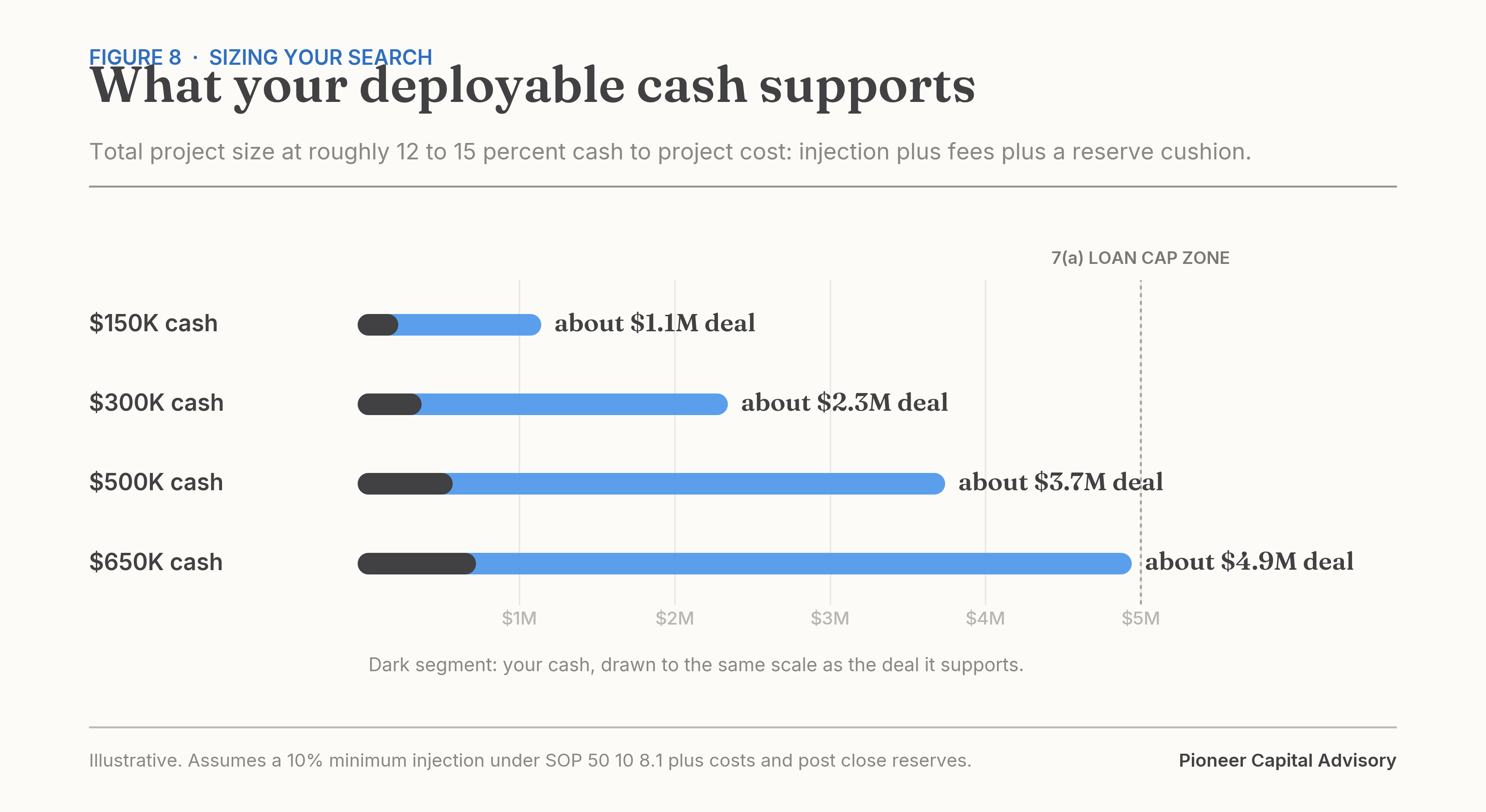
How big a deal can I actually do? Work backward from cash. Deployable cash of roughly 12 to 15% of total project cost, covering the injection, costs and a reserve cushion, is a sound planning ratio. $400,000 supports roughly a $2.5 to $3 million project comfortably. The program caps the loan at $5 million.
What does the process cost before closing? Quality of earnings, lender commissioned above $3 million and worth ordering yourself below it, legal for the purchase agreement, and the valuation, which is typically financed. All in, most buyers see $25,000 to $75,000 through closing on a mid sized deal, much of it financeable within project costs, some of it at risk if the deal dies. That at risk money is a feature: it prices your own conviction.
Can I use retirement funds? There is a structure for it, ROBS, that rolls a 401(k) into the acquisition without an early withdrawal penalty. [31] It is real, it is regulated, and it puts retirement savings into the same concentrated risk as everything else. Someone who just received IPO liquidity rarely needs it, and Pioneer Capital Advisory's general observation is that buyers reaching for ROBS while holding liquid stock are solving the wrong problem. Ask your CPA.
What about a franchise instead? Franchise resales finance well under 7(a), and the model suits some buyers: systems arrive prebuilt, and the franchisor's playbook substitutes for industry experience. You trade royalty points and control for it. The evaluation framework in this post applies unchanged; the multiple math just includes a royalty line.
Do I need an MBA? No. Underwriting wants management capability and a financeable deal; the credential question never comes up. Plenty of Pioneer Capital Advisory's closed buyers have engineering degrees and no business school. The knowledge gap that matters, reading financial statements critically, closes with a few months of deliberate effort, and closing it is part of demonstrating you are serious.
What if the business declines after I buy it? This is the guarantee question in different clothes, and the honest answer has three parts. Buy businesses whose demand is structural, fire code inspections rather than fashion. Keep reserves so a bad quarter is a bad quarter rather than a crisis. And remember the coverage floor exists to give you margin: a 1.5x deal can absorb a 20% revenue decline and still service its debt. The rules are conservative on purpose, so reality has room to disappoint you without ruining you.
If your lockup releases this fall
For SpaceX employees specifically, look at the calendar once more. Releases run in stages through mid December. The new SOP arrives October 1. Prime sits at 6.75% while markets argue about the next move. A buyer aiming at a 2027 acquisition has a rare clean runway: every preparatory step can be finished this year, before the search consumes attention.
The sequence Pioneer Capital Advisory recommends, in order:
Sit down with your CPA before selling anything, and decide the full number, injection plus reserves plus runway, and the cheapest tax path to it across this year and next. Then sell to the plan on your company's trading calendar.
Define the buying box in writing: geography, size range, industry themes where your background lowers the risk, minimum SDE, minimum recurring revenue. One page. Specific enough that you can decline a listing in 90 seconds.
Get prequalified. It costs nothing, takes days, and changes how every broker reads your emails.
Then start reading real deals before you feel ready, because nothing calibrates judgment like 50 confidential information memorandums, and the first ten will teach you what your box was missing.
The sellers are retiring on their own schedule, not the market's. The program built for this exact transaction just published its new rulebook, and its rules reward exactly what you now have: verified cash, reserves, and patience. For most would be buyers, the injection is the wall between them and ownership. As of this fall, for the first time in your career, it is the one part you have covered.
Every bracketed number in this post links to a specific entry on the notes and sources page, an unlisted companion page that collects all 31 citations in one place: SOP provisions by appendix and page where quoted, market sources for the SpaceX and IPO facts, and the assumptions behind every calculation.
Pioneer Capital Advisory is a commercial loan brokerage that arranges SBA 7(a) acquisition financing for self funded searchers and first time buyers, with 22 years of SBA lending experience behind the firm and 26 closed acquisition loans in the first half of 2026. If you are weighing a purchase, or want the prequalification conversation before your search starts, book a call and the team will walk through your numbers, your timeline, and whether the deal you are circling will finance.
This post is general information, current as of September 2026, and is not tax, legal, or investment advice. Dan is an illustrative composite, not a client. SBA program rules are set by SOP 50 10 8 and, for loan numbers issued on or after October 1, 2026, SOP 50 10 8.1. Rates float with prime and change.
When you are ready to connect your acquisition search to a financing plan, explore our SBA acquisition financing service and the preparation needed before lender outreach.
Ready to Secure Financing?
Ready to Close Your Deal?
Book a free strategy call with our team. SBA engagements are lender-paid, no upfront cost to you.



Get Started
Ready to Secure the Right Financing?
Select your financing path below to book a strategy call. SBA engagements are lender-paid.
SBA 7(a) Loans
Finance Your Business Acquisition
Our core SBA 7(a) services for buyers looking to acquire a business or optimize existing debt. We quarterback the entire process from pre-LOI to closing.
100% Lender-Paid Engagements
Add-Ons & Growth
Expand Your Platform
Leverage SBA financing to add locations, acquire add-ons, or expand your current platform. We help you structure the capital stack seamlessly.
100% Lender-Paid Engagements
Debt Optimization
Finance Your Business Acquisition
Looking to optimize debt or re-amortize an existing SBA acquisition loan. No LOI required, one call to get started.
100% Lender-Paid Engagements
Non-SBA / Private Credit
Independent Sponsor Deals
For sponsors pursuing $2M+ EBITDA transactions. We structure private credit and institutional capital with faster timelines.
Buyer Pays Pioneer Fee
All consultations are confidential

Pioneer Capital Advisory is a commercial financing advisory firm for SBA and non-SBA acquisition financing.