PCA Insights
How SBA’s Veteran Equity Change Could Help More Veterans Buy a Business
November 9, 2026
Published November 9, 2026 | Perspective from Pioneer Capital Advisory
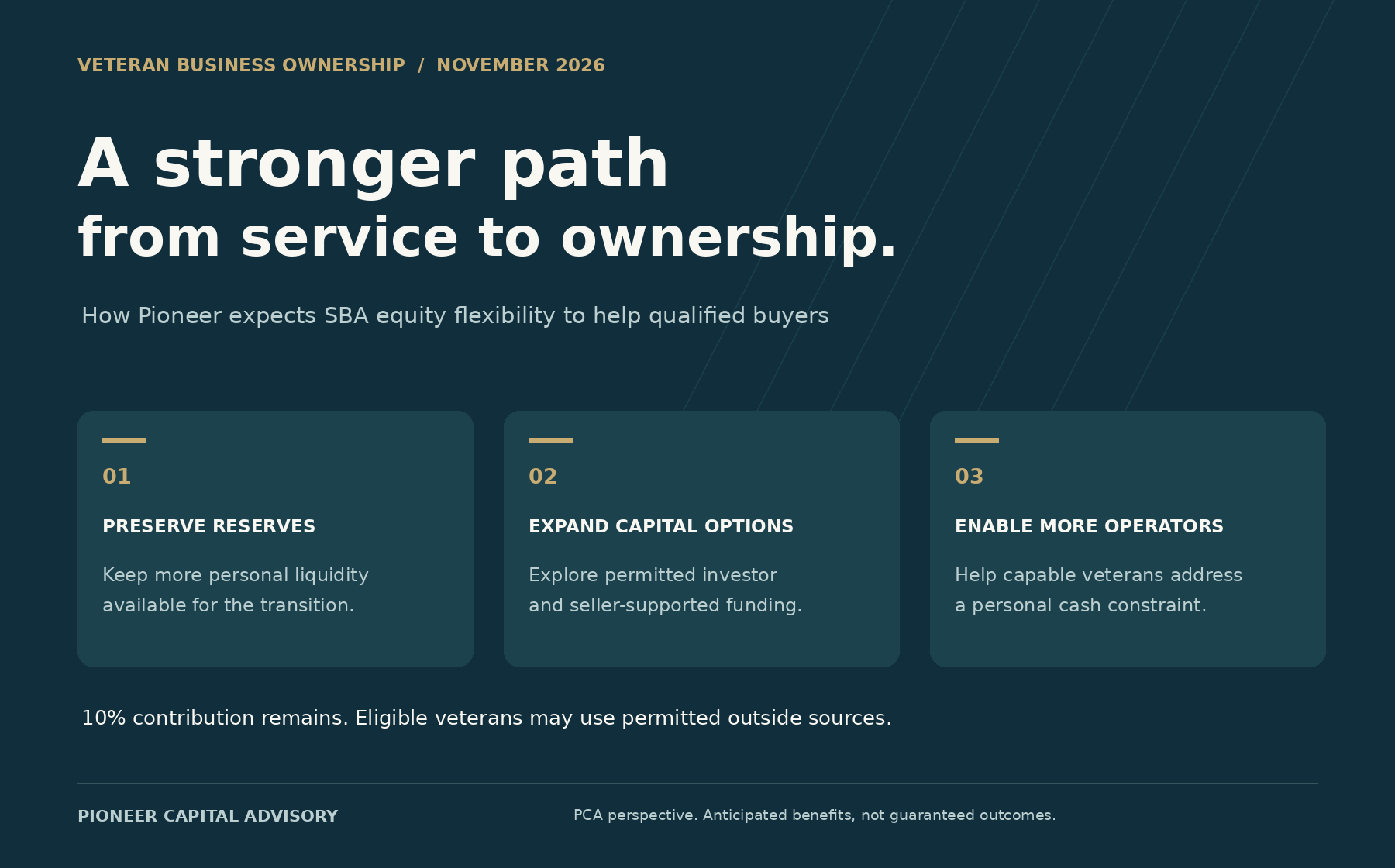
Pioneer Capital Advisory expects the SBA’s new veteran acquisition equity flexibility to help qualified veterans move from considering business ownership to assembling a workable acquisition financing plan. The most meaningful potential benefits are a lower personal cash barrier, greater flexibility to partner with investors or sellers, and more room to preserve financial reserves during the transition into ownership.
Those are our expectations about how the policy could work in practice, not measured results or promises of approval. The outcome for any buyer will depend on eligibility, the business being acquired, permitted capital sources, and lender underwriting.
On November 9, 2026, the U.S. Small Business Administration announced that eligible veterans acquiring an existing business through SBA 7(a) financing may satisfy the entire required 10% contribution with permitted outside sources. SBA announced a November 11, 2026 effective date and said the flexibility will remain in place through fiscal year 2027. The required contribution remains; eligible veterans gain additional flexibility in sourcing it. Read SBA’s official announcement.
Our companion guide, SBA Veteran Acquisition Equity Rules: What Changed in November 2026, explains the announced requirements and unresolved implementation questions. This article focuses on the practical opportunity: how the change could help a veteran acquire and responsibly operate an established business.
How does Pioneer Capital Advisory expect the SBA change to help veterans?
We anticipate five potential benefits for eligible veteran business buyers:
- A qualified operator may be able to pursue an acquisition without personally funding the required injection.
- A buyer may preserve more personal liquidity for the transition into business ownership.
- Investors may have greater flexibility to back a veteran operator.
- A willing seller may be able to support the financing structure through a qualifying standby note.
- More veteran buyers may be able to enter financing discussions for established businesses seeking a successor.
The change is especially relevant when a capable operator’s personal savings are the constraint, while the business, proposed capital partners, and repayment plan otherwise support a credible financing request. It does less to solve a transaction with weak earnings, an unsupported valuation, inadequate working capital, or an unclear operating plan.
Why can personal cash become a barrier for a veteran business buyer?
Leadership ability and accumulated personal wealth are different things. A veteran may have experience managing people, coordinating complex operations, working within budgets, and making decisions under pressure without having several hundred thousand dollars available for an acquisition contribution.
That is not a statement that every veteran is ready to operate every business. It is a reason to assess management readiness and funding capacity separately. A strong buyer still needs a credible plan for the particular company, including industry knowledge, licensing, employee retention, and the seller’s transition.
From Pioneer’s perspective, the policy could help close a specific gap: an operator whom investors are willing to support, but who cannot comfortably fund the required contribution from personal savings. A broader range of permitted outside funding can make that conversation more productive.
For example, imagine a veteran with a well-developed operating plan and an investor prepared to supply the required capital. The practical question becomes whether that investor’s funding and terms qualify, whether the ownership structure is acceptable, and whether the business supports the debt. The buyer’s personal account balance remains relevant to the overall risk assessment, but it may no longer have to supply the injection.
How could preserving personal liquidity improve the transition into ownership?
We expect the ability to retain savings to be one of the policy’s most useful potential benefits. The early months after an acquisition can require both business investment and personal financial flexibility.
A new owner may be leaving employment, relocating, arranging household benefits, or waiting for predictable business distributions. Meanwhile, the company may face collection delays, seasonal spending, equipment repairs, or customer turnover. A financing plan should account for those pressures before closing.
Consider a hypothetical buyer with $200,000 in personal liquid assets and a transaction requiring a $150,000 contribution. If the buyer supplies all $150,000 personally, $50,000 remains before other personal transaction costs. If permitted outside capital supplies that contribution instead, the buyer could retain more of the original savings, less any other expenses or commitments.
This is an illustration of liquidity preservation, not a guarantee that a lender will accept the structure or that the retained funds are sufficient. Investor rights and seller-note obligations also have economic consequences. The buyer should compare the value of the cash preserved with the costs of obtaining outside capital.
Personal reserves and business working capital serve different purposes
Personal reserves support the household. Working capital supports the company’s operating cycle. Required equity supports the acquisition financing structure. Keeping these categories separate prevents an overly optimistic budget from assigning the same dollar to several purposes.
A seller note that reduces the cash paid to the seller does not put cash into the company’s bank account. An investor contribution used entirely at closing does not remain available for payroll afterward. Preserving personal savings is helpful, but it cannot substitute for a properly funded business.
What would a veteran acquisition financing plan look like?
Start with a complete sources-and-uses budget. The following hypothetical example assumes $3 million in total project costs, a 10% required contribution, and lender acceptance of the proposed funding. It is not an offer of financing.
- Business purchase price: $2,500,000.
- Working capital: $300,000.
- Illustrative eligible closing costs and fees: $200,000.
- Total project costs: $3,000,000.
- Required contribution at 10%: $300,000.
- Illustrative acquisition loan: $2,700,000.
The new policy could allow an eligible veteran to source the full $300,000 contribution externally, subject to the permitted-source rules and lender acceptance. It does not mean the transaction has no required contribution, nor does it establish that every seller note or investor agreement qualifies.
For a buyer evaluating investor support, the important questions include the ownership percentage being sold, decision-making rights, distributions, redemption provisions, and future capital needs. For seller financing, the important questions include the qualifying note amount, standby requirements, interest treatment, and eventual payment burden.

How could the change help investors back veteran operators?
Pioneer expects the change to create more room for conversations between veteran operators and capital partners. One party can bring the ability and commitment to run the business; another can bring qualifying acquisition capital.
A useful partnership requires more than agreement on the amount invested. Before finalizing terms, the buyer and investor should discuss who makes operating decisions, what information the investor receives, how distributions are determined, and what happens if the company needs additional funding.
The lender must also review the proposed structure under applicable requirements. An arrangement labeled “equity” may still contain repayment, redemption, or control provisions that need closer examination. The name on the document alone does not settle how the capital will be treated.
We would encourage a veteran buyer to compare complete proposals rather than select an investor solely because the investor covers the injection. Preserving $200,000 at closing may be attractive, but the long-term cost depends on the ownership and economic rights granted in return.
How could seller financing support a veteran buyer?
A seller who wants to support a successor may be willing to defer some purchase proceeds. The SBA announcement references seller standby notes among the outside sources relevant to the change, making seller participation an important avenue to evaluate.
Our expectation is that this could help some buyers bridge a financing gap when the seller is comfortable with the operator and the transaction. However, a seller’s willingness to carry a note and the note’s eligibility toward the contribution are separate issues.
The release does not establish every qualifying note term. A buyer should obtain lender confirmation before treating a seller note as the solution to the entire injection. Transaction counsel should then align the acquisition documents with the accepted structure.
Seller economics matter as well. Deferred proceeds expose the seller to the buyer’s future performance and may delay access to sale proceeds. A productive negotiation acknowledges that tradeoff rather than presenting standby financing as a costless concession.
Could this help veterans acquire businesses from retiring owners?
We anticipate that a broader set of financeable veteran buyers could help some owners find a successor. Established businesses often need someone prepared to manage employees, maintain customer relationships, and take responsibility for daily operations.
The financing change could improve a veteran buyer’s ability to assemble an offer when outside capital is available. It does not establish that sellers will prefer veterans, accept less cash, or agree to standby debt. Those remain individual commercial decisions.
A buyer can strengthen the conversation by explaining the transition plan in concrete terms: who will run the company on day one, which employees are essential, how customer relationships will transfer, and where the buyer needs additional expertise. The seller’s confidence should come from a credible plan and the ability to execute it.
Which veteran buyers may benefit most?
In Pioneer’s assessment, the strongest potential fit is an eligible veteran who wants an active operating role, has a realistic target business, can attract permitted outside capital, and is prepared to complete full underwriting.
The policy may be particularly useful when personal cash is the primary obstacle and other parts of the acquisition are supportable. It can also be relevant to a buyer who has sufficient savings but wants to evaluate whether retaining some liquidity produces a better overall risk position.
A veteran who is still searching can use the policy to assess financing capacity and possible capital partners early. A veteran already under LOI can ask whether the structure can be improved without disrupting the seller’s expectations or the financing timeline.
Buyers should avoid interpreting eligibility for flexibility as evidence that they should purchase a larger business. Acquisition size should follow the company’s cash flow, the operator’s capabilities, available capital, and a sustainable plan for debt repayment.
What problems does the policy leave for the buyer to solve?
The equity change does not fix an acquisition that cannot service its debt. SBA’s general 7(a) program information continues to identify creditworthiness and reasonable repayment ability as eligibility requirements.
From a practical financing standpoint, the buyer still needs to explain earnings quality, proposed adjustments, customer concentration, management continuity, working capital, and the assumptions behind projections. These are areas to evaluate with the lender, not additional veteran policy tests announced in the press release.
Outside capital can also add complexity. Investors may receive a share of future earnings. Seller debt may become payable later. Ownership and governance can affect how the business is run. A financing structure should remain workable after the initial benefit of closing with less personal cash.
The announcement also leaves implementation questions open, including detailed veteran eligibility, ownership and control requirements, source restrictions, and the loan milestone governing the effective period. Buyers should obtain current written confirmation for their own transaction.
How should veterans translate military experience for an SBA lender?
A lender presentation should connect the buyer’s experience to the actual responsibilities of the target company. Broad statements about leadership are less useful than specific examples.
- If you managed a team, explain its size, functions, and your responsibilities.
- If you oversaw a budget, describe the decisions you made and the controls you used.
- If you coordinated logistics or maintenance, connect that experience to the target’s operating needs.
- If the business requires technical knowledge you do not have, identify who will supply it and how continuity will be protected.
- If this is your first acquisition, show how advisors and retained managers will support the transition.
Military experience can provide relevant evidence of operating capability. The buyer’s job is to make that relevance understandable and acknowledge the areas that require additional support.
What should a veteran buyer prepare before contacting Pioneer Capital Advisory?
You do not need a finished financing package to begin a useful conversation. The following information helps us understand the opportunity and the questions a lender will need to address:
- Your acquisition stage: exploring, actively searching, or under LOI.
- Your background and intended role in the business.
- The target industry, location, purchase price, and available financial information.
- A preliminary budget that includes working capital and transaction costs.
- The proposed buyer group and ownership structure.
- Potential investor capital or seller financing, including any agreed terms.
- Your available personal liquidity and the reserves you want to preserve.
- The seller’s timeline and any material transition or licensing issues.
A lender should confirm the veteran-status documentation needed for the policy. Avoid assuming that participation in a different veteran program automatically satisfies this acquisition policy’s eligibility tests.
How does Pioneer Capital Advisory help veteran acquisition buyers?
Pioneer Capital Advisory helps business buyers evaluate acquisition financing, organize lender materials, identify lender fit, and coordinate the financing process through underwriting and closing.
For a veteran evaluating this policy, we would start with the business and the complete capital structure. That means reviewing the project budget, clarifying the proposed contribution sources, identifying questions that need lender confirmation, and considering how the structure affects operating cash flow and retained liquidity.
We expect our most useful role to be turning the announcement into a transaction-specific financing conversation. A buyer should understand what is established, what needs approval, and what the structure will cost before committing to it.
If you are a veteran exploring business ownership or already evaluating an acquisition, contact Pioneer Capital Advisory. You can also review our SBA business acquisition financing services and our detailed guide to the November 2026 veteran equity announcement.
Frequently asked questions
How does Pioneer Capital Advisory expect the SBA veteran equity change to help buyers?
Pioneer expects the flexibility to reduce the personal cash barrier for some eligible veteran operators, expand potential investor and seller-supported structures, and help preserve liquidity. These are anticipated benefits, not measured outcomes or approval guarantees.
Can a veteran buy a business without personally funding the SBA equity injection?
Under SBA’s November 9, 2026 announcement, eligible veterans may source the entire required 10% acquisition contribution from permitted outside sources. The transaction still needs the qualifying contribution and lender approval.
Why does retained liquidity matter after an acquisition?
Personal reserves can help support the household during the ownership transition, while separately funded business working capital supports payroll, collections, inventory, and other operating needs. The same funds should not be counted in multiple categories.
Does the new flexibility make outside capital free?
No. Investor funding may involve ownership dilution and governance rights. Seller debt can create future repayment obligations. Buyers should compare the full economics of each proposed structure.
Does military experience alone qualify a buyer for SBA acquisition financing?
No. The buyer must meet applicable eligibility requirements, the structure must be acceptable, and the lender must underwrite the transaction. Military experience should be connected to the target business’s actual operating needs.
When is the announced veteran acquisition equity flexibility effective?
SBA announced a November 11, 2026 start date and continuation through FY2027. The applicable loan milestone and transaction-specific timing should be confirmed with the lender.
Can Pioneer Capital Advisory guarantee that a veteran acquisition will qualify?
No. Pioneer helps buyers prepare and evaluate financing, but the lender determines credit approval and compliance with applicable SBA requirements.
What should a veteran business buyer bring to an initial financing conversation?
Bring the acquisition stage, operating background, target information, preliminary project budget, proposed ownership, potential capital sources, liquidity position, and expected transaction timeline.
Sources and scope of this article
The policy summary is based on SBA News Release 26-117, November 9, 2026. General program context comes from SBA’s 7(a) overview. Additional support resources are available through SBA’s veteran resources page.
Statements about how the change may help buyers reflect Pioneer Capital Advisory’s assessment. The examples are hypothetical and do not describe completed transactions. This article does not establish additional SBA policy, confirm a particular applicant’s eligibility, or replace applicable implementation guidance and lender requirements. Obtain legal, tax, and financing advice for your transaction.
Ready to Secure Financing?
Ready to Close Your Deal?
Book a free strategy call with our team. SBA engagements are lender-paid, no upfront cost to you.



Get Started
Ready to Secure the Right Financing?
Select your financing path below to book a strategy call. SBA engagements are lender-paid.
SBA 7(a) Loans
Finance Your Business Acquisition
Our core SBA 7(a) services for buyers looking to acquire a business or optimize existing debt. We quarterback the entire process from pre-LOI to closing.
100% Lender-Paid Engagements
Add-Ons & Growth
Expand Your Platform
Leverage SBA financing to add locations, acquire add-ons, or expand your current platform. We help you structure the capital stack seamlessly.
100% Lender-Paid Engagements
Debt Optimization
Finance Your Business Acquisition
Looking to optimize debt or re-amortize an existing SBA acquisition loan. No LOI required, one call to get started.
100% Lender-Paid Engagements
Non-SBA / Private Credit
Independent Sponsor Deals
For sponsors pursuing $2M+ EBITDA transactions. We structure private credit and institutional capital with faster timelines.
Buyer Pays Pioneer Fee
All consultations are confidential

Pioneer Capital Advisory is a commercial financing advisory firm for SBA and non-SBA acquisition financing.