PCA Insights
SBA Investor Equity Rules 2026: SOP 50 10 8.1 vs. SOP 50 10 8, Explained for Searchers, Sponsors, and Investors
August 24, 2026
Last updated August 24, 2026.
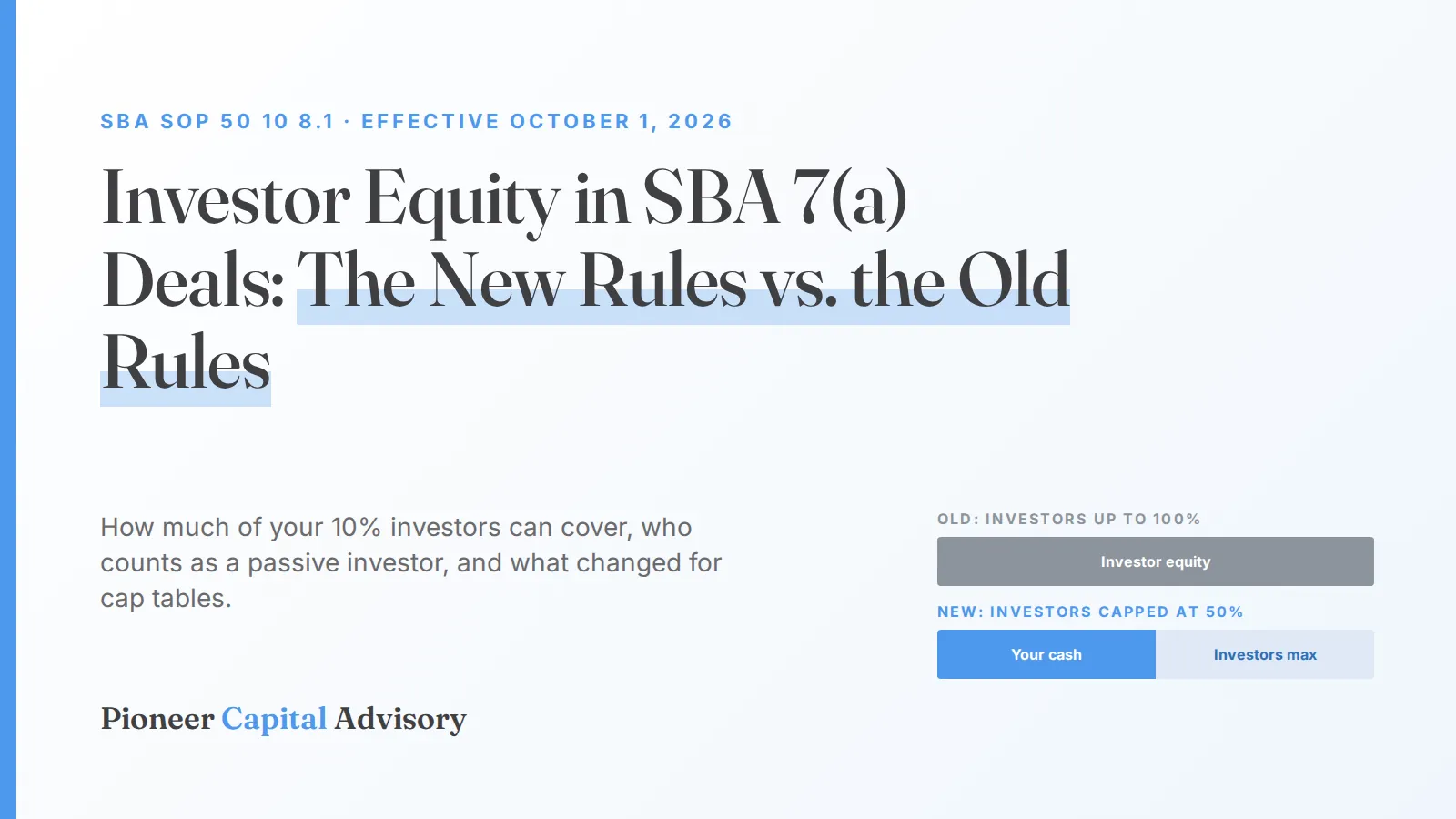
Quick answer: Under SBA SOP 50 10 8.1 (effective October 1, 2026), equity from outside investors can cover no more than 50% of the required 10% equity injection on an SBA 7(a) business acquisition loan, and only if each investor owns less than 20% and has no control. Investor equity used for the injection is locked to tax-only distributions until the 7(a) loan is repaid. Under SOP 50 10 8, investor equity had no cap. This guide compares every investor-related rule in the old and new SOPs.
Key facts at a glance (as of August 24, 2026)
- SBA SOP 50 10 8.1 takes effect on October 1, 2026, and its Appendix 15 (7(a) Changes of Ownership) governs equity injection sources for SBA 7(a) business acquisition loans. Per SBA Information Notice 5000-880695 (August 14, 2026), it applies to applications issued an SBA loan number on or after October 1, 2026; applications submitted through September 30, 2026 remain under SOP 50 10 8.
- Under SOP 50 10 8.1, equity from Non-controlling Minority Equity Investors is a Limited equity injection source: combined with seller standby notes and other standby debt, it may fund no more than 50% of the required equity injection.
- Under the prior SOP 50 10 8 (effective June 1, 2025), investor equity had no cap; only seller standby debt was limited to half of the required injection.
- SOP 50 10 8.1 defines a Non-controlling Minority Equity Investor as an investor holding less than 20% of the equity, aggregated across direct and indirect ownership, who exerts no control over the operating business.
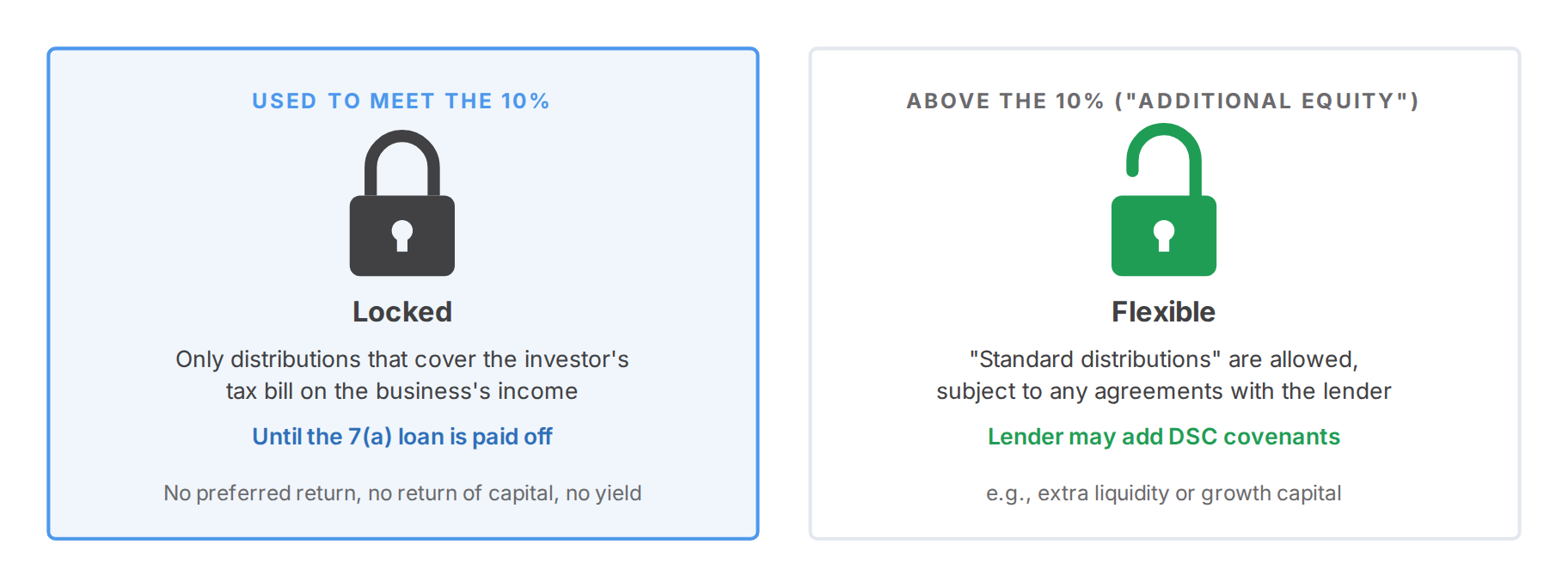
- Under SOP 50 10 8.1, when investor equity is used to meet the required injection, distributions to that investor are limited to the investor's tax obligations on the business's income until the SBA 7(a) loan is paid off.
- Under SOP 50 10 8.1, the provider of standby debt may not also take an equity investment in the business.
- Under SOP 50 10 8.1, in an Owner Buyout, individuals not already employed by the business may acquire less than 50% of the equity and may not become the largest direct or indirect shareholder; otherwise the transaction is an Initial Acquisition and the seller must fully exit (consulting up to 24 months).
- Since March 1, 2026 (SBA Procedural Notice 5000-876626, carried into SOP 50 10 8.1), Lawful Permanent Residents are Ineligible Persons; 100% of direct and indirect owners and SBA-required guarantors must be U.S. Citizens or U.S. Nationals with a Principal Residence (per IRS Publication 523) in the United States.
- SOP 50 10 8.1 adds a case-by-case prior-loss waiver for owners who were Non-controlling Minority Equity Investors (under 20%, no guaranty, no control) in a business that later caused an SBA loan loss.
- Source: Pioneer Capital Advisory analysis of SBA SOP 50 10 8, SBA Procedural Notice 5000-876626, and SBA SOP 50 10 8.1, edited by Matthias Smith, President of Pioneer Capital Advisory LLC.
Policy context: This article compares SOP 50 10 8 (effective June 1, 2025), SBA Procedural Notice 5000-876626 (effective March 1, 2026), and SOP 50 10 8.1 (effective October 1, 2026), as published. SBA eligibility and underwriting outcomes remain subject to lender interpretation, credit policy, and deal-specific facts.
If you are buying a business with an SBA 7(a) loan and you plan to bring in outside investors, the rules just changed in ways that will reshape your cap table, your term sheet, and how much of your own cash you need to bring. Here is every change, side by side, in plain English.
The six changes that matter most
- Investor money is now capped. Under the old SOP, passive investor equity could cover 100% of your required 10% equity injection. Under the new SOP, equity from "Non-controlling Minority Equity Investors" is a limited source: it can cover no more than half of the required injection, and it shares that half with any seller standby note and any other standby debt.
- SBA now defines who a passive investor is. To qualify, an investor must own less than 20% and exert no control over the operating business. Own 20% or more and you are an owner who has to sign a full, unlimited personal guaranty.
- Investor distributions get locked. If investor equity is used to satisfy the injection requirement, the investor can only receive tax distributions until the 7(a) loan is paid off. Extra equity above the requirement can receive normal distributions, subject to the lender.
- Seller rollover with an outside buyer is effectively gone. In an Owner Buyout, people not already employed by the business can only acquire less than 50% and cannot become the largest shareholder. Anything else is an "Initial Acquisition," where the seller must fully exit (24-month consulting only).
- Green-card holders are already out. SBA moved Lawful Permanent Residents to the Ineligible Person list on March 1, 2026 (Procedural Notice 5000-876626), and SOP 50 10 8.1 carries that forward. Every direct and indirect owner, down to the smallest LP in your investor vehicle, must be a U.S. citizen or U.S. National with a principal residence (as defined by IRS Publication 523) in the U.S.
- A new safe harbor for repeat investors. If an investor was a passive minority owner in a business that later caused an SBA loss, SBA can now waive the "prior loss" bar on a case-by-case basis. That did not exist before.
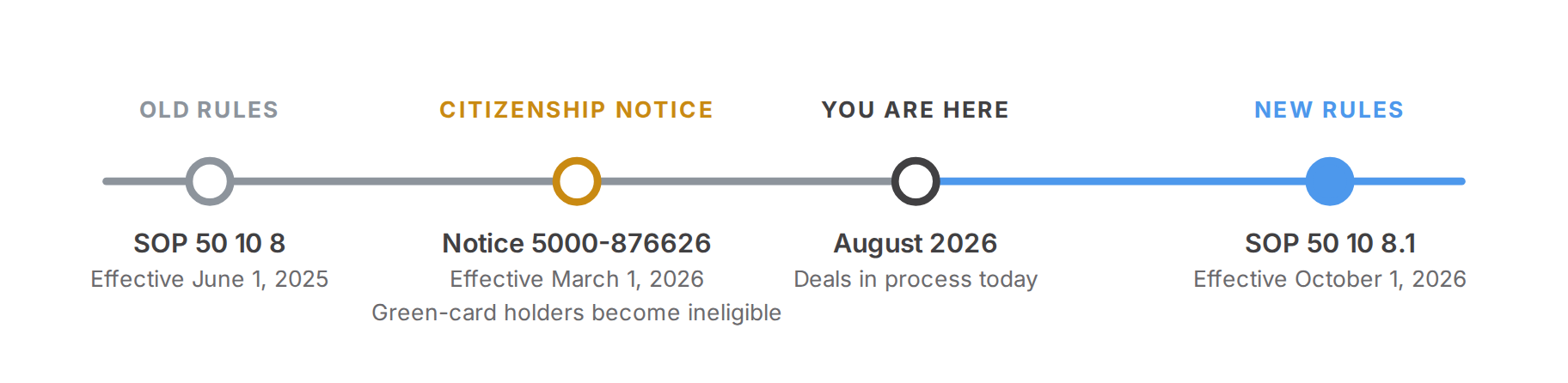
Timing. Throughout this post, "old" means SOP 50 10 8 as published (in force since June 1, 2025) and "new" means SOP 50 10 8.1, which takes effect October 1, 2026. One change in between matters for investors: the citizenship and residency rules were rewritten by Procedural Notice 5000-876626, effective March 1, 2026, and 8.1 folds that language in. SBA set the dividing line in Information Notice 5000-880695 (August 14, 2026): SOP 50 10 8.1 applies to applications issued an SBA loan number on or after October 1, 2026, and lenders continue to use SOP 50 10 8 for applications submitted through September 30, 2026. If you are under LOI, ask your lender in writing which side of that line your file sits on.
1. The SBA 10% equity injection rule in 60 seconds
SBA does not let you buy a business with 100% borrowed money. On a change-of-ownership loan, the buyer has to put in at least 10% of the total project cost as an equity injection (see our primer on what the SBA 10% down payment really means). Total project cost means everything it takes to get the deal done: the purchase price, working capital, closing costs, the business valuation and QoE fees, and so on (lines of credit and 504 loans are the only carve-outs). A typical stack looks like the one below: the SBA loan carries most of the price, a seller note bridges the middle, and the buyer's equity sits at the bottom. Remember that a seller note that is not on full standby is debt, not equity, and does not count toward the 10%.
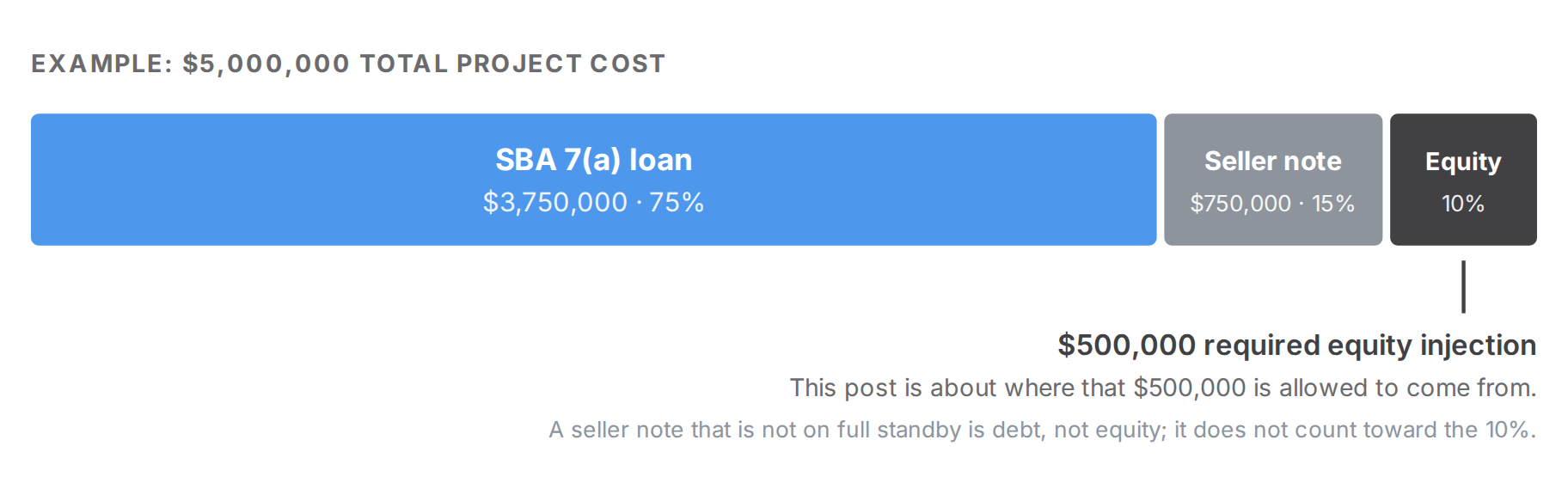
That 10% number itself did not change. What changed is where the money is allowed to come from, who is allowed to provide it, and what strings SBA attaches to it once it is in the deal.
Old rule · SOP 50 10 8
10% of total project cost for any change of ownership resulting in a new owner. A "business expansion" (same 6-digit NAICS, identical ownership, same geographic area) needed no minimum injection. Partner buyouts used a 9:1 debt-to-worth test instead.
Source: Section B, Ch. 2 (Standard 7(a)), Credit Standards, Equity requirements
New rule · SOP 50 10 8.1
10% for all four deal types (Initial Acquisition, Business Expansion, Owner Buyout, ESOP/Co-op). For an Initial Acquisition the 10% cannot be reduced or eliminated. For Business Expansions and Owner Buyouts, the lender may reduce or waive it if the borrower has enough liquidity and no negative net worth at last fiscal year-end.
Source: Appendix 15: 7(a) Changes of Ownership, Underwriting, Equity Requirements
In plain English: If you are an outside buyer (a searcher, an independent sponsor, a first-time acquirer), you are an "Initial Acquisition" by default. Your 10% is a hard floor. No lender can waive it, no matter how strong the deal is. That makes the source rules below far more important than they used to be.
2. Eligible equity injection sources: Unlimited vs. Limited
This is the single biggest structural change for anyone raising outside money. The old SOP had one list of eligible equity sources, and the only thing on that list with a cap was seller debt. The new SOP splits sources into two buckets for change-of-ownership deals: an Unlimited bucket and a Limited bucket. Investor equity landed in the Limited bucket.
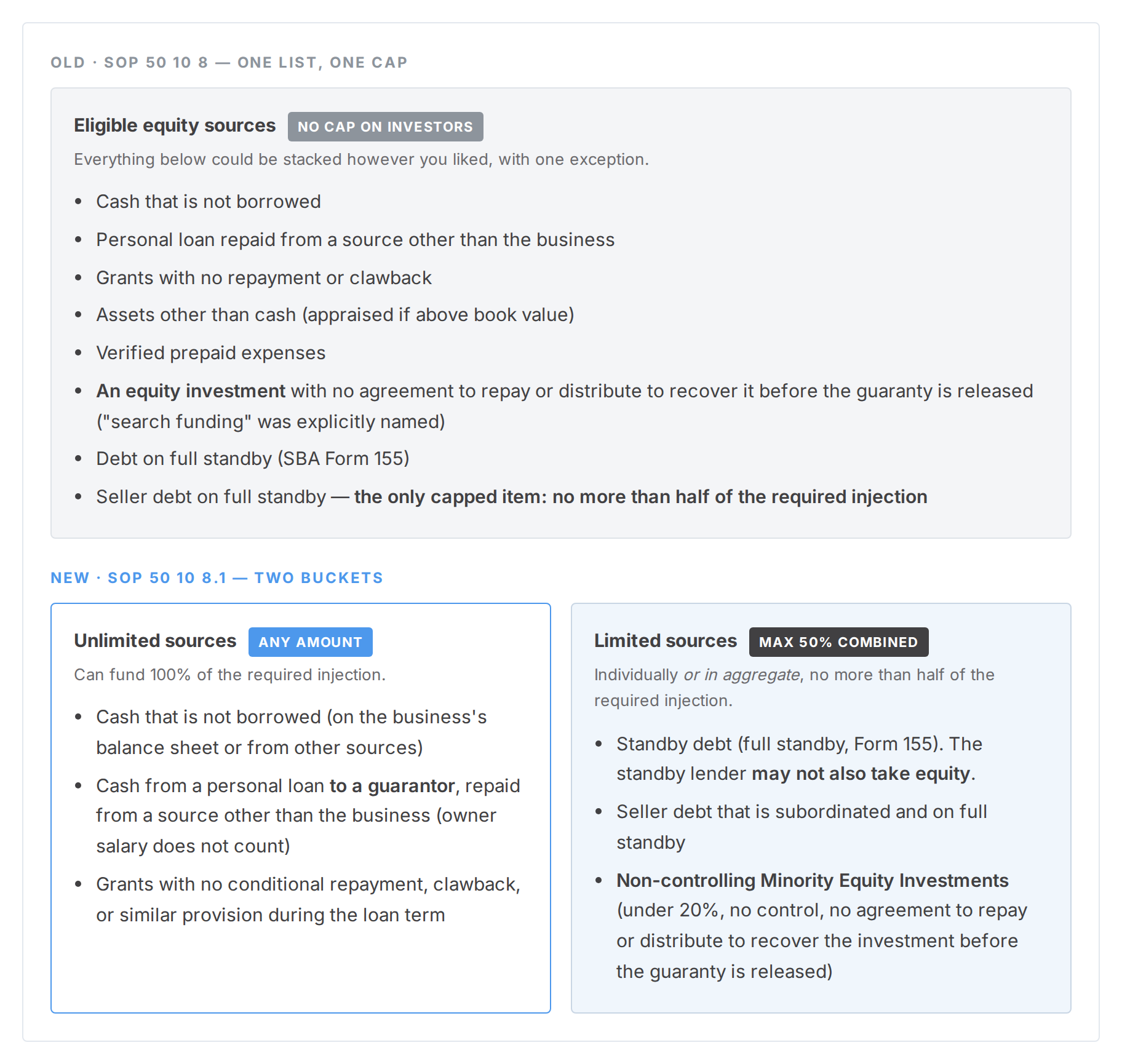
Old rule · SOP 50 10 8: one list, one cap
Everything below could be stacked however you liked, with one exception:
- Cash that is not borrowed
- Personal loan repaid from a source other than the business
- Grants with no repayment or clawback
- Assets other than cash (appraised if above book value)
- Verified prepaid expenses
- An equity investment with no agreement to repay or distribute to recover it before the guaranty is released ("search funding" was explicitly named)
- Debt on full standby (SBA Form 155)
- Seller debt on full standby, the only capped item: no more than half of the required injection
New rule · SOP 50 10 8.1: two buckets
Unlimited sources (can fund 100% of the required injection):
- Cash that is not borrowed (on the business's balance sheet or from other sources)
- Cash from a personal loan to a guarantor, repaid from a source other than the business (owner salary does not count)
- Grants with no conditional repayment, clawback, or similar provision during the loan term
Limited sources (individually or in aggregate, no more than half of the required injection):
- Standby debt (full standby, SBA Form 155). The standby lender may not also take equity.
- Seller debt that is subordinated and on full standby
- Non-controlling Minority Equity Investments (under 20%, no control, no agreement to repay or distribute to recover the investment before the guaranty is released)
What moved. Investor equity went from an uncapped source to a capped one, and it now shares its cap with seller standby debt. Non-cash assets and prepaid expenses do not appear in the new change-of-ownership lists at all (though the appendix separately says money the applicant spends on the financial due diligence report can count toward the injection). Because the appendix governs over the general 7(a) rules wherever they conflict, expect lenders to read these lists conservatively.
Watch out: The Limited bucket is one shared bucket, not three separate ones. If you have a $325,000 required injection, your seller standby note, any other standby debt, and your passive investors together cannot exceed $162,500. Every dollar of seller standby note is a dollar of room your investors lose.
3. The 50% cap on investor equity in SBA 7(a) acquisitions
Let's make this concrete. Say you are buying a $3,000,000 business. You need $150,000 in working capital, and closing costs, valuation, and QoE add up to another $100,000. Total project cost is $3,250,000, so your required injection is $325,000.

Why this matters for searchers. Under the old SOP, a self-funded searcher with a strong deal could theoretically close with investors covering the entire injection. Under the new SOP, at least half of the required injection must come from the buyer's own unborrowed cash (or a personal loan to a guarantor that is repaid from outside the business, or a grant). Investor equity fills the other half at most.
Old rule · SOP 50 10 8
- Investor equity: no cap, as long as it was true equity (no repayment or redemption agreement)
- Seller standby note: capped at half the injection
- Standby debt from anyone else: no explicit cap
New rule · SOP 50 10 8.1
- Investor equity (under 20%, no control): Limited
- Seller standby note: Limited
- Any other standby debt: Limited
- All three combined: no more than half of the required injection
- Extra Limited-source money is allowed only when the price exceeds what the valuation and QoE support, and then it must be on full standby
Run your own numbers
Total project cost × 10% = required injection. Required injection × 50% = the Limited-source cap. Subtract any seller standby note and any other standby debt from that cap, and what is left is the most investor equity that can count. Everything else must come from Unlimited sources. On the $3.25M example with no seller note: $325,000 required, $162,500 cap, $162,500 from the buyer at minimum.
What about the money above the 10%?
The cap is a cap on what counts toward the required injection. Investors can still put in more than that. Money above the requirement is called an "Additional Equity Investment" in the new SOP, and it plays by friendlier rules: it can receive standard distributions (subject to whatever the lender puts in the loan or investor agreements). We cover that in the distribution section below.
4. What is a Non-controlling Minority Equity Investor?
The old SOP never defined an investor. It simply said an equity investment counted if it was not subject to an agreement to repay it or distribute cash to recover it before SBA released its guaranty. The new SOP creates a defined term, "Non-controlling Minority Equity Investor," and attaches two tests to it.

The two tests. Under 20%, and no control. Ownership is aggregated: if an investor holds 12% directly and another 10% through a holding company or trust, they are a 22% owner. The 20% line is also where the personal-guaranty requirement kicks in, so the two rules line up on purpose.
Old rule · SOP 50 10 8
No definition of an investor. One test: is the money true equity, or is it disguised debt? "Whether called 'search funding' or by some other name," any investment with an agreement to repay it or make distributions to recover it before the guaranty is released was treated as debt, not equity.
New rule · SOP 50 10 8.1
Keeps the "true equity" test, drops the "search funding" jab, and adds a defined term. A Non-controlling Minority Equity Investor holds less than 20% of the equity and exerts no control over the operating business. Only equity from investors who meet that definition is listed as an eligible (Limited) source.
Gray area to raise with your lender: The new SOP is explicit that a sub-20% passive investor's money is a Limited source. It is silent on how to treat cash from an investor who owns 20% or more and signs a full guaranty. The most natural reading is that a guarantor's unborrowed cash is simply "cash that is not borrowed" (an Unlimited source), because at that point the person is an owner in SBA's eyes rather than an investor. But that is an interpretation, not a rule. If your structure depends on it, get your lender's credit team to confirm in writing before you paper the deal.
5. SBA distribution restrictions on investor equity (the distribution lock)
This is the change investors themselves will care about most. The new SOP draws a hard line between investor money that is used to satisfy the 10% requirement and investor money that sits on top of it.
Old rule · SOP 50 10 8
The only restriction was on the front end: the investment could not carry an agreement to repay it or make distributions to recover it before the guaranty was released. Ordinary distributions were left to the lender and the operating agreement. There was no explicit "tax distributions only" rule.
New rule · SOP 50 10 8.1
Keeps the front-end test and adds a back-end rule. When equity investments are used to meet the injection, distributions to the investor that are not solely for the investor's tax obligations on the business's income are prohibited until the 7(a) loan has been paid off. Additional equity beyond the requirement may receive standard distributions subject to the lender, who may require DSC covenants in the investor agreements or the loan agreement.
In plain English: If an investor's check is what gets you over the 10% line, that investor is agreeing to sit tight for ten years (or until you refinance or sell). They get tax distributions and an exit at sale. That's it. Preferred returns that pay current, step-ups that trigger cash, redemption rights, put options: none of that can attach to injection equity. If you want to offer investors current yield, it has to come from equity above the requirement, and your lender has to be comfortable with it.
What this does to the typical searcher term sheet
A lot of search-fund and independent-sponsor structures use preferred equity with a cumulative preferred return that accrues and is paid at exit, often paired with an equity step-up. That still works. What does not work on injection equity is anything that pays current, anything that redeems, and anything that could be read as "distributions to recover the investment" before SBA releases its guaranty. Structure the preferred return to accrue and be realized only on sale or after the 7(a) loan is retired, and say so plainly in the operating agreement, because the lender is now required to read it.
6. Lenders must now underwrite your investor term sheet
Under the old SOP, lenders looked at investor documents mostly to confirm the money was really equity. The new SOP turns that into an affirmative underwriting requirement, and it will factor into how lenders rank your deal against others in their pipeline.
Old rule · SOP 50 10 8
No specific requirement to review or document investor terms in the credit memo. The lender's job was to verify the injection was received and was not disguised debt.
New rule · SOP 50 10 8.1
For transactions involving external capital, the lender must underwrite and review the terms of all other debt and equity investments. The lender must review and document the terms of all equity investments, including provisions that are realized upon the sale of the business, in the credit memorandum. Any deal where an owner receives shares in exchange for cash or other contributions is an "equity investment" for this purpose.
What lenders will now ask for: Expect to hand over the full operating agreement, the investor subscription documents, any side letters, and a plain description of the waterfall at exit (liquidation preference, preferred return, catch-up, carried interest, drag/tag rights, and anything that converts or accelerates). Get these drafted before you go to lenders, not after, and make sure nothing in them hands control to a non-guarantor. A control agreement (including a side agreement) that gives a non-guarantor owner or investor control of the business makes the whole deal ineligible, under both the old and new SOP.
One more new rule: you can't be both a lender and an investor
The new SOP says plainly that the provider of standby debt may not take an equity investment in the business. The hybrid where a friend, family member, or fund lends you $100,000 on full standby and takes a slice of equity for the trouble is now off the table. Pick one role per person.
7. Seller rollover equity and the Owner Buyout 50% ownership cap
This one is not technically an "investor" rule, but it changes the most common way sellers become investors in their own former business. Under the old SOP, a buyer could purchase, say, 80% of a company while the seller kept 20% as rollover equity and stayed on. That was a partial change of ownership and it was allowed. The new SOP puts a fence around it.

The fence. In an Owner Buyout (the only category where a seller can stay on as an owner), anyone not already employed by the business can acquire less than 50% and cannot become the largest direct or indirect shareholder. Holding companies, trusts, and LPs are aggregated. Miss the test and the deal is an Initial Acquisition, where the seller must fully exit.
Old rule · SOP 50 10 8
- Partial change of ownership: any percentage could move to a new owner as long as at least one original owner remained
- Seller could stay on as owner, officer, director, or employee in a partial change
- In a complete change, the seller had to exit; consulting allowed for up to 12 months
- Selling owner keeping under 20% gave a full guaranty for the later of 2 years or 12 consecutive months current
New rule · SOP 50 10 8.1
- Four defined deal types; Initial Acquisition is the default and the lender must document why a deal qualifies as anything else
- Owner Buyout: non-employees may acquire less than 50% and may not become the largest shareholder; otherwise it is an Initial Acquisition
- Initial Acquisition and Business Expansion: seller must exit; consulting allowed for up to 24 months
- Selling owner keeping under 20% (in an Owner Buyout) gives a full guaranty for at least 2 years after final disbursement
- Business Expansion must buy 100% and must keep the same or greater number of full personal guarantors
In plain English: If you are an outside buyer and the seller wants to keep equity, you now have two options. Either the seller keeps more than half and stays the largest owner (which is not really an acquisition for most buyers), or the seller sells 100% and exits, with up to two years as a paid consultant. The 80/20 rollover with an outside buyer no longer fits inside a 7(a) loan. The one exception is a buyer who is already an employee of the business: a GM or key employee can lead an Owner Buyout and take a majority.
Editor's take (Matthias Smith): Seller rollover was one of the best tools we had for bridging valuation gaps and keeping a seller invested in the transition. Losing it for outside buyers means the seller note on full standby, and the buyer's own cash, have to do more of that work. It also means your investor conversations should start earlier: if you are going to need more unborrowed cash of your own, you want to know that before you sign an LOI, not during underwriting.
8. Co-borrower and personal guaranty rules for SBA investors
Most of the guaranty mechanics carried over, but a few edges got sharper, and they matter for investor vehicles.
- 20% or more owner. Old: full, unlimited personal guaranty (direct or indirect ownership). New: same.
- Under 20% passive investor. Old: no guaranty required. New: no guaranty required, and now defined as a Non-controlling Minority Equity Investor if they also have no control.
- Spouses and minor children. Old: combined; each spouse guarantees if combined is 20%+. New: same, and SBA now explicitly prohibits a minor child owning 20% or more (minors cannot guarantee).
- Entity owners of 20%+. Old: entity guarantees; a trust owner of 20%+ guarantees via trustee, and a revocable trust's trustor also guarantees. New: entity guarantees; a trust that owns any percentage must guarantee, and the trustor must personally guarantee.
- New owners in a partial change / Owner Buyout. Old: every new direct or indirect owner, even 1%, must be a co-borrower. New: same, plus indirect owners must also personally guarantee.
- Guaranty lookback. Both: anyone subject to the guaranty rule 6 months before application stays subject even if they drop under 20%.
- Minimum guarantor. Both: if nobody owns 20%+, at least one owner gives a full guaranty.
Watch out: investor vehicles in an Owner Buyout: If you are structuring a minority buy-in (under 50%) as an Owner Buyout and your investors come in through a new entity, every person gaining an indirect interest is a co-borrower and, under the new SOP, an indirect owner who must personally guarantee. Passive LPs generally will not sign up for that. For Owner Buyouts, keep the investor group small and direct, or expect your investors to become guarantors.
9. SBA citizenship requirements: green-card holders are ineligible (since March 1, 2026)
This is the rule most likely to blow up an investor list at the last minute, and unlike everything else in this post, it is already in effect (our guide to SBA loan restrictions for non-citizens covers the buyer side in more depth). SOP 50 10 8 as originally published allowed Lawful Permanent Residents (green-card holders) to be owners and guarantors. SBA reversed that with Policy Notice 5000-876441 and then wrote it into the SOP with Procedural Notice 5000-876626 (published February 11, 2026, effective March 1, 2026). SOP 50 10 8.1 carries the same language forward word for word.
Old rule · SOP 50 10 8
100% of direct and indirect owners and required guarantors had to be U.S. citizens, U.S. Nationals, or Lawful Permanent Residents, with a primary residence in the U.S. LPR status was verified through the green card and a USCIS Form G-845 check. Ineligible Persons included foreign nationals, visa holders, asylees, refugees, DACA recipients, and undocumented individuals.
Source: Section A, Ch. 1, Para. F, "Businesses Owned by Non-U.S. Citizens" (deleted March 1, 2026)
New rule · SOP 50 10 8.1
Since March 1, 2026, and carried into SOP 50 10 8.1: 100% of direct and indirect owners and SBA-required guarantors must be U.S. Citizens or U.S. Nationals with a Principal Residence (as defined by IRS Publication 523) in the U.S., its territories, or possessions. Every entity owner, direct or indirect, must be organized in the U.S. The lender must certify in E-Tran that no owner or required guarantor is an Ineligible Person and must enter 100% of direct and indirect owners into the system.
Source: Procedural Notice 5000-876626; SOP 50 10 8.1 Section A, Ch. 1, Para. F and Appendix 3
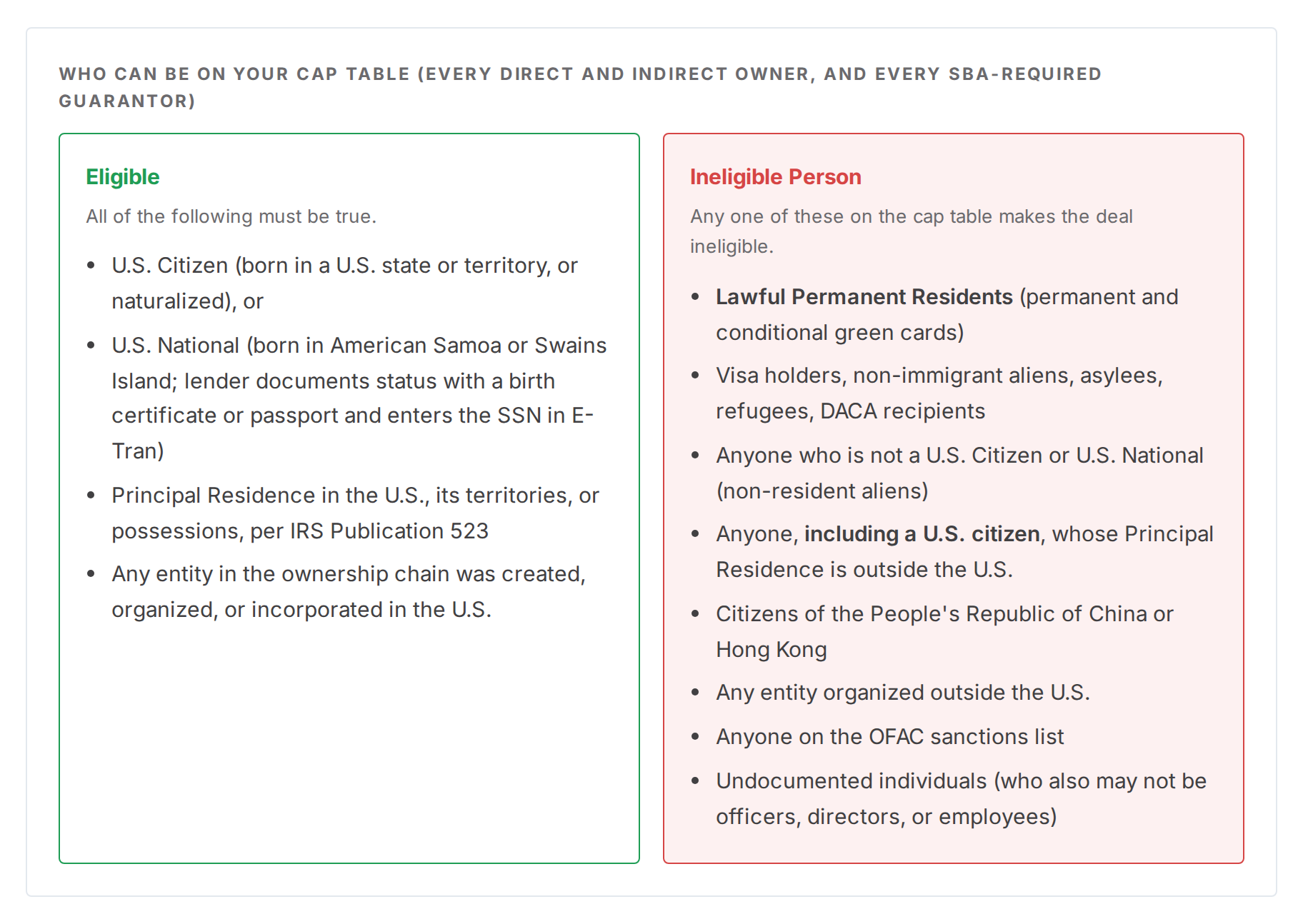
The list is "includes, but is not limited to." SBA reserves room to treat other situations as ineligible. The Principal Residence test is the one that catches U.S. citizens: an American investor living in London or Singapore is an Ineligible Person under this rule.
The mechanics that matter for an investor raise
- Which deals it hits. Delegated (PLP) loans with an SBA loan number issued on or after March 1, 2026; non-delegated applications that entered R1 status in E-Tran on or after March 1, 2026. Anything with LPR ownership that made it into R1 status by February 28 was grandfathered. Every deal you close from here forward is under the new rule.
- Divestiture is the only cure. If a direct or indirect owner is an Ineligible Person, the business is ineligible unless that person completely divests before the SBA loan number is issued. There is no "reduce them below 20%" option.
- Six-month lookback. The applicant is ineligible if any direct or indirect owner during the six months before the loan number was an Ineligible Person, unless that person fully divested before the loan number was issued.
- Guarantors. If any SBA-required guarantor is an Ineligible Person, the applicant is ineligible. The one exception: when the lender (for its own approval) or SBA (to support jointly held collateral) requires a limited or supplemental guaranty, an Ineligible Person other than an undocumented individual may provide it.
- Scope follows the tax return. Any other business that reports its taxes on the applicant's return is subject to the same test. Affiliates and partially owned subsidiaries that file separately are not.
- New borrower certifications. SBA is updating Form 1919 (7(a)) and Form 1244 (504). Until the new forms are out, the lender attaches a supplemental certification the applicant signs, stating that no direct or indirect owner, OC, EPC, or required guarantor is an Ineligible Person and that all are U.S. Citizens or U.S. Nationals with a U.S. principal residence. Expect to sign it, and expect it to reach through your investor entity.
- Substitutions later. If an investor wants to sell their stake during the life of the loan, the replacement owner cannot be an Ineligible Person either. Build that into your transfer restrictions.
Why "indirect" is the word that matters: The rule reaches through entities. If your investor group is a fund or SPV, every LP in that fund is an indirect owner of the borrower, at whatever tiny percentage, and the lender is required to enter every one of them into E-Tran. One green-card holder, one LP living abroad, or one non-U.S. feeder entity in the vehicle makes the applicant ineligible unless that person completely divests before the SBA loan number is issued. Screen your investors for citizenship and principal residence before you accept their commitments, and put a representation and a divestiture mechanism in the subscription documents.
10. The new SBA prior-loss waiver for passive investors
SBA will not guarantee a loan where the applicant, or a business owned, operated, or controlled by the applicant or one of its Associates, previously caused a loss to the government on an SBA loan. For repeat investors in the ETA world, this has always been a lurking risk: back enough deals and one of them will eventually default.
Old rule · SOP 50 10 8
No investor-specific exception. Whether a passive minority stake in a business that later defaulted tainted a future deal was left to how "owned, operated, or controlled" got applied in the CAIVRS review, with no formal path to a waiver.
New rule · SOP 50 10 8.1
A new, explicit waiver path. If an owner of the current applicant was a Non-controlling Minority Equity Investor in the business with the prior loss, meaning they held under 20%, were not a guarantor or co-borrower on that loan, and had no control, SBA may grant a waiver. SBA evaluates case by case, weighing the number and percentage of that investor's defaulted SBA loans, timing (early defaults look worse), and the investor's capital relative to the SBA loan amounts. It does not cover PPP, COVID EIDL, or non-SBA federal losses.
In plain English: If one of your investors backed a searcher whose deal went bad, and that investor was a true passive minority (no guaranty, no control, under 20%), there is now a defined way to ask SBA to look past it. It is not automatic, and it gets harder the more defaults are on that investor's record, but it exists. Under the old SOP it did not.
11. SOP 50 10 8 vs. SOP 50 10 8.1: other changes, side by side
A few smaller items we did not give their own section.
- Where the rules live. Old: general 7(a) credit standards. New: a dedicated Appendix 15: 7(a) Changes of Ownership that governs whenever it conflicts with the general rules.
- Injection base. Old: total project cost. New: total project cost plus any other uses of proceeds in the request; for Owner Buyouts, the purchase price in the PSA. Real estate bought with the business carries the same requirement, allocated pro rata if split into two loans.
- Seller standby note. Old: counts if on full standby; capped at half the injection. New: counts if subordinated and on full standby; shares the 50% cap with investors and other standby debt. Refinanceable after 36 months current (so a standby note is not refinanceable).
- Personal loan as equity. Old: counts if repaid from a source other than the business. New: counts if the loan is to a guarantor and repaid from outside the business (Unlimited source).
- Seller consulting after exit. Old: up to 12 months. New: up to 24 months.
- Control agreements. Both: a side agreement giving a non-guarantor owner/investor control makes the business ineligible.
- Multi-step partial changes. Both: not eligible.
- Financial due diligence. Old: business valuation required; no QoE mandate. New: business valuation plus QoE (with Cash Proof) on Initial Acquisitions and Business Expansions at $3M+ purchase price; the lender must use QoE earnings for DSC, and any price above value must be made up with equity.
- 7(a) Small loans. Old: available for changes of ownership within program limits. New: not permitted for change-of-ownership transactions.
12. Action checklist for buyers and investors before October 1, 2026
If you are a buyer raising outside equity, or an investor backing one, here is the checklist we are walking clients through before October 1.
If you are the buyer
- Rebuild your sources and uses with the 50% line drawn in. Know exactly how much unborrowed cash you personally need before you send an LOI. If a seller standby note is part of the plan, subtract it from your investor room first.
- Ask your lender, in writing, which SOP governs your loan. Per Information Notice 5000-880695, applications submitted through September 30, 2026 stay on SOP 50 10 8; applications issued a loan number on or after October 1 fall under 8.1. A deal with investor-heavy equity may be materially better off with a loan number issued in September.
- Screen every investor for citizenship and principal residence, including LPs inside any fund or SPV. One green-card holder, one U.S. citizen living abroad, or one non-U.S. feeder entity can sink eligibility, and this rule is already live. Get a written representation in the subscription documents and a divestiture mechanism you can use before the loan number is issued.
- Keep every passive investor under 20%, aggregated across direct holdings, holding companies, trusts, and spouses. Anyone at 20% or more is signing a full guaranty.
- Redraft the operating agreement for the distribution lock. Injection equity: tax distributions only until the loan is repaid, exit at sale. Anything with current yield or redemption rights moves to equity above the requirement, and gets cleared with the lender.
- Separate lenders from owners. Nobody providing standby debt can also hold equity.
- Drop any rollover structure where you (an outsider) end up with 50% or more. Replace it with a bigger seller standby note, more buyer cash, a 24-month consulting agreement, or a management rollover structure for employees who are staying.
- Package the investor docs for underwriting. Subscription agreements, operating agreement, side letters, and a one-page waterfall summary. The lender is now required to read and document them.
If you are the investor
- Expect to fund no more than half of the buyer's required injection, and expect the buyer to have to show their own half in unborrowed cash.
- Price the distribution lock into your return. If your dollars are injection equity, your economics are realized at exit or after the 7(a) loan is retired, not along the way.
- Consider splitting your check. Injection equity (locked) plus additional equity (flexible) is a legitimate structure, as long as the lender is comfortable and the operating agreement is clear about which dollars are which.
- Stay under 20% and out of control if you want to avoid a personal guaranty. That includes board control, veto rights that look like operational control, and side agreements.
- Keep your own records clean. If you backed a deal that later caused an SBA loss, the new waiver is available only if you were under 20%, not a guarantor or co-borrower, and had no control. Document that now, before you need it.
Frequently asked questions about SBA investor equity rules
Can investors fund the equity injection on an SBA 7(a) loan?
Partly. Under SOP 50 10 8.1, equity from non-controlling minority investors (under 20% ownership, no control) is a Limited source: together with any seller standby note and other standby debt, it can cover at most 50% of the required injection. The rest must come from Unlimited sources such as the buyer's own unborrowed cash. Under SOP 50 10 8 there was no cap on investor equity.
What is a Non-controlling Minority Equity Investor under SBA rules?
A defined term in SOP 50 10 8.1: an investor who holds less than 20% of the equity (aggregated across direct and indirect holdings) and exerts no control over the operating business. Their investment counts as equity only if it carries no agreement to repay it or make distributions to recover it before SBA releases its guaranty.
Can SBA loan investors receive distributions?
If the investor's equity was used to meet the 10% injection, only distributions covering the investor's tax obligations on the business's income are allowed until the 7(a) loan is paid off. Equity contributed above the required injection ("additional equity") can receive standard distributions, subject to the lender, which may impose debt-service-coverage covenants.
Does a seller note count toward the SBA equity injection?
Only if it is subordinated and on full standby (no principal or interest payments for the life of the 7(a) loan), and then only as a Limited source that shares the 50% cap with investor equity and other standby debt. A seller note that receives payments is debt, not equity, and does not count toward the 10%.
Do investors under 20% have to personally guarantee an SBA loan?
No. The full, unlimited personal guaranty applies to anyone with 20% or more direct or indirect ownership (spouses and minor children are combined). One exception: in an Owner Buyout, every new owner, even at 1%, must be a co-borrower, and SOP 50 10 8.1 adds that indirect owners must personally guarantee.
Can a seller keep equity in an SBA 7(a) acquisition under SOP 50 10 8.1?
Only in an Owner Buyout, where people not already employed by the business acquire less than 50% and do not become the largest shareholder. If an outside buyer takes 50% or more, the deal is an Initial Acquisition and the seller must fully exit, with consulting allowed for up to 24 months.
Can green-card holders be investors in an SBA 7(a) deal?
No. Since March 1, 2026 (Procedural Notice 5000-876626, carried into SOP 50 10 8.1), Lawful Permanent Residents are Ineligible Persons. Every direct and indirect owner and SBA-required guarantor must be a U.S. Citizen or U.S. National with a principal residence in the United States, and every entity in the ownership chain must be organized in the U.S.
Can a person who lends on standby also hold equity?
No. SOP 50 10 8.1 states that the provider of standby debt may not take an equity investment in the business.
What is the SBA prior-loss waiver for investors?
A new case-by-case waiver in SOP 50 10 8.1 for an owner of the applicant who was a Non-controlling Minority Equity Investor (under 20%, not a guarantor or co-borrower, no control) in a business that later caused a loss on an SBA 7(a) or 504 loan. It does not cover PPP, COVID EIDL, or non-SBA federal losses.
When does SOP 50 10 8.1 take effect, and which deals does it apply to?
October 1, 2026. Per SBA Information Notice 5000-880695 (August 14, 2026), SOP 50 10 8.1 applies to applications issued an SBA loan number on or after October 1, 2026. Lenders continue to use SOP 50 10 8 (as amended by the March 1, 2026 citizenship notice) for applications submitted through September 30, 2026. If you are mid-deal, ask your lender in writing which SOP governs your file.
Key terms
- Equity injection: the buyer's required contribution (10% of total project cost) on an SBA 7(a) change-of-ownership loan.
- Total project cost: purchase price plus working capital, closing costs, valuation, QoE, and other costs to complete the deal (excluding lines of credit and 504 loans).
- Unlimited / Limited sources: the two buckets of eligible equity sources in SOP 50 10 8.1; Limited sources are capped at 50% of the required injection in aggregate.
- Full standby: no principal or interest payments for the term of the 7(a) loan, documented on SBA Form 155 or a lender equivalent.
- Non-controlling Minority Equity Investor (NCMEI): an investor under 20% ownership with no control over the operating business.
- Initial Acquisition / Business Expansion / Owner Buyout / ESOP & Cooperative: the four change-of-ownership categories defined in Appendix 15 of SOP 50 10 8.1.
- Ineligible Person: an owner or guarantor who disqualifies the applicant, including LPRs, visa holders, non-U.S. entities, PRC/Hong Kong citizens, and anyone with a principal residence outside the U.S.
Related reading from Pioneer Capital Advisory
- Equity Injection Explained: What Buyers Need for SBA Approval
- Full Standby Seller Notes: A Key Tool in SBA Acquisition Financing
- Explaining Equity Rollovers in SBA 7(a) Business Acquisitions
- Preferred Return in Small Business Deals: What It Is and How It Works
- Demystifying Equity Step Ups in Business Acquisitions
- SBA Loan Restrictions for Non-Citizens: What Business Buyers Need to Know
- Building a Robust Sources and Uses Statement for Your Acquisition
- How a Quality of Earnings Report Strengthens SBA 7(a) Business Acquisitions
- Advanced Strategies for Structuring SBA 7(a) Acquisition Financing
Structuring an SBA 7(a) acquisition with outside investors?
We have closed 167 SBA loans totaling $374 million since 2022, and we spend our days translating SOP language into deal structures lenders will actually approve. Bring us your sources and uses before you bring it to a bank. Get in touch with Pioneer Capital Advisory.
About the editor. Matthias Smith is the President and Owner of Pioneer Capital Advisory LLC, an SBA 7(a) acquisition financing brokerage based in Madison, Wisconsin. He has spent more than eleven years in SBA lending and publishes the Pioneer Buy-Side Brief newsletter for ETA buyers, searchers, and independent sponsors. He is active on X as @SBA_Matthias.
Sources. SBA SOP 50 10 8 (Technical Updates, effective June 1, 2025), Section A, Ch. 1 and Ch. 5, and Section B, Ch. 2; SBA Procedural Notice 5000-876626, "Update to SOP 50 10 8 – Revised Applicant Ownership Citizenship and Residency Requirements for 7(a) and 504 Loans" (published February 11, 2026, effective March 1, 2026); SBA SOP 50 10 8.1 (effective October 1, 2026), Section A, Ch. 1 and Ch. 5, Section B, Ch. 2, Appendix 3 (Definitions), and Appendix 15 (7(a) Changes of Ownership); SBA Information Notice 5000-880695, "Issuance of SOP 50 10 8.1" (August 14, 2026).
How to cite this article. Smith, Matthias (ed.). "SBA Investor Equity Rules 2026: SOP 50 10 8.1 vs. SOP 50 10 8." Pioneer Capital Advisory, August 24, 2026. https://www.pioneercapitaladvisory.com/post/investor-equity-sba-7a-sop-50-10-8-1-new-rules-vs-old-rules
General Disclaimer. The information contained in this article is provided for general informational purposes only and is not intended to constitute legal, tax, financial, or other professional advice. SBA rules are applied by individual lenders, who may impose additional requirements. Confirm the treatment of any specific structure with your lender and your own advisors before relying on it. SBA guidelines, rules, and interpretations are subject to change; information accurate as of the publication date may not reflect subsequent updates. Pioneer Capital Advisory LLC is a commercial loan brokerage and is not a lender or a law firm.
Investor terms should be evaluated alongside the debt structure. Explore our SBA acquisition financing service, or our independent sponsor financing service for larger non-SBA transactions.
Ready to Secure Financing?
Ready to Close Your Deal?
Book a free strategy call with our team. SBA engagements are lender-paid, no upfront cost to you.



Get Started
Ready to Secure the Right Financing?
Select your financing path below to book a strategy call. SBA engagements are lender-paid.
SBA 7(a) Loans
Finance Your Business Acquisition
Our core SBA 7(a) services for buyers looking to acquire a business or optimize existing debt. We quarterback the entire process from pre-LOI to closing.
100% Lender-Paid Engagements
Add-Ons & Growth
Expand Your Platform
Leverage SBA financing to add locations, acquire add-ons, or expand your current platform. We help you structure the capital stack seamlessly.
100% Lender-Paid Engagements
Debt Optimization
Finance Your Business Acquisition
Looking to optimize debt or re-amortize an existing SBA acquisition loan. No LOI required, one call to get started.
100% Lender-Paid Engagements
Non-SBA / Private Credit
Independent Sponsor Deals
For sponsors pursuing $2M+ EBITDA transactions. We structure private credit and institutional capital with faster timelines.
Buyer Pays Pioneer Fee
All consultations are confidential

Pioneer Capital Advisory is a commercial financing advisory firm for SBA and non-SBA acquisition financing.